

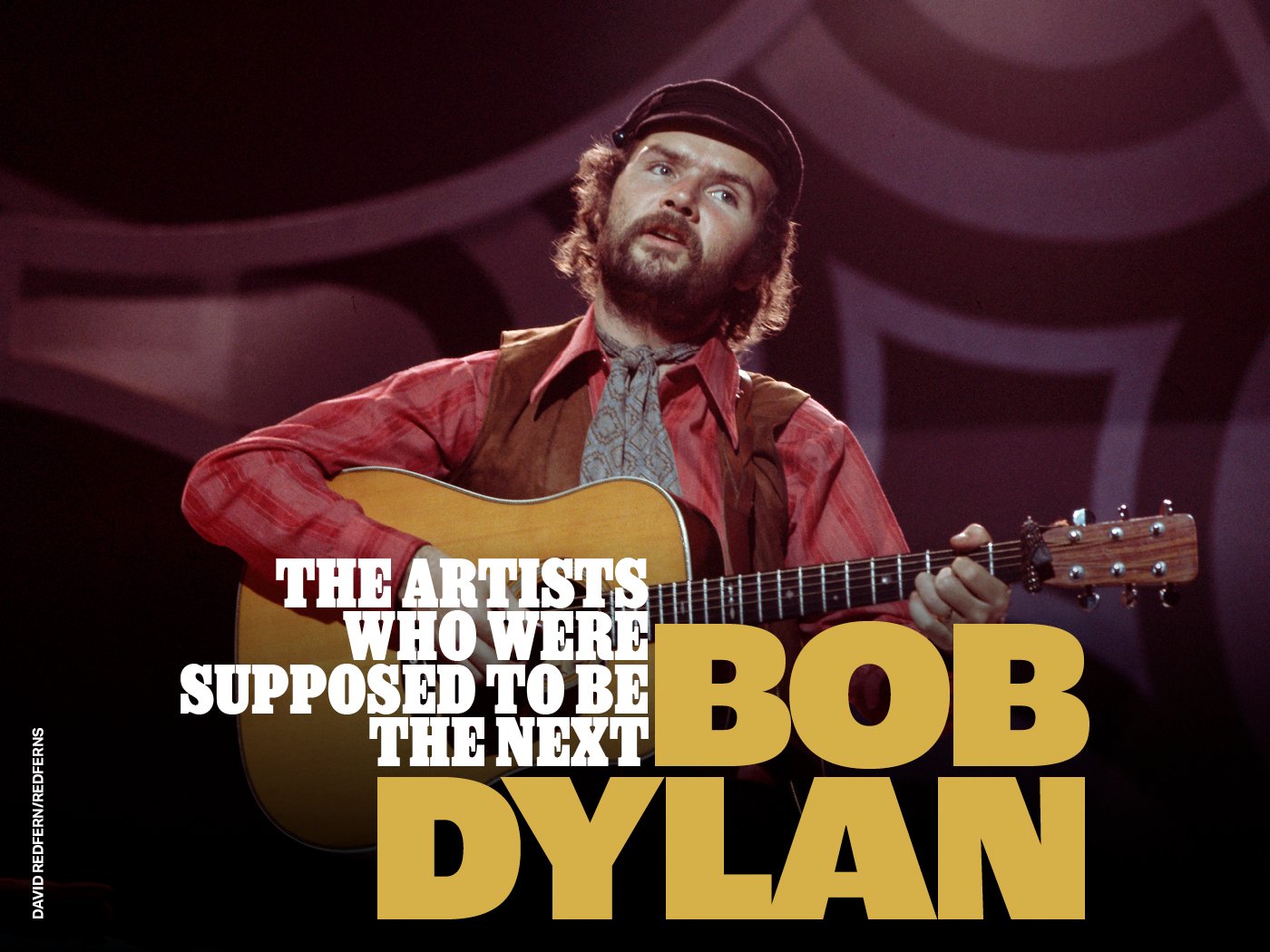
The folkies started it. Feeling abandoned when Bob Dylan gave up hand-wringing protest for the wild rock’n’roll of Highway 61 Revisited, they cast around for a replacement. As early as 1965, therefore, they were looking for someone to replace him as their spokesman, figurehead, whatever, although the old Bob had only been in business for barely four years.
Then, after Dylan left the public square after whatever happened between him and his motorbike in September 1966 and retreated to his Woodstock estate – abdication followed by exile – his silent absence created what record company types saw what’s known as a gap in the market.
The folkies’ yearning search for a new messiah was replaced by an unseemly rush to crown the “New Bob” or the “Next Dylan” not so much to fill an ideological vacuum as rake in a few bucks by turning up someone who sounded enough like the Dylan of yore to satisfy fans who first missed Dylan as he mucked out the stables in Hi Lo La and then bewildered when he returned with the mystifying John Wesley Harding and then followed the even more unrecognisable Nashville Skyline with Self Portrait.
In the early 70s especially, it seemed like any aspiring songwriter with a modicum of literary flair and an ear for a decent tune was suddenly declared Dylan’s unquestioned heir. There were careers that never recovered from the comparison; the heightened expectations it provoked. Others survived, flourishing on their own terms. Here we look at 31 artists championed in their time as the “Next Dylans”, from Dylan’s immediate Greenwich Village contemporary to YouTube sensation Jesse Welles…
1
Richard Farina
Because he was married to Joan Baez’ sister Mimi, wrote powerfully poetic songs like “Birmingham Sunday” and “The Bold Marauder, and was a Greenwich Village regular, the charismatic Richard Farina is often assumed to be one of the first “New Bobs” or “Next Dylans”. He was more peer than acolyte, however, and enjoyed a competitive friendship with Dylan, addressed in “Morgan The Pirate”, the last song he wrote. In April 1966, he was killed in a motorcycle accident in California, three months before Dylan’s own motorbike crash. His first novel, the counterculture classic Been Down So Long, It Looks Like Up To Me, had been published two days earlier. As a footnote, Thomas Pynchon’s great American novel Gravity’s Rainbow was dedicated to Farina, who was a close friend of Pynchon’s at Cornell University in the late 50s. The legendarily reclusive Pynchon was also best man at Farina’s wedding to Mimi.
2
Tom Paxton
Bald, mustached, almost homely; Tom Paxton was no one’s idea of an angry young protest singer. But he was writing his own songs and playing Greenwich Village folk clubs before Dylan even fetched up in New York, where he was cheered by the same crowds who later anointed Bob and turned to Paxton for musical solace when Dylan hit the boards with a band. Dylan wrote admiringly about him in Chronicles, picking out Paxton’s “The Last Thing On My Mind” as one of his favourite songs from the era and delivering a wonderful cover of his “Annie’s Going To Sing Her Song” on 2013’s The Bootleg Series Vol 10: Another Self Portrait. “Buckets Of Rain”, the closing track on Blood On The Tracks, was directly inspired by Paxton’s 1965 song, “Bottle Of Wine”.
3
Phil Ochs
There was a time when no major anti-war protest or civil rights rally seemed complete without Phil Ochs on the back of a truck or foot of a monument singing something like “I Ain’t Marching Anymore” or “Too Many Martyrs”. Folk purists who felt abandoned and betrayed when Dylan ditched protest songs for hepcat rock’n’roll inevitably turned to him as the new voice of defiant protest. He had the songs. “White Boots Marching In A Yellow Land”, “Draft Dodger Rag”, “Love Me, I’m A Liberal”, “There But For Fortune”, “The War Is Over”. “Here’s To The State Of Mississippi” was the bravest song of the entire protest era, no less piercing when it was later reworked as “Here’s To The State Of Richard Nixon”. Ochs, however, was deeply frustrated by his lack of commercial success. His life became consumed by depression and alcoholism. Once a prolific songwriter, he now suffered from writer’s block. An assault on a trip to Tanzania left him with permanently damaged vocal cords. Now he couldn’t sing, either. His drinking got worse. By the mid-70s, he was stumbling around the Village like a Bowery bum, loaded on cheap rotgut wine and whatever pills he could scrounge. Friends looked away, embarrassed. He blew a chance to join Dylan’s Rolling Thunder Revue tour, moved to his sister Sonny’s house in Far Rockaway where he hung himself in April 1976.
4
Eric Anderson
Anderson made an early reputation playing the same Greenwich Village folk clubs as Dylan, Tom Paxton and Phil Ochs. But by the time he released his 1965 debut album, Today Is The Highway, his typical folky romanticism already sounded a little dated compared to Dylan’s Bringing It All Back Home. Beatles’ manager Brian Epstein was nevertheless impressed enough to want to sign him but died before a deal was made. His most celebrated record was 1972’s Blue River, but the tapes of its follow up were lost, and the wind went out of a career that was revived when he moved to Europe in 1983, where he was eventually part of a trio that included The Band’s Rick Danko. Since 2000, he’s released almost an album a year, the last of which, 2025’s Dance Of Love And Death, featured Lenny Kaye, Larry Campbell and longtime Dylan bassist Tony Garnier. There’s a beautifully wrenching cover of his “Thirsty Boots” on The Bootleg Series Vol 10: Another Self Portrait.
5
Donovan
When Donovan popped up with “Catch The Wind” in 1965, he seemed like the product of a Dylan sperm bank. He had the look and sound of an archetypal Village protest singer, and an almost hysterical UK music press was quick to dub him the UK’s equivalent to Dylan. Some went as far as handing him Dylan’s crown, although Bob had not yet abdicated the throne. He’s mentioned constantly in DA Pennebaker’s Don’t Look Back documentary on Dylan’s 1965 British tour. At one point, Dylan is seen reading a music paper article about him, and Alan Price tells Dylan that Donovan’s a better guitarist than him. “I hate him already,” Dylan says. Pennebaker filmed them meeting for the first time in Dylan’s rooms at London’s Savoy Hotel, a famous scene. Not exactly shy, Donovan picks up a guitar and plays his winsome song “To Sing For You”, perhaps looking for praise from Dylan, who replies by playing the recently recorded “It’s All Over Now, Baby Blue”. The gulf between the two songs is enormous, and Donovan looks like he knows it. By the end of the year, Donovan had dropped the Dylan pretensions and with producer Micky Most recorded a string of psychedelic folk masterpieces including “Sunshine Superman”, “There Is A Mountain”, “Hurdy Gurdy Man”, “Season Of The Witch” and “Atlantis”.
6
Barry McGuire
McGuire was playing Los Angeles folk clubs when he met an then joined folk revivalists The New Christy Minstrels, singing and writing their 1963 hit, “Green Green”. He split for a solo career in 1965 and is best remembered for the 1965 smash, “Eve Of Destruction”. Folk purists dismissed it as a cash-in on the protest boom, but it sounded rousing enough on the radio to make it a worldwide hit and critics to trot out the usual “Next Dylan” reviews. He became a born-again Christian in 1971, devoting the rest of his career to Christian music. “Eve Of Destruction” was written by prolific West Coast songwriter PF Sloan, and its huge success revived his own recording ambitions, but his 1965 album, Songs Of Our Times, was poorly received, as was everything that followed. He fell into a long period of depression and catatonia, returning to recording in the early 2000s and in 2006 releasing Sailover, an album featuring contributions from Buddy Miller, Lucinda Williams and Frank Black. He died from pancreatic cancer in Los Angeles in 2015, not long after publishing the memoir, What’s Exactly The Matter With Me? Memoirs Of A Life in Music.
7
Gordon Lightfoot
The search for new Dylans must have been getting desperate by the time the spotlight fell briefly on Canadian singer-songwriter Gordon Lightfoot. Apart from sharing Albert Grossman as manager, there wasn’t much to connect Dylan and Lightfoot, whose songs tended towards the weepy and lachrymose. “Early Morning Rain” and “If You Could Read My Mind” made him millions of fans, however, including Dylan, who covered “Early Morning Rain” on the original Self Portrait in 1970.
8
David Blue
There were enough similarities between Blue and Dylan on Blue’s eponymous 1966 Elektra debut that he was among the first of Dylan’s contemporaries to be hailed as a potential successor. Dylan seems to have regarded him as more friend than rival and filmed him for a sequence in Renaldo & Clara, talking about their early days together in Greenwich Village. Blue recorded a series of well-received albums for Asylum in the 70s, and died in 1982, aged 41, after suffering a heart attack jogging in Central Park.
9
Leonard Cohen
By the time he released The Songs Of Leonard Cohen in 1967, Cohen had published four books of poetry and two novels and was already too singular a songwriter to be compared to anyone, although that didn’t stop some critics from applying the weary New Dylan tag to him. He and Dylan seemed to share a mutual respect. Dylan covered Cohen’s fabulous “Hallelujah” at a concert at Quebec’s Montreal Forum in 1988, on the first leg of The Never Ending Tour, three years before the John Cale version that in turn inspired Jeff Buckley’s cover. He also appeared on Cohen’s 1977 album, Death Of A Ladies’ Man, the one produced by Phil Spector, singing backing vocals with Allen Ginsberg on “Don’t Go Home With Your Hard On” after turning up drunk in the studio. “He comes in through the back door,” session guitarist David Kessel told Sylvie Simmons in her Cohen biography, I’m Your Man. “He’s got each arm around a different woman and in his right hand he’s got a bottle of whiskey and he’s drinking it straight.” For his part, Cohen was typically graceful about Bob being awarded his Nobel Prize. “To me, it’s like pinning a medal on Everest for being the highest mountain,” he told a Los Angeles audience in October 2016 at the press launch of his final album, You Want It Darker.
10
Al Stewart
Stewart was a stalwart of the 60s UK folk revival, playing the same circuit as Roy Harper, Bert Jansch, Ralph McTell and briefly Paul Simon, who shared an East London flat with Stewart. He taught Jimmy Page the arrangement of the traditional “Blackwater Slide” he’d learned from Jansch that Page turned into “Black Mountainside” on Led Zeppelin III. His first two albums of sometimes self-consciously confessional songs – 1967’s Bedsitter Images and it’s 1968 follow-up Love Chronicles – encouraged some UK music critics to identify him as some kind of Dylan approximate and “Life And Life Only” on Love Chronicles took its title from Bob’s “It’s Alright Ma, I’m Only Bleeding”, but he was altogether too winsome for the label to stick. His first six albums barely bothered the charts, but seemingly out of nowhere 1976’s Year Of The Cat was a huge success and went gold in the UK and platinum in the US. By anecdotal account, he felt miserably underappreciated by the UK music press and after being scathingly described by Roy Harper in Melody Maker as the “King Of Drip Rock” decamped to new digs in Laurel Canyon where his career continued to flourish.
11
Paul Seibel
The two incredible albums Paul Seibel made for Elektra in the early 70s seemed to disappear almost as soon as they were released, much like Seibel, their charismatic author, not much later. Seibel made a local reputation in the clubs and coffeehouses of Buffalo, New York. By 1965, he was playing the usual haunts in Greenwich Village and writing the songs that got him signed to Elektra, who bankrolled the four three-hour sessions it took to record his 1970 debut, Woodsmoke & Oranges. There was enough of Dylan’s dustbowl voice in Seibel’s singing for critics in Rolling Stone and The Village Voice to make explicit Dylan comparisons. But Seibel’s writing was beyond convenient comparison. Two of the album’s songs – “Bride, 1945” and “Louise”, narrative portraits of a young war bride and a lonely truck stop whore – became immediate classics, “Louise” quickly covered by Bonnie Raitt, Willie Nelson, Jerry Jeff Walker, Eric Anderson and Leo Kottke.
On his second album, 1971’s Jack-Knife Gypsy, Seibel was back by a band of crack LA musicians, including Clarence White and Bernie Leadon on guitars, Buddy Emmons on pedal steel, drummer Russ Kunkel, David Grisman on mandolin, with Doug Kershaw and Sea Train’s Richard Greene on fiddles. You could hear Dylan all over it. The title track was like a surreal parable lifted from John Wesley Harding; the self-lacerating “Chips Are Down” as grim as Dylan’s “Dirge”, that bleak nugget from Planet Waves.
Dejected by poor sales, Seibel started drinking heavily, spiraling into depression and addiction. He then simply disappeared from the scene, unheard of for years until he was rediscovered in 1996, working as a bread maker in a cafe in Maryland, where he died, aged 84, in April 2022.
12
Roy Harper
Harper came up through the same early 60s UK folk clubs as Bert Jansch, John Renbourne and Al Stewart, but would probably have bitten you on the leg if you described him as a folk singer. The truth was the folk scene could no more contain him than it could Bob Dylan, to whom early on he was constantly cast as an UK equivalent. For Harper as much as Dylan, the folk scene was a convenient route to a larger stage. Between 1967 and 1975, Harper produced a series of albums of increasingly vaulting ambition, full of wild poetic imagery and profoundly articulate indignation, a fierce anger coursing through uncompromising songs like “McGoohan’s Blues” and “I Hate The White Man”, the latter as full of venom as “Masters Of War”. The longform epics of 1971’s landmark Stormcock made fans of Pink Floyd (Harper took the vocal lead on “Have A Cigar” on the Floyd’s Wish You Were Here), Kate Bush, Peter Gabriel and Led Zeppelin, whose “Hats Off To Harper” on Led Zeppelin III was a tribute to him, Robert Plant and Jimmy Page both great fans. Page, in fact, became a close friend and regular collaborator, the pair recording1985’s Whatever Happened To Jugula? Major record sales eluded him, however, and punk sent him into a 20-year exile. After being rediscovered by Joanna Newsome, who brought him out of retirement for a concert at the Royal Albert Hall in 2007, and Fleet Foxes’ Robin Pecknold, who amazed even a longstanding Harper fan with his knowledge of albums like Folkjokeopus and Stormcock during a 2011 interview with Uncut. He made a triumphant recording comeback in 2013 with Man & Myth, which also turned out to be his last released album. In November 2025, Harper played what was announced as his last London show. Backed only by his son Nick on guitar, he was on spectacular form, fearless and uncontained, even at 84.
13
Steve Goodman
Discovered by Kris Kristofferson in a Chicago bar, Steve Goodman is remembered best for writing “City Of New Orleans”, a 1972 hit for Arlo Guthrie. Like his friend John Prine, he was one of a bunch of early 70s songwriters burdened with being the New Bob. Dylan liked him enough to play and sing on his 1972 album Somebody Else’s Troubles, under the pseudonym Robert Milkwood Thomas. Goodman died of leukemia in 1984 at the age of 36.
14
John Prine
“It must have been like stumbling onto Dylan when he first busted onto the Village scene,” Kris Kristofferson said after being taken to see Prine by Steve Goodman. Prine was still working at the time as a Chicago postman with a regular gig at the Earl Of Old Town coffee house. Kristofferson invited Goodman and Prine to open for him at New York’s Bottom Line. Jerry Wexler was in the audience. Stunned by Prine’s songs, he signed him to Atlantic the next day. His eponymous first album came out in 1971. The comparisons with Dylan were as immediate as they were emphatic. Dylan himself turned out to be genuinely a fan and even backed him at an early New York show. Prine was a stellar songwriting talent in his own right, however, and went onto a lauded career interrupted in the late 90s by cancer in his neck and later his lungs. His last album was 2018’s The Tree Of Forgiveness, his first collection of original songs in 13 years, featuring contributions from Jason Isbell, Amanda Shires, Dan Auerback and Brandi Carlisle. He died of complications from Covid in March 2020.
15
Loudon Wainwright III
Loudon Wainwright III in November 1976 was in London to promote his sixth album, T-Shirt. Over a lunch that involved more drinking than eating, the subject of Loudon at one time being proclaimed the “New Bob Dylan” inevitably came up. “I’m certainly not being called the ‘New Bob Dylan’ now,” he said ruefully, acknowledging a general lack of album sales, despite regularly getting the kind of reviews some people might have been inclined to frame and hang on a wall. “They’re not even calling me the ‘Old Bob Dylan’ anymore. I guess I just wasn’t a voice of a generation kind guy.” In truth, there wasn’t much to connect Dylan and Wainwright as songwriters, even on Loudon’s stripped-down, solo acoustic 1970 debut album, the one with the picture of him on the front looking like a getaway driver for the Dillinger gang. He returned to the early 70s New Dylan frenzy on “Talkin’ New Dylan” on 1992’s History. “Well, I got a deal and so did John Prine, Steve Forbert and Springsteen, all in a line,” he sang. “They were lookin’ for you and signin’ others,” he went on. “We were New Bob Dylans, your dumb ass kid brothers.”
16
Tom Waits
“More Dylan Than Dylan!” shrieked a 1999 Newsweek article about Tom Waits, in a piece that didn’t quite articulate how Waits was in any way “more” Bob than Bob, or anyone else for that matter. There were tracks across Waits’ first couple of albums – 1973’s Closing Time and 1974’s The Heart Of Saturday Night – that some critics insisted were Boblike, but this was at a time when nigh on any singer songwriter capable of a rhyming couplet was routinely tagged the “New Dylan”. More interesting are their shared, reflecting affection for such swathes of traditional American roots music – Delta blues, gospel, folk, country, corny showtunes – they have turned into phantasmagorical musical landscapes on albums like “Love And Theft” and Mule Variations. As for Waits’ opinion of Bob, it was pretty unequivocal: “Suffice it to say, Dylan is a planet to be explored – before epic tales and poems were ever written down, they migrated on the winds of the human voice and no voice is greater than Dylan’s.”
17
Steve Forbert
In 1975, the 21-year-old Steve Forbert quit his job as a truck driver in Mississippi and moved to New York, guitar in hand. He graduated from busking in Grand Central Station to the Manhattan club scene where he came to the attention of CBS offshoot Nemporer. His first album, Alive On Arrival, full of the kind of literate folk songs that had been all the rage on the 60s Greenwich Village scene, was released in 1978. The Village Voice could barely contain themselves, declaring Forbert unequivocally as “the new Dylan”. A modest, if generally well-regarded career followed, although his only hit was “Romeo’s Tune” from his second album, 1979’s Jackrabbit Slim. He recalled his early New York days and the New Dylan tag in his 2018 memoir, Big City Cat: My Life In Folk Rock. His most recent album was 2024’s Daylight Savings Time.
18
Bruce Springsteen
Springsteen once said he’d like his records to sound like they were written by Bob Dylan, produced by Phil Spector and sung by Roy Orbison. Of the three, you could only hear Dylan on his first album, 1973’s Greetings From Asbury Park, NJ, especially on an alliterative word-torrent like “Spirit In The Night”. The leading UK music weekly Melody Maker ran an ecstatic review by its star writer Richard Williams, who rhapsodically reported that it took him back to his teenage bedroom, listening for the first time to Dylan. He was barely alone in making the connection. There probably wasn’t a single review of the album that didn’t mention Dylan, more than a few of them claiming Springsteen as Bob’s true heir. “Hi,” Dylan said, when he first met Springsteen. “I hear you’re the new me.” Springsteen’s regard for Dylan was never more apparent than in a passage in his 2016 autobiography, Born To Run. “Bob Dylan is the father of my country,” he began. Bob pointed true north and served as a beacon to assist you in making your way through the new wilderness America had become. He planted a flag, wrote the songs, sang the words that were essential to the times, to the emotional and spiritual survival of so many young Americans at that moment.”
19
Graham Parker
Backed by the pub rock veterans of The Rumour, Graham Parker brought some desperately needed excitement to an otherwise dismal pre-punk London music scene. The angry, confessional songs on Howlin’ Wind and Heat Treatment, released within months of each other in 1976, put some people in mind of 65-66 Dylan, although he owed as much if not more to Van Morrison and the Stones. He may have enjoyed the stellar career often predicted for him if punk hadn’t happened. In October 1976, he played a show at London’s Victoria Palace Theatre, supported by The Damned, who two weeks earlier had unleashed “New Rose”, the first UK punk single. The Damned were incendiary that night. Parker and The Rumour played as well as they ever did but suddenly seemed a bit old hat. Parker was further upstaged by Elvis Costello, who came from a similar musical background, but wrote more incisive, catchier songs laced with an even more exciting venom than anything Parker had been able to muster. His career ascendancy was further checked by mixed reviews and only passable sales for Stick To Me, his third album. It’s follow-up, 1979’s Squeezing Out Sparks was his best album, but an expected commercial breakthrough didn’t happen. His moment, basically, had come and gone. Still, he got to support Dylan in front of 250,000 people at Blackbushe. He had that to look back on, at least.
20
Elvis Costello
When Declan MacManus made his public debut as Elvis Costello at London’s Nashville Rooms in May 1977 as the unannounced opening act for Graham Parker’s backing band The Rumour who were promoting their Parkerless album, Max, it wasn’t just the tab-collared polka dot shirt he was wearing that made almost everyone in the room that night think at some point of Bob Dylan. The songs – all from the yet unreleased My Aim Is True – were absolutely electrifying in ways you associated with hearing “Like A Rolling Stone”, “Positively 4th Street” or “Highway 61 Revisited” for the first time. Costello’s early shtick, in fact, seemed wholly derived from repeated viewings of Don’t Look Back, with his fiery manager Jake Riviera often cast in the Bobby Neuwirth partner-in-mischief role. Elvis had his own role down pretty pat, clearly relishing a growing reputation for sharp-tongued truculence, a combative relationship with the music press, a generally disdainful attitude that he eventually took further than Dylan ever did. Things came to a head one night in Columbus, Ohio, during 1978’s Armed Forces tour. During an altercation in a hotel bar with Bonnie Bramlett and Stephen Stills – veterans of a discredited musical generation in Costello’s addled opinion – Elvis, fueled by too much drink and cocaine, made some outrageous comments about Ray Charles that Bramlett quickly passed onto Rolling Stone. The American music press already felt slighted by Costello’s offhand dismissal of their repeated requests for interviews and turned on him with a vengeance, accusing him of being an outright racist, turning up at a hastily convened New York press conference, demanding apologies that Costello refused to make and acting generally like an angry lynch mob. His career survived, but only just.
21
Elliott Murphy
Murphy spent the late 60s busking in Europe, also scoring a bit part in Fellini’s 1972 movie Roma. By 1973, he was back in New York, where he formed a band that started playing regularly at Max’s Kansas City and the Mercer Arts Centre that brought him into the orbit of Patti Smith and The New York Dolls. His 1975 debut album, Aquashow, got rave reviews. “He’s the best Dylan since 1968,” the influential critic Paul Nelson announced in Rolling Stone. “Elliott Murphy is going to be a monster,” the Village Voice predicted in a headline reproduced on posters all over New York. A two-page New Yorker review compared the album to the Dylan of Highway 61 and Blonde On Blonde. For all the critical enthusiasm, the album didn’t sell. Neither did the albums that followed. Ten years of alcohol and drug addiction followed, after David Bowie gave him his first line of cocaine. In 1990, he emigrated to Paris where he successfully revived his career, his discography now running to 35 albums. He is also the author of 15 books, including the 2019 memoir, Just A Story From America, named after his fine 1977 album.
22
Jim Carroll
Carroll was famously the author of the acclaimed 1978 memoir The Basketball Diaries – a 1995 film of the book starred Leonardo DiCaprio as the teenage Caroll –and already a much-admired poet when his friend Patti Smith encouraged him to follow her example and set his poetry to rock’n’roll music. Keith Richards was a fan, and Caroll signed a three-album deal with Atco via Rolling Stones Records. The first, 1980’s Catholic Boy, was the best, “People Who Died” the stand-out track. Critics were soon queuing up to compare him to the young Dylan. But after a poorly received third album, 1983’s I Write Your Name, he gave up on music completely, returning full-time to writing and occasional spoken word albums. He died of a heart attack in September 2009.
23
Willie Nile
A regularly sold-out late 70s residency at a Greenwich Village club called Kenny’s Castaways brought Willie Nile to the attention of Clive Davis, who quickly signed him to Arista. His eponymous 1980 debut album was full of enough smart, literate rock’n’roll songs to encourage the New York Times to compare him to the young Dylan, an accolade that Nile thought did his career no favours at all. The legal dispute that followed his second album, 1981’s Golden Dawn, hampered his career for years. In fact, before 2006’s Streets Of New York, he’d released only four albums in nearly 30 years. He’s been prolific since, releasing 10 more albums, the last one, The Great Yellow Light, in 2025. As much as the New Dylan tag rankled, Nile never denied Dylan’s influence, which he celebrated on 2017’s Positively Bob: Willie Nile Sings Bob Dylan.
24
Billy Bragg
Bragg brought a welcome dishevelment to a mid-80s UK music scene largely dominated by the sleek sounds of synth pop and the foppish extravagance of the New Romantics and all their big hair, eyeliner and polyphonic synthesisers. Compared to the New Romantics’ sartorial finery, Bragg looked like an Essex lad who’d fallen off a night bus on his way home from a punk gig. He sounded raw, untutored, played angry protest songs on scratchy electric guitar. The music press loved him, dubbing him the “Dagenham Dylan”. It was a jokey sobriquet that rather overlooked his genuine songwriting talent, his best songs full of wit, insight, candour and righteous indignation. A tenuous connection with Dylan was made when in the late 80s, Norah Guthrie, daughter of Dylan’s early hero Woody, asked Bragg to set some of her father’s unrecorded lyrics to music, which led to 1988’s Mermaid Avenue, a collaboration with Wilco. It was followed by Mermaid Avenue Vol II in 2000 and a third volume, plus The Complete Sessions in 2012 to coincide with Woody’s centenary.
25
Dan Bern
No one on the list you’re currently reading sounds more like Bob Dylan than Dan Bern apart from Bob himself. started out in the same Chicago clubs as John Prine and Steve Goodman before moving to Los Angeles, where he was quickly wowing audiences with a repertoire of angry, lacerating, often hilariously scathing songs. a protest singer incarnate and compared by everyone who wrote about him to Dylan. He seemed to relish and invite the comparison. “Estelle” on his 1977 debut, Dan Bern, seems to recast Estelle from “Up To Me” in a remake of “Brownsville Girl”, to which the track bears an astonishing resemblance. The 10-minute “Thanksgiving Day Parade”, meanwhile, was like a version of “Desolation Row” set to the rolling melody of “Positively 4th Street”. Inspired by the Dylan comparisons, his brilliant song 1997 song “Talkin’ Woody, Bob, Bruce And Dan Bern Blues” imagines Dan scaling the wall of Springsteen’s mansion, breaking into his bedroom and generally carrying on like Bob visiting the dying Woody before an irate Boss wakes up and chases him off.
26
Ryan Adams
Apart from a set full of mostly incredible songs, what you may remember as vividly about the London shows that Ryan Adams played around the release of his first solo album, 2000’s Heartbreaker, was the unfettered self-confidence beneath the scruffy self-deprecation, his tousled casualness. He was on fire with the same unquenchable self-belief you imagine Dylan was when he first lit up Greenwich Village. Heartbreaker was an influential landmark of early Americana, and people heard a lot of Dylan on it. The brash clatter of “To Be Young (Is To Be Sad, Is To Be High)” joyfully recalled the Bob of “Subterranean Homesick Blues” and the whole album gave off a breakup vibe akin to Blood On The Tracks. Adams in interviews was prone to describing it as “my Dylan album”. For all the inevitable Dylan comparisons, there were as many people who listened to Heartbreaker and heard Adams as an heir not only to Bob, but also to Gram Parsons and Neil Young. Adams’ career would eventually blow up, but for a moment with Heartbreaker his promise was breathtaking.
27
Josh Ritter
The sometimes dense narrative songwriting and poetic flourishes of Ritter’s four albums between 1999 and 2007 were enough for critics to describe him as a potential Dylan heir, something about his voice and phrasing that brought Bob to mind on countless tracks. Like John Prine before him however, he survived such compoarisons largely because he was such a fine, distinctove songwriter whose career has now included 13 albums – the most recent, 2025’s I Believe In You, My Honeydew – and two novels, 2011’s Bright Passage and 2011’s The Great Glorious Goddam All Of It.
28
Conor Oberst
After starting out in his native Nebraska playing with punk and hardcore bands, Conor Oberst formed Bright Eyes as solo project in 1995, getting a lot of attention for 2000’s Lifted Or The Story Is In The Soil, Keep Your Ear To The Ground. In January 2005, Oberst released two Bright Eyes albums simultaneously, I’m Wide Awake, It’s Morning and Digital Ash In A Digital Urn that hit the US charts at 10 and 15 respectively. Critics went nuts about him. He was now “a cleverer Kurt Cobain”, “heir to Woody Guthrie” and “the new Bob Dylan”. Oberst was flattered, if bewildered by the comparison to Dylan, resisting the typecast role of spindly 60s troubadour for a career of prolific sprawl and diversity.
29
Jeff Tweedy
You could trawl through Jeff Tweedy’s extensive discography – a total of 20 studio albums, including four with Uncle Tupelo, 14 with Wilco and five solo albums – and find across them songs that will make you think of Bob Dylan, but not so much that you could take seriously the few claims that he was an heir to whatever legacy Dylan might leave. There are Dylan connections, though. Wilco collaborated with Billy Bragg on 1988’s Mermaid Avenue, setting unpublished Woody lyrics to their music, he recorded a fine version of “Simple Twist Of Fate” for the soundtrack to Todd Haynes’ 2007 Dylan biopic I’m Not There, and in 2014 wrote an entire album’s worth of songs around recently discovered Dylan lyrics from 1967, originally intended for T-Bone Burnett’s Lost On The River: The New Basement Tapes project. They were never used and remain unreleased.
30
Jason Isbell
If Dylan’s name comes up in anything written about Jason Isbell, you can bet it’s because the writer has run out of superlatives to attach to the countless great songs Isbell has written since his early days with Drive-By Truckers, with whom he put in a six-year stint between 2001 and 2006, from which he emerged a coke-addicted alcoholic. Newly sober, his fourth solo album, Southeaster, was a major commercial breakthrough, now regarded as an Americana classic. You won’t hear much that reminds you of Dylan on the six albums that followed, but Isbell has always cited Dylan as a songwriting inspiration, if not specific influence. It might be a token of his admiration that he has a tattoo of a line – “Just carry yourself back to me unspoiled from across that lonesome ocean” – from his favourite Dylan song, “Boots Of Spanish Leather”, tattooed on his inner left forearm.
31
Jesse Welles
Welles became an internet sensation in 2024, when he started posting videos of what were clearly folk protest songs like “The Poor”, “Join ICE” and “War Isn’t Murder” that vividly recalled Woody Gurthrie and early ‘60s Greenwich Village Dylan. Prolific and permanently angry about something, he’s released an astonishing 10 solo albums since 2024’s Hells Wells. He was nominated for four awards at the 2026 Grammys and in 2025 was granted the Spirit Of Americana/Free Speech Award.