

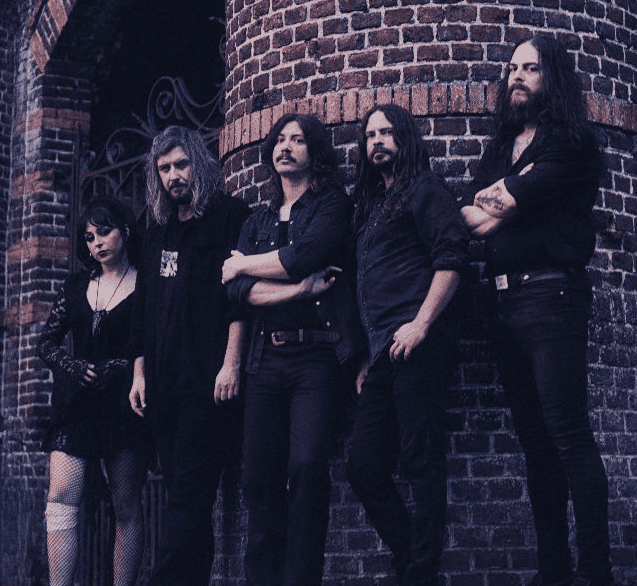
There’s a particular kind of dread that runs through the work of Uncle Acid and the Deadbeats, a slow, creeping unease that feels at once timeless and painfully contemporary. On the band’s new album, Shapes of Midnight (out September 18), that dread becomes fully weaponised: a twisted gothic vision of power, class, and paranoia that feels like Edgar Allan Poe dragged into the age of 24-hour news, billionaire bunkers, and endless crisis.
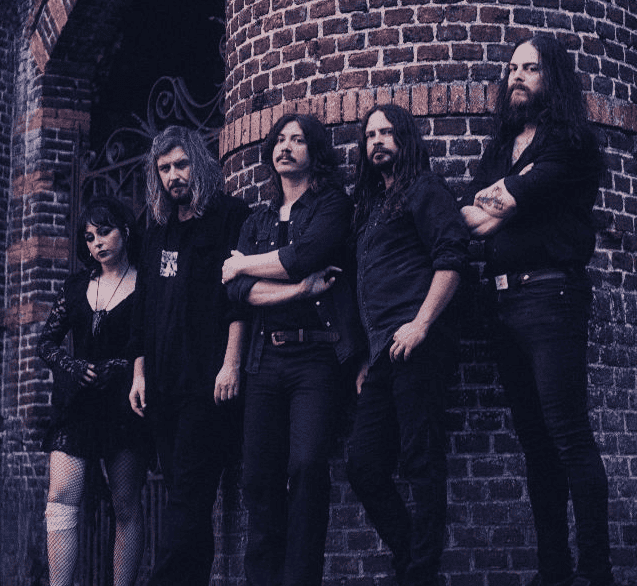
Photo credit: Karin Hunt
When I sit down withKevin Starrs, the elusive architect behind Uncle Acid’s warped psych/prog universe, he’s midway through a long day of press and on the brink of heading out to the US for tour rehearsals. But there’s a quiet satisfaction in his voice. “Yeah, good,” he says when I ask how he’s feeling. “It’s finally all sort of coming together. Getting ready to head off to the US next week… final bit of practising, getting all the set lists and things together, and yeah, we’re pretty much good to go.”
It’s an understatement, and very on-brand. Behind that understatement is one of heavy music’s most distinctive, self-contained worlds: a place where horror, social decay, and doomed characters swirl together over fuzzed-out riffs and deceptively catchy hooks.
Shapes of Midnightmight be Uncle Acid’s most complete expression of that world yet.
Abbey Road
A big part of the mythology aroundShapes of Midnightis its home:Abbey Road Studios, arguably the most storied recording space in modern music history.
For Starrs, recording there wasn’t just a bucket-list moment; it was a way of plugging directly into a particular sound and atmosphere that suits Uncle Acid’s haunted sensibilities. “We’ve always wanted to record in there,” he explains. “Obviously, the history of the place, the albums that have been recorded there, it’s just got an atmosphere to it. And then on top of that, it’s the amazing equipment that they’ve got… those old microphones that are in such good condition, and the EMI desks, which are really unique to that studio. So being able to use them was a real honour, and that was one of the big reasons why I wanted to go in there.”
In an era where you can make an album on a laptop, Starrs deliberately leans into tactility: ancient consoles, vintage mics, the weight and warmth of analogue gear. It’s not nostalgia for its own sake; it’s about giving physical form to the world he’s building, letting the room itself bleed into the songs.
And he did it all on a tight schedule:three daysat Abbey Road. For a band known for expansive arrangements and cinematic scope, that kind of constraint could sound terrifying. Instead, it sharpened the record.
The result is an album that feelsurgent but meticulously constructed: concise in runtime, expansive in imagination.
Masque of the Red Death
The press notes (and some early chatter online) have locked onto the album’s thematic link with Edgar Allan Poe’s The Masque of the Red Death, a story about the rich hiding from a devastating plague while the outside world collapses.
Starrs is quick to clarify that it wasn’t a direct adaptation so much as a collision of influences and obsessions. “It’s sort of an unintentional inspiration,” he says. “I was working on this idea… a lot of it, as you say, inspired by modern events, current events. So I’d come up with this basic story about there being a mansion in this small village where all the rich people, all the powerful people, live in there, and they’re behind a fence… segregated from everybody else. And then everybody else has to live in this absolute hellscape where it’s just a nightmare.”
As the concept evolved, the Poe parallels became impossible to ignore. “I realised actually this is quite similar to Masque of the Red Death… that’s written 100 years ago, whatever it is, but still relevant today. And that’s the thing.”
What’s striking is that, lyrically, Starrs still avoids literal references to modern politics or headlines. The songs don’t namecheck pandemics, tech billionaires, or specific wars. Instead, the anger and anxiety are baked into the atmosphere. “The lyrics are never really about anything modern specifically, but the intent is there,” he explains. “It’s all these things that exist in a world that’s very similar to ours, but… certain things that wouldn’t happen here, happen in this world.”
In the early Uncle Acid albums, that parallel universe still clung to a rough moral arc: good, eventually, had a chance. “For the most part, in this alternative reality, good always overpowers evil in the end,” he says. “But I felt the last couple of albums, that’s not really been the case. Evil has now just taken over everything, so it’s maybe now the two worlds are colliding… merged into one horrible hellscape.”
It’s a bleak assessment, but it rings uncomfortably true.Shapes of Midnightdoesn’t offer a way out. Itinhabitsthat hellscape and turns it into sound.
The Lore
Over the years, fans have mapped out intricate theories connecting characters, imagery, and themes across the Uncle Acid discography. There are Reddit threads and deep dives treating the albums almost like a horror cinematic universe.
Starrs takes that in his stride—but he doesn’t sit around plotting flowcharts. “I’ve never really thought about it too much,” he says. “For me, it’s just things that come naturally… I try not to think about any sort of outside influence in that way. But yeah, it just seems to be the way that the stories and things have come together—the idea that they could all exist in the one world.”
That looseness is part of why the records feel so richly interpretable. There’s an internal logic, but it’snever over-explained. The door is left half-open for listeners to wander in and impose their own angles. “That’s the good thing about it—it’s all open to interpretation,” Starrs says. “I have the meaning that I know… but from other people’s perspective, they have a totally different theory or outlook on what a lot of the songs or albums are about, and you can’t really tell people that they’re wrong. If that’s what you think and that’s what makes you enjoy the album a little bit more… there’s nothing wrong with that.” [0:07:24–0:07:55]
In that sense, Uncle Acid occupies an interesting space betweenhorror fiction, concept album, and cult world-building. It shares DNA withStephen King’s overlapping towns and timelines orJohn Carpenter’s eerily connected films and scores, but it’s also more instinctive than planned.
Starrs doesn’t sit down and say, “Right, this is Phase 3 of the Uncle Acid Universe.” He gets angry at some injustice in the news, picks up a guitar, and lets the world build itself.
When Evil Waits…
IfShapes of Midnightis a vision of a world where the rich barricade themselves in and the rest of us scramble in the dirt, its songs explore how that feels on an almostpsychological level: the paranoia, the anger, the refusal to be entirely crushed.
Two tracks in particular, “Don’t Let It Control You” and “When Evil Waits”, offer a window into Starrs’ writing process and the record’s emotional architecture.
“Don’t Let It Control You” nearly didn’t make the album at all. “It was one that I added really late, actually,” he says. “I felt like the album was a little bit too long, sort of meandering a little bit, and I wanted everything to fit onto one LP. I didn’t want a double album because it’s more expensive for the fans… So I ended up cutting two tracks… that were just a little bit too long and didn’t really progress the album… Then we had two shorter tracks, so ‘Don’t Let It Control You’ was one of them, and ‘Psycho on the Loose’ was the other one. And I just felt like the balance then… was much better.”
Sonically, it’s a more straight-ahead rock song, drawing from some of Starrs’ earliest musical loves. “For me, it’s kind of a Stooges, New York Dolls, just a straight-ahead… I always like the ‘oohs’, all those kind of things, which the New York Dolls were great at, and that goes back to ’60s girl groups and things. So that was a very just sort of a straight-ahead rock song.”
Lyrically, it might be one of the album’s clearest statements of defiance. “It’s about… don’t let sort of outside forces and manipulation get to you,” he says. “There’s reasons to be positive. You don’t have to be beaten down by all this crap that you read all the time. So yeah, it’s basically saying don’t let hate control you.”
In a record drenched in dread, “Don’t Let It Control You” works like a dark pep talk, a refusal to cave in to the hellscape, even as you acknowledge it.
“When Evil Waits,” by contrast, is more of a structural and tonal shapeshifter. “I had the riff, and I was kind of thinking maybe almost a little bit of a T. Rex kind of feel to it to start with,” Starrs says. “And then… I came up with another riff, and it just felt like a perfect place to then go in a different direction, and then the song speeds up and goes in… So it’s almost like two songs put together in some ways, but that just again sort of a natural progression.”
You can hear, in that description, the way he’s honed his craft over the years. The early days were more about pure instinct; now there’s instinct plus an understanding of how to shape a song so it evolves instead of just repeating. “Sometimes it just comes naturally. Everything just flows out, and it’s fine,” he says. “But there are other times when you need that skill to be able to think, ‘Well, how can I progress it onto the next section of the song, or finish it up?’”
The result on Shapes of Midnight is an album that constantly shifts under your feet, hooks and grooves that feel immediate, tied to structures that twist in unexpected ways.
Total Freedom
For all the horror, Uncle Acid is, at its core, about control, who has it, who doesn’t, and what happens when you refuse to give it up. That runs through the songs, but it also runs through how Starrs runs the band.
The new album is coming out on Killer Candy Records, Starrs’ own imprint—something that completes a strange full circle. “It’s just something that I’ve always wanted to do,” he says. “When we started, the first two albums, Volume One and Blood Lust, were self-released on Killer Candy… then [I] kind of got as far as I could take it. Didn’t have the financial backing to progress it further, to get vinyl pressed, didn’t really have any connections in the industry, so it kind of ran its course.”
That’s when Lee Dorrian’s Rise Above Records stepped in, giving the band the push they needed without ever meddling. “We signed with Rise Above, and they were great. They never interfered with anything. We had complete freedom to do whatever we wanted.”
When that deal ended, Starrs knew he didn’t want to roll the dice on a label that might try to reshape Uncle Acid into something more marketable. “I’ve heard so many horror stories from other bands… the amount of interference that they get and the amount of direction that they’re told to go in—I just wouldn’t put up with that,” he says. “I knew that as long as I could keep my artistic freedom, that would be the main thing. So yeah, it made sense to just go back to self-releasing.”
Killer Candy now isn’t just a logo on the back cover; it’s a philosophy. Starrs is already looking beyond Uncle Acid too. “Hopefully I can work on other projects that I have, and maybe at some point other bands… nothing to do with me, and just release those things as well.”
A Cult Institution
For all the global touring, millions of streams, and feverish online fandom, Starrs speaks about his career with the same mindset he had in the early Cambridge days. “Back then, obviously, we didn’t have a fan base. We didn’t have anybody. We were just nobodies,” he says. “I’ve always just thought, as long as I write music that I like, that’s the main thing.” [0:14:25–0:15:51]
That attitude has become his shield against expectation and trend-chasing. “It’s never trying to chase any kind of trends or trying to think, ‘Oh, I wonder what the fans are going to think about this,’” he explains. “That never comes into it. It’s always, ‘What’s going to make me happy? What am I going to enjoy listening to?’ Sometimes people like it, and sometimes they don’t… If you were to try and think about what your fan base is going to want, you end up tying yourselves in knots.”
So how does he define success now, standing on the brink of another world tour with what might be his most ambitious record yet? “Just being able to do whatever you want to do—that is success to me,” he says simply. “There’s nobody that can tell me to do anything… I can make the decision. But there’s nobody forcing me to do anything. And for me, that freedom is just complete success.”
Legacy, in the grand, ego-driven sense, doesn’t interest him. What matters is that he can keep pushing deeper into this twisted universe without compromise. “We’ve managed to keep it going all this time,” he adds. “So it’s been working.”
A World-Building Tour
With Shapes of Midnight about to drop, Uncle Acid are heading back on the road—US, Australia, New Zealand, the UK and beyond. This time, the setlist won’t be tied to any single album concept. “We’re going to be playing a set list that has songs from all the albums,” Starrs says. “Every album that we’ve ever done is represented… I think that’s the best way of doing things. On the last tour we did a specific album tour, which was fun… but it’s nice to do a set list where it’s a complete representation of your back catalogue.”
As ever, it’s not just about the music. “We’ve got the visuals—we’ve always got the projections and all that kind of thing going on behind us as well, so yeah, it should be a good tour.” [0:18:42–0:19:25]
Sequencing that kind of set—balancing deep cuts, fan favourites, and new material—is its own form of world-building. “It can be quite difficult,” he admits. “Sequencing songs is quite a challenge. Trying to pick points in the set where you slow it down a little bit or pick it up… having the general flow, getting it right. Usually it takes a few shows before you can really settle, and sometimes you end up swapping songs around… until you feel like you’ve got it right.”
But when it clicks, it’s more than just a gig—it’s a tour through the whole twisted canon. “I just hope people come and enjoy the show,” he says. “That’s the main thing.”
In a time that often feels like a “horrible hellscape” of its own, Uncle Acid and the Deadbeats offer something rare: a world that’s darker than ours, yet somehow clarifies it—and a stubborn, distorted voice insisting that, even when evil waits and sometimes wins,you don’t have to let it control you.
Listen: