

Like Tony Allen’s drumming in Fela Kuti’s band, or Clyde Stubblefield’s beats for James Brown, there’s something essentially timeless about krautrock rhythms. Can’s Jaki Leibezeit and Neu!’s Klaus Dinger created a rhythmic language that is “motorik” in every sense – a way of delineating forward-momentum, a propulsive groove that links rock music’s physicality with the repetition of electronica. Perhaps this is why a genre of music that emerged in a West German counterculture of the early 1970s continues to represent futurism and progress, even for bands who have absolutely no contact with Germany – from Tokyo’s Minami Deutsch to Chicago’s Lifeguard; from Sao Paulo’s Bike to Bristol’s Beak; from London’s Snapped Ankles to Venice’s Squadra Omega.
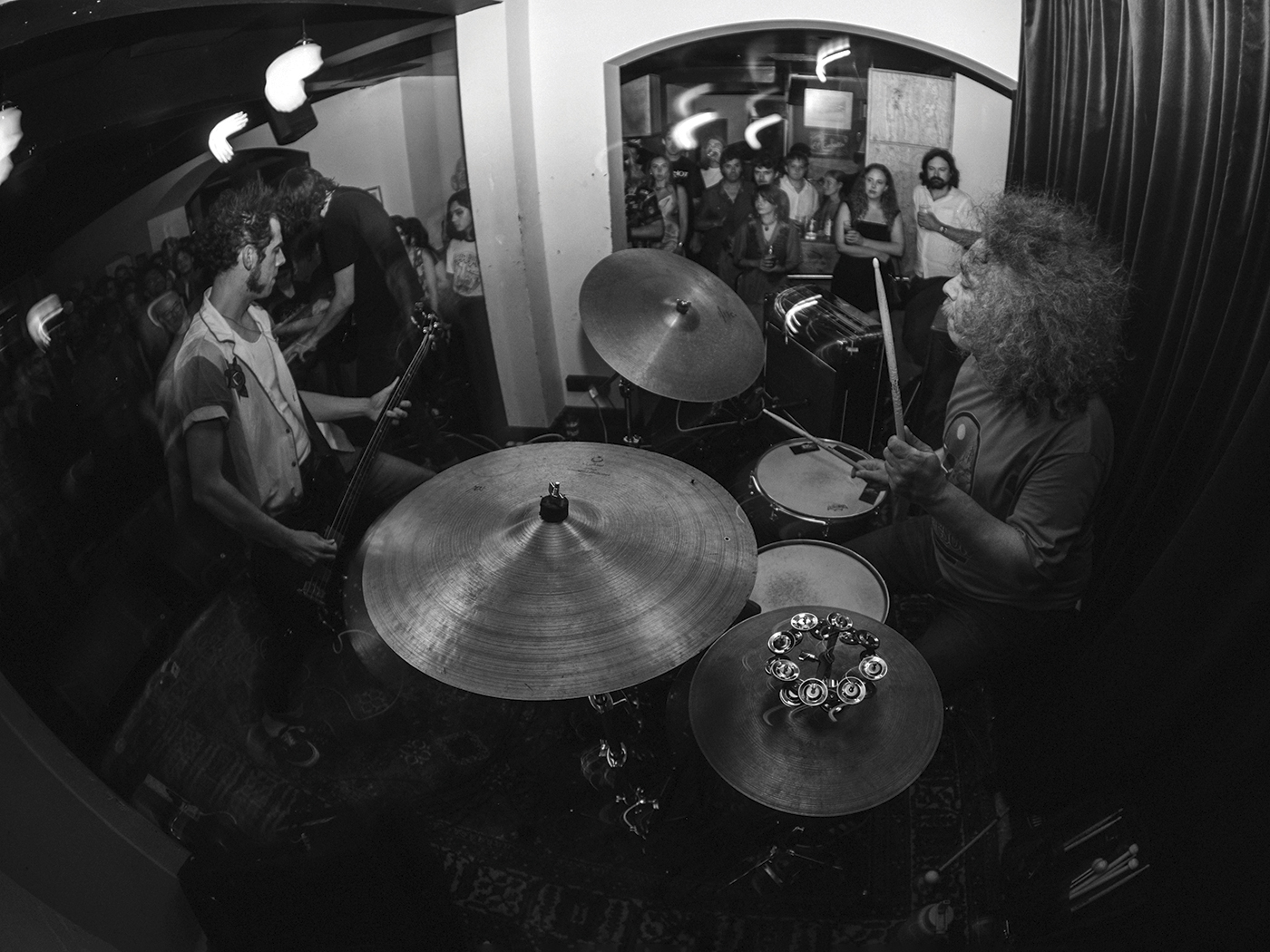
You could describe the music of the Australian trio Brown Spirits as extreme, fundamentalist krautrock. They make motorik, repetitive rooves that rarely change key or chord. Their music contains nothing as frivolous as a vocal or a chant – the basslines and drum grooves are overlaid by freakout guitars and FX-laden keyboards. Can are clearly a key influence: guitarist and keyboardist Tim Wold has described 1971’s Tago Mago as “the gift that keeps on giving”, while drummer Agostino Soldati’s rock-solid beats have the same tribal, metrical quality as those of Leibezeit.
Brown Spirits emerged from the Melbourne milieu that birthed the likes of Amyl & The Sniffers, King Gizzard And The Lizard Wizard and Courtney Barnett and, on paper, they appear to obey some of the retro-fetishism common to that scene: for instance, they record largely live to quarter-inch tape in Wold’s home studio in Coburg. But what’s striking about Brown Spirits is how non-nostalgic their music sounds. The drums and basslines are usually metrical and machine-like, but the surface is smeared with skronky guitars, filthy-sounding Hammonds and grinding synth textures. Watch Wold at gigs and you’ll see him switch from playing a series of blistering, angular riffs on his guitar and then leaning forward to play drones on an organ, a vintage Moog or a Fender Rhodes put through a ring modulator.
They started as a duo, before enlisting bassist Ash Bushcombe and recording two albums as a trio – 2023’s Solitary Transmissions and last year’s Cosmic Seeds. But, between 2017 and 2019, they also recorded three LPs that received only a few hundred pressings – the first two releases for the German indie Clostridium, the third on the band’s own Lysergic Library – and these are now finally getting a wider release from Soul Jazz.
Every track is recognisably Brown Spirits, and all share similar tropes – trance-like rhythms, freak-out guitars and synths, simple lead lines, repetitive melodies. Agostino Soldati is one of those rare drummers who’s immediately identifiable while never sounding the same – every rhythmic pattern he plays appears to be unique to each song. On the first album’s “Flying And Falling”, he’s playing somewhere between a 6/8 shuffle and a jazz waltz; “Back To Arms” finds Soldati entering double-time junglist territory; and “Another Vintage Phase” sees Soldati replicating the trance-like drumming from “Tomorrow Never Knows” under Wold’s synth drones.
The Ringo vibe continues on #2, with off-kilter, tom-heavy grooves on “Parallels”, while other tracks, like “Mutations”, see Soldati’s rumbling mallet patterns resemble the Nick Mason of early-’70s Floyd. On the same disc’s slow closing number, “First Sign Of Life”, he hints at the dubby effects achieved by Stewart Copeland of The Police. But it’s Wold’s FX-laden guitars, organs, electric pianos and synths that split the difference between old and new: between retro fetishisation and cutting-edge futurism, between trance and skronk. Playing tracks often written through improvisation, a lot of Brown Spirits’ music is reminiscent of another Australian trio, The Necks – there is that similar spirit of adventure, of venturing into the unknown, of a band starting a song and never quite knowing how or when they’re going to finish it.
You can hear the band slowly expanding their chops with each successive release. On the second album, “Finite Universe” sees them flirting with modal jazz, layering liquid-sounding Fender Rhodes riffs over a hypnotic bassline; while the episodic “Suite East Meets West” sees them marrying sitar drones and tribal drums before mutating into a jazz waltz.
By #3 there’s a swagger and confidence to every track, and a noticeable improvement in Wold’s keyboard chops. “Bakelite Dashboard”, featuring a thrillingly woozy synth riff, resembles a Stereolab instrumental; “Montage Homage” sees them playing in 15/4, sounding like some vintage prog-funk track sampled by a Dilla-style hip-hop producer. “Tumultuous Clouds” sounds like early Kraftwerk playing a track from Dark Side Of The Moon; the organ riffs on “Hats Off to Pajama” are oddly reminiscent of the Steve Miller Band’s “Fly Like An Eagle”; “Chemical Miscalculation” suggests an outtake from Umagumma sonically mutilated by Madlib.
It reminds us that krautrock is an example of how rock music can be a genuinely collective medium; of how technology can be used without fetishising it; of how control and minimalism can sound oddly ecstatic. Far from slavishly recreating a genre that’s now more than half a century old, Brown Spirits are using the methodology of krautrock to restructure time, to create new meaning from repetition.