

There are wrestling books that are basically just lists: matches, belts, towns, a few wild road stories. Dan Spivey’s book, The Dangerous Truth isn’t one of those.
From the first few pages, it hits with a very different energy. It’s bleakly funny, self-deprecating and brutally honest about the years lost to drink and drugs, the broken relationships, the chaos of the business. At one point in our chat, he sums up his old lifestyle with a single, savage line: “I probably snorted a couple of Rolls Royces in my day, you know.”
He’s not boasting. He’s almost bewildered that he’s still here. Spivey hit rock bottom at 56 (he’s 73 now at the time of writing). That, he says, was when everything changed. “I finally hit rock bottom with my drugs and alcohol, I was 56 years old when I had a spiritual awakening, and started a road of sobriety.”
The book came later, and it wasn’t about ego or legacy. It was about making that wreckage mean something. “[The] Reason I wrote the book is people wanted me to tell my story and… if this book and my story helps anybody get sober, then it was worth the time and effort of it.” You can feel that purpose running through the pages, but there’s something else threaded through it too, a quieter story that sneaks up on you.
“It Really Turned Out to Be a Love Story”
When the conversation turns to his wife, Ann [Russo], Spivey’s voice softens. Dom brings up the way the book charts their relationship, how Dan finally ended up married “for the right reasons” around 60. Spivey laughs and admits that when he, Ann and their ghostwriter looked at the finished manuscript, they realised they’d done something they hadn’t set out to do. “When we finished with the book, the ghost writer… we all [were] talking, and this really turned out to be a love story, you know, between me and her.”
It’s a striking thing to hear from a man who has been married a lot (six times). “With my past relationships, she has by far lasted a lot… Each day is a blessing to have her in my life.” After decades of chaos, injuries and self-destruction, this is one thing in Dan Spivey’s life that actually feels complete. Which is more than you can say for the character that hangs over our whole conversation.
The Gimmick That Haunts Him
By any logical metric,Waylon Mercy as a wrestling gimmickshouldn’t loom as large as he does.
Spivey spent years carving out a reputation around the world: running with The Skyscrapers, working as the Golden Boy, battering people in Japan alongside Stan Hansen. He talks fondly about that run, about how some of his best in-ring work came over there: “My best work, as far as wrestling in the ring, was over in Japan with me and Stan Hansen… against Terry Gordy and Dr. Death Steve Williams. Those were some of the best matches… we beat hell out of each other.”
But when fans meet him at conventions now, that’s not what they want to talk about. “When I go to these conventions and stuff, I see people, they’re interested in Waylon Mercy, they’re not interested so much in Dan Spivey Skyscraper or the Golden Boy, they want to know about Waylon Mercy.”
This is off the back of a run that lasted around nine months. “That character… I only got to do it for nine months, you know. Thirty-something years later, it’s still popular.”
It clearly sits strangely with him. He calls Waylon Mercy “unfinished business”. “I wish I had… you know, it’s unfinished business as far as I’m concerned with Waylon Mercy… it’s just something that I wish I could have finished. It… haunts me, sort of.”
There’s no bitterness in how he says it, it feels like a cut-off story.
Cape Fear in a Hawaiian Shirt
The genesis of Waylon Mercy is as simple and specific as you’d hope. Spivey, Vince McMahon and Gerald (Gerry) Brisco took inspiration from Cape Fear and built out from there. “It was a character that me and Vince and Gerry Briscoe came up with. It’s based off Cape Fear, and we got together, and we got talking about it, and that’s something that came very easy to me to do, for some reason.”
For Spivey, it was a creative breakthrough. After years essentially playing versions of “Dan Spivey, the big intimidating guy”, Waylon Mercy was the first time he could really disappear into someone else. “It’s the first time that I got to be somebody other than Dan Spivey, and I enjoyed doing it.”
“I Was a Person You Couldn’t Trust”
Everything about Mercy is built on contradiction. He looks approachable, even friendly, right up until the moment he isn’t.
Spivey is particularly proud of how the character behaved on the way to the ring: smiling, shaking hands, giving off this almost over-polite Southern charm. Dom brings up how he’d be every inch the good guy—shaking the referee’s hand, playing nice with the crowd, until the bell rang and something in his eyes changed. Spivey admits there was no complicated system or script behind it. It was just who Mercy was. “There was no rhyme or reason. It was just, I guess, I’m just that sinister in my other side and crazy, and that’s what I wanted to project to the people—that I was a person you couldn’t trust. I’d be happy and smile at you, and then just cut your throat next move, you know.”
That’s the core of Waylon Mercy: not just a villain, but someone fundamentallyuntrustworthy. The kind of man you instinctively know you shouldn’t turn your back on, no matter how polite he’s being.
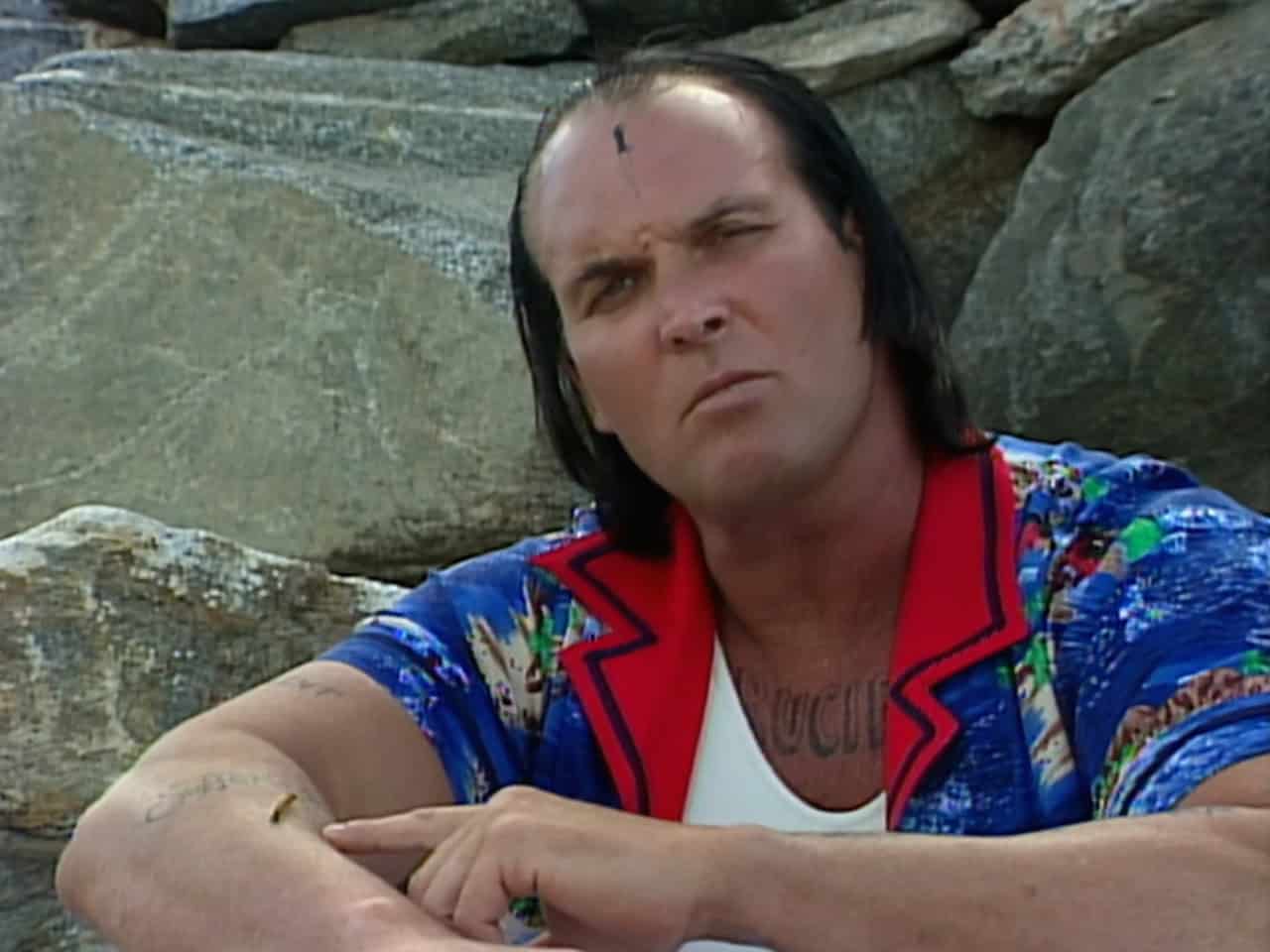
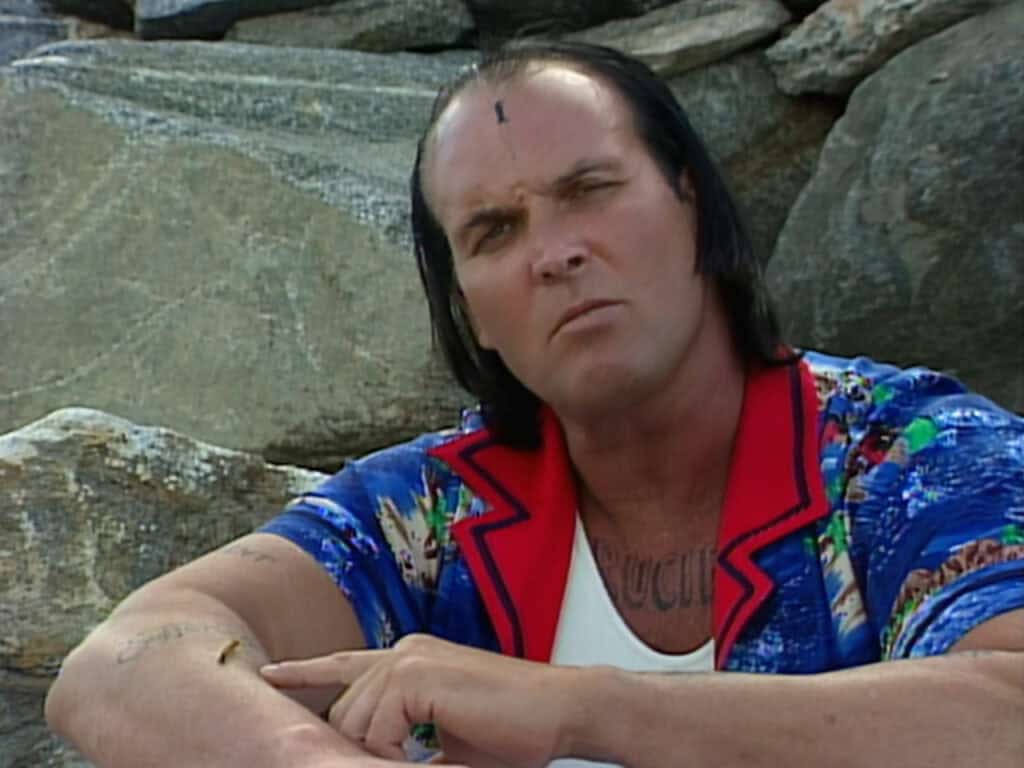
It helped that he wasn’t boxed in by heavy scripting. This was still an era where guys largely had to find their own voice. “Back then, you know, we didn’t have writers… I just winged the whole thing, the vignettes and with the bug… on my arm and smacking it and just winging it, and luckily it just came easy for me, and I enjoyed doing that way.”
That famous “worm” promo is the perfect example. Dom brings it up as something that gave him chills as a kid. Spivey reveals how spur-of-the-moment it really was. “I looked at my arm and saw this caterpillar [I’m pretty sure it was a worm – Dom] on my arm. It wasn’t planned or anything, it just happened, and it was just perfect, you know… and that just came out.”
A tiny, unscripted moment, and yet it became one of the character’s defining images: Mercy casually crushing this harmless thing on his arm and turning it into a twisted metaphor.
The Power of a Soft Voice
If there’s one thing Spivey keeps circling back to, it’s thewayMercy communicated.
He’s openly critical of the idea that a heel has to scream to be taken seriously. In his mind, that’s the quickest way to lose people. “Bray [Wyatt]… was more upbeat and crazy, wild uncontrollable statements and stuff, whereas Waylon Mercy was more sinister, he was slower with his deliberation, and always gave everything a lot of thought before he said it, and it sucked people in, speaking with a soft voice.”
Then he delivers the thesis outright: “I really believe that when you get on, start yelling and screaming at people, it makes them mad, but if you talk real slow and deliberate, they pay attention.”
That’s the unnerving magic trick of Waylon Mercy: he doesn’t push you away, he draws you closer. You lean in. You listen. And that’s when he gets into your head.
Bray Wyatt and the Mercy DNA
The line from Waylon Mercy to Bray Wyatt is one fans have talked about for years. Hearing Spivey articulate it fills in the emotional detail. “Bray Wyatt did a great job. I mean, me and him collaborated on, you know, his character, and he did a great job with it, and that’s where he got it, you know.”
But Spivey is very clear that they wanted Bray to be his own man, not just a Mercy re-run. “He didn’t want Windham [Rotunda] to be that close to being Waylon Mercy, and he did a great job of changing it around. He was more upbeat and crazy… whereas Waylon Mercy was more sinister… slower with his deliberation.”
There’s a bittersweet layer when he talks about the possibility of working alongside Wyatt on screen – an idea fans have fantasy-booked for years. Did Bray ever actually approach him about that? “I did think about it when Bray Wyatt came out, as far as being a manager, but no one ever approached me on that. I don’t know why. They should have, it would have been great…”
They lived in the same town. The what-ifs write themselves.
Would Waylon Mercy Work in 2026?
Dom puts the obvious question on the table: would a character like Waylon Mercy work in modern WWE?
Spivey doesn’t pause here. “I think Waylon Mercy could still scare a lot of people, make it very sinister.”
Given how much modern fans consume layered storytelling, horror and psychological drama, it’s hard to argue. In a landscape of big entrances and louder-than-life personas, there’s something genuinely chilling about a man in a simple shirt, talking in a low voice, smiling while he explains how easily he could hurt you.
And if you’re wondering who, in today’s scene, he actually enjoys watching, he doesn’t miss a beat. “Drew McIntyre, I think he’s a great worker for his size, you know, he really does a lot of stuff. He would have been a fun guy for me to work with as Dangerous Dan—but Waylon Mercy, I don’t think he’d be able to handle Waylon.”
You believe him.
Waylon Mercy’s Take on Modern Wrestling
Where Spivey gets more animated is on the subject ofmodern in-ring style. The word that comes up is “gymnastics.” “I’ll tell you what I would like to see that was less of, and that’s doing all these gymnastic moves and stuff. Jesus Christ, you know, you got five guys standing around a huddle, waiting for somebody to jump over top rope, do three flips, and then knock them all down, and they get back in the ring, and he beats ’em by a small package. That makes no sense to me.”
To him, it’s about logic and believability. If huge moves don’t mean anything, the story breaks. “Guys now get hit with these fantastic moves and stuff, and [they’re] kicked out at one, and they’re good to go… it just makes no rhyme or reason.”
Contrast that with how he describes the way he was taught to work, and the way Mercy wrestled. “Working a lot slower, grabbing a hold and making it work… slow and methodical, and when you did something, it meant something.”
He ties that directly into kayfabe and how seriously the business used to be protected. “Back in my day, you know, kayfabe was around… we respected the business to make people believe that it was real, and that’s why I enjoyed working in Japan, because you didn’t have any of this stuff.”
In Japan, they worked stiff, they worked serious, and yeah, it took years off his body. But he’d rather that than stand around waiting to catch a choreographed flip.
Dream Feuds and Lost Matches
For all that Mercy’s run was short, Spivey has thought about the matches that might have been. When Dom asks who he would have liked to work with as Waylon Mercy, one name stands out immediately. “I would have loved to work with The Undertaker. I would have loved to have a match with him, who used to be my partner, of course… Undertaker in a casket match, that would be pretty awesome.”
He also mentions others: Triple H, Shawn Michaels, Stone Cold, as guys it would simply have been “fun” to work with. You can hear the old worker’s imagination ticking over when he talks about them, blending styles, thinking about tempo and psychology. “That’s why the Undertaker would have been very good, because he was slower and deliberate, it would have been a lot of fun.”
These matches never happened. But the fact fans are still booking them in their heads, thirty years on, says a lot about how strong a foundation Waylon Mercy really had.
“Save Your Money”
For all the talk of characters and psychology, the most grounded thing Spivey offers young wrestlers in 2026 is brutally simple. “I don’t know. I tell them to save their money, that’s what I do, because it’s just temporary employment nowadays. I don’t think you’re going to see another guy go 30 years in the business. I think that that has passed by.” He’s speaking from a place of relative good fortune. Away from wrestling, his family ran an underground utility business. “My family and I had an underground utility business, and so I had health insurance, which I damnly needed after having six hip replacements, two knee replacements, and that fusion, and 10 concussions, and six marriages. Other than that, I’m good.”
He laughs when he says that last line, but the point is clear. He had something to fall back on. A lot of guys he sees on the convention circuit now don’t. “I see these guys that come to do these conventions, and they count on those conventions to get by on, and you know, I’m just grateful. I’m very fortunate that, you know, I had something to fall back on.”
So yes, he’ll talk to young wrestlers about slowing down, about making moves matter, about psychology and presence. But he’ll also tell them to think long-term, to treat wrestling as the temporary job it so often is, not a guaranteed lifetime career.
The Dangerous Truth
By the end of the conversation, a sharp picture of Dan Spivey emerges.
He’s a man who went to the edge and somehow clawed his way back. A man whose body has paid for every bump and every Japan tour, but who still clearly loves the craft when it’s done with purpose. A man who created, in Waylon Mercy, one of wrestling’s most quietly influential cult characters almost by accident—and still feels the ghost of what might have been.
He’s also an author now, whether he ever expected to be or not. And he knows exactly what he wants his book,The Dangerous Truth, to be for the people who pick it up. “If you know somebody has an alcohol or drug problem, it’s a great book to read. If Dan Spivey got sober, anybody can get sober, and that’s the reason I wrote the book.”
Waylon Mercy never got his WrestleMania pay-off, never got that casket match with The Undertaker, never had the chance to sink his teeth into the kind of long-term feud his psychology was built for. The character’s run was cut short.
And yet here we are: still talking about him, still quoting those promos, still a little uneasy at the idea of that handshake and that soft, measured voice.
Maybe that’s the real legacy. A character without an ending, still walking around in people’s heads, three decades after the music stopped.
Check out a video of the chat below (edited by BabyCube), and listen to the full chat where we talk more about the book on our podcast!
Watch the edited video (edit by BabyCube):