

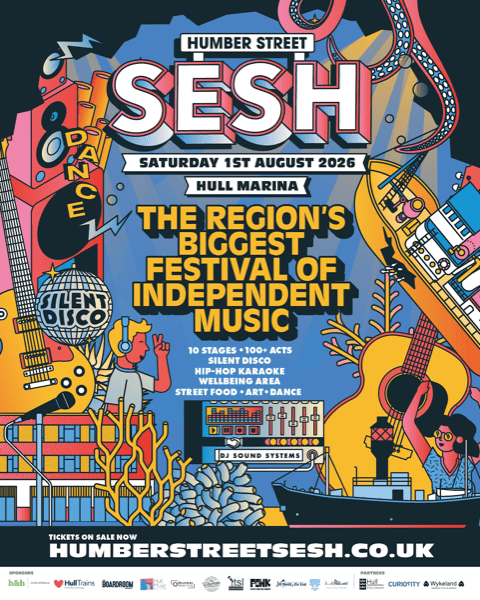
As Humber Street Sesh 2026 barrels toward Hull Marina with over 100 acts across 11 stages and an expected crowd of up to 15,000 people, its co-founderMark “Mak” Page is brutally honest: this festival is not guaranteed to exist in 2027. “It’s not a given, it’s not a case of, miss out this year, maybe come back next year. We need your support now.”
This year’s Sesh isn’t just another date in the city’s cultural calendar – it’s the product of financial risk, community faith, and two and a half decades of obsession with grassroots music. Across a long, candid conversation, Mak opens up about the real costs of putting on a festival like this, why metrics aren’t everything when it comes to picking bands, and what he wants emerging artists to finally understand about treating themselves like a serious proposition.
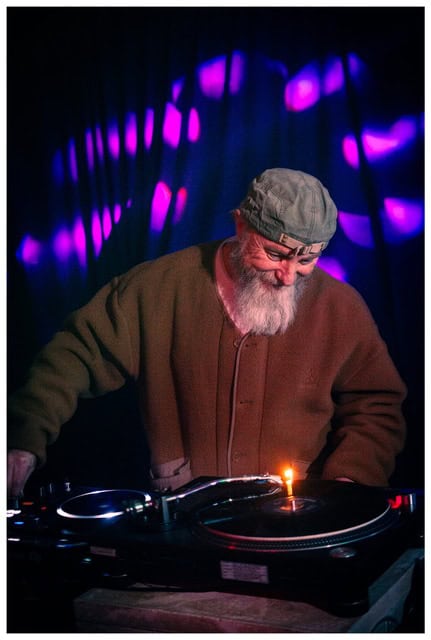
Mark Page
A Festival Held Together by Passion and Pressure
If you’ve ever assumed that Humber Street Sesh is a stable institution that will “always be there,” Mak is quick to dismantle that myth. “I think you’ve got to be insane to put on a festival in this day and age. I mean, there’s so many of them across the UK now. I think 120 have fallen by the wayside in the last three years.”
The last edition didn’t even break even: “We didn’t break even last year, and that sort of put us under a lot of pressure, and we spent probably three or four months just sort of getting our heads back in the game… we didn’t know whether we could come back in 2026. And for like three, four months, it didn’t look that way.”
The team tried to adapt structurally and financially. They created a CIC (Community Interest Company) arm to try to access grants. Mak and the team wrote six long funding bids. Every single one was rejected. “We didn’t receive any arts funding this year. Unfortunately, it’s been about six years since we’ve been successful with Arts Council. So that was a proper body blow at Christmas when we didn’t get the funding that we were hoping to.”
With funding doors closed, they went back to the spreadsheet.
Cutting, Rebuilding, and the Reluctant Ticket Rise
Initially, Mak’s solution was simple but brutal: cut stages and cut costs. “We removed three stages, reduced the build by about £40,000. We looked at the P&L again and thought, well, you know, removing those three stages, we’ve got a chance.”
Then came the decision that no grassroots promoter ever enjoys: raising ticket prices.
This year’s festival uses a three-tier system: Tier 1 at £20, Tier 2 at £25, and a current price of £30. “The only way we can do this with the rising costs of infrastructure and everything, we have to put the ticket price up by a fiver… even at that £30 price, we still think it’s a bargain… Over 100 acts across 11 stages… in any other city across the UK, this festival would be an £80, £100 ticket.”
Then the universe played a little trick. As soon as they cut three stages to survive, sponsors wanted to sponsor the very stages they’d removed. “The first three stages that people wanted to sponsor were the three stages that we pulled out… we end up putting them back in, and lo and behold, we’ve ended up with more stages than we had last year… and introduced a hip hop karaoke stage this year.”
Sponsorship, Mak stresses, has been “really good” this year – but that doesn’t mean they’re safe. “It’s now down to ticket sales, and ticket sales, I won’t lie, have been slow this year… we’re hoping with three days to go that we get the numbers we need to break even at least.”
He doesn’t pretend there is a big payday at the end of this. “Putting on a festival is an expensive business, and you’ve got to drive it by passion first and foremost because you can’t go into it thinking you’re going to make lots of money from this – because you basically don’t.”
The Sesh: 24 Years of Free Entry
If Humber Street Sesh is the big visible explosion,The Sesh – the free weekly Tuesday night at Polar Bear – is the slow-burning fuse that’s kept Hull’s music scene lit for nearly a quarter of a century. “For 24 years, coming up to 25 in October this year, we’ve run that weekly session night… that weekly night’s been a free entry night for 24 years. And if it was about money, we would have put a five pound entry fee on that years and years ago, and we never have.”
That night has always been about platform and development, not profit. It is free entry for the public. It is a regular, safe place for bands to cut their teeth, build confidence and learn stagecraft. Stylistically, it is wide open – post-punk, indie, folk, metal, hip-hop and more have all gone through that room. “It breeds confidence, it breeds skills, it just gives a voice to local music on a weekly basis… you can go missing for like three months, but rest assured, on a Tuesday night you can pop down to Polar Bear and you can catch some free quality grassroots original live music.”
Mak lists off other projects – Trinity Live, the cruise to Amsterdam/Rotterdam with bands on the boat, collaborations with The Warren and others – but the message is consistent: this work has been relentless and deeply community-driven.
And yet, emerging bands are not always meeting that effort halfway.
Mak’s Message to Emerging Bands: “Be Hungry, and Show Up”
One of the strongest themes in our conversation is Mak’s quiet frustration with how some local artists engage – or don’t – with the platforms that exist right under their noses.
He makes it absolutely clear: for Hull bands who want to play Humber Street Sesh, the weekly Sesh isn’t just a nice night out; it is part of the audition. “When we’re looking at local bands, we look at bands and acts that are engaging with us at the weekly session night. Are they sending in tracks to us? Are they playing the night? Are they coming down and supporting other bands? Are they engaging with us? Are they showing enough passion in return to our passion? Are they hungry?”
He’s not asking bands to be there every week. “I’m not asking them to be down there every week because life’s busy, but it’d be nice for them to show their face… even if it’s three or four times a year, that’s enough. Just show your face, show your support to what we’re doing.”
Metrics Matter, But They Aren’t Everything
Mak is realistic about the modern landscape: Spotify listeners, Instagram followers and engagement do play a role. “We do monitor Spotify monthly listeners. We do look at Instagram. We do look at Facebook and seeing if bands are building up a buzz… but I don’t think it’s the be all and end all. The music has to come first and foremost.”
He gives a stark example of a beloved Hull band that’s been rotated out in recent years despite being a perfect festival band. “We put Fire (The Unstoppable Force) on for I think 10 or 12 years of the last 14… but what we’d seen was: no releases, they weren’t playing gigs, the metrics were slow, so we gave them a break last year.”
For bands outside Hull, live videos are crucial. “Anyone could go in a studio and make a fancy song. But what they do at a live gig is the real deal, and that’s what I want to see in the video before I book someone I might not know.”
“Think Like a Micro Business”
One of Mak’s most important messages for emerging bands is this: stop thinking like a hobby, start thinking like a small, serious operation. “Bands need to think bigger and think of themselves as like a little business, a micro business where they build a team around them… someone in charge of social media, someone doing their photographs, someone doing their filming, someone doing their driving, their booking, and whatever.”
He’s honest about the red flags he sees in the numbers. “We’ve got bands and acts in the city who I think are amazing, but I look at their metrics and they might have like 100 monthly listeners on Spotify but they’ve been a band for 10 years… 300 likes on Instagram, but they’ve been a band for 10 years. That doesn’t tell me they’re shit. It tells me they’re possibly not hungry enough, that they’re not building up their audiences, they’re not doing enough work.”
Hunger, for Mak, isn’t just a vibe – it’s visible. It shows in regular releases, active socials, live footage, turning up at local nights and sending tracks in without having to be begged. “It’s the hungry ones that will get noticed.”
Hull vs The Rest: Money, Infrastructure, and the Gaps
We talk frankly about why Hull’s bands often lag behind peers in cities like Manchester or Leeds when it comes to streaming numbers, social reach and industry access.
Mak acknowledges that resources and infrastructure are part of the problem. “It’s definitely part of the problem… we haven’t got the labels and the pluggers and everything in the city.”
But he refuses to let that become an excuse for passivity.
He points to people and organisations doing meaningful work: Scott [Langthorp] at The Warren mentoring young bands and feeding Mak new tracks; Cath and the team at Hull City Council pushing the UNESCO City of Music bid and wider support; Stu [Baxter] and Hinterland helping acts like Aimée Fatale, LIFE and bdrmm; and the Northern Network – AMI North, Launchpad, Kicker and more – who are actively willing to involve Hull.
His advice is uncompromising. “I’d say to local artists, reach out to those type of organisations and try and get involved with that… people should be engaging with you more, and they should be engaging with me and Dan at Sesh, and they should be engaging with Stu at Hinterland, Meg at Adelphi, Nick at Dive, Darren at O’Riley’s, Gary at Wrecking Ball… get talking to the venues, build up relationships, engage with them more, send your tracks in, get in their face, tell them that you want to play. Be hungry. Be hungry because it’s the hungry ones that will get noticed.”
Yes, there are structural disadvantages. Yes, some bands elsewhere have label backing or money behind them. But Hull artists can’t control that. They can control their work ethic and engagement.
Curating 2026: Diversity, UNESCO, and Fiona Lee’s “Pinnacle” Moment
This year’s programming has been particularly intense because the go/no-go decision for the festival came late. “For 2026… we left it late because we couldn’t make a decision on the festival returning until around March… So that’s only given us like five months to pull it all together, whereas usually we’d have eight to ten months.”
On top of that, Humber Street Sesh clashes with major national events like Kendal Calling and Y Not Festival, both of which snap up many of the UK’s brightest emerging acts. “We had a wish list… but when it came down to actually asking the question, they were already booked up… By the time we got to May, we realized we’re going to have to cast our net a little bit wider.” [0:16:46–0:19:00]
That’s where Hull City Council’s UNESCO Music City support came in. Backing for a dedicated UNESCO Music City stage allowed Sesh to expand its scope internationally. Acts like Lickor from Sweden and artists from fellow UNESCO-linked cities such as Glasgow now sit alongside Hull and UK names.
The heart of the lineup, though, is one of Humber Street Sesh’s own success stories:Fiona Lee, headlining the main stage. “I think the proudest moment for me this year will be seeing Fiona Lee headline the main stage… someone that we’ve invested in for a good 10 years… she started on the youth stages… then acoustic stage… her trajectory in the last 12 months is incredible – Tom Grennan support, The Maccabees, Great Escape, BBC Introducing, South by Southwest… This is her time… she’s hit the pinnacle for us at Humber Street Sesh.”
Mak is also clear that diversity and representation aren’t just buzzwords for the programming team. “There’s lots of factors involved… you’ve got to think of diversity on the stages. There’s got to be a good male to female ratio. We’ve got to make sure LGBT is catered for. Race comes into it as well. We’ve got to make sure we tick all boxes, and that we reflect society as we see it in the city of Hull.”
The 2026 bill reflects that mix, from black metal to post-punk, indie, hip hop, jazz and beyond. A new hip hop karaoke stage gives local MCs their moment, and carefully chosen out-of-town acts like Walt Disco, The Family Battenberg, Conscious Pilot and others plug genuine genre gaps in the local scene. “Where there’s gaps in our genres, that’s where we’ll reach out to national bands.”
The Reality
From the outside, Mak’s life might look like a swirl of stages, bands and big weekends. The unseen side is far heavier. “End of the day, I’m a family man. I’ve got three beautiful kids and a gorgeous grandson and a lovely wife, and I’d love to spend more time with them. But obviously, the music and the work takes precedence a lot of the time because of what’s involved. It isn’t just a case of just booking bands. I wish it was.”
Alongside programming with Dan [Mawer] and input from people like Joe Hubbard at Futuresound, Mak is juggling sponsors and keeping them invested all year; contractors and infrastructure deals; authorities, developers and landowners on the marina; residents and businesses who all want a piece of the pie; health and safety, road closures and logistics; and the never-ending cycle of marketing and press. “We’re putting a festival in people’s back garden, really, down on the marina. So we have to work alongside these people and try and appease everyone and keep everyone happy.” [0:11:06–0:11:53]
Layered over that are the weekly Sesh, Trinity Live, cruises, one-off events and future ideas – some outside Hull – that he hints at but won’t fully reveal yet. Not long ago, he was talking about needing a rest. Now he is expanding again. Why? “First and foremost it’s music and people. I’ve always been heavily invested in music and heavily invested in people since a young kid… I started DJing at 16… organizing events at a water park by 19… booze cruises abroad… then live music nights when I came to Hull… It just never ended.”
He still buys records weekly, still chases new sounds. “More than anything, I love discovering new music… that’s an absolute passion… and through putting on the events, I get the opportunity to meet some amazing people, and people are great by and large.”
Legacy
Mak isn’t a Hull native – he’s from Paignton/Torquay in Devon – but Hull has been home since 1992. “People were so welcoming. Salt of the earth people, honest, full of integrity, speak their mind… probably because a lot come from nothing. They don’t expect much, and when things do happen, people get very excited about it, and I love that.”
He’s fully aware that, on paper, Humber Street Sesh isn’t Glastonbury. “It’s an incredible event, but if you put it into comparison to some of the events around the country, it’s minuscule really… It’s not necessarily Kendal Calling or Y Not or End of the Road or Truck or Green Man, is it?”
But for Hull, and for the artists who’ve moved from youth stages to international touring, it has been transformative.
When I ask the “legacy” question – whether Humber Street Sesh is what he’ll leave behind – he doesn’t flinch. “My legacy is my kids, Alice, Elliot and Lucy, and my grandson Luca. They’re my legacy… Whatever they achieve in life, that’ll be my legacy. It’ll just prove that I was a good parent and a good grandparent… The festival – that’s work.”
If there is a work legacy, he refuses to claim it alone. “It’s always been a team effort. I might be the face of it, I might be the voice of it, but there’s no way I could have pulled this off without some incredible people… Hull can claim the legacy on that because they’re all Hull people.”
Why This Year Matters
So why go this year? Why not just catch it “next time”?
Mak is crystal clear. “We need your support now… if we’ve got any chance of coming back in 2027, and we’d like to, with it being hopefully the UNESCO City of Music year for Hull, we need to have a place next year.”
Beyond the survival question, there is the experience itself: a dense, high-energy site squeezed into a reduced post-development marina footprint; sound bleed between stages that Mak embraces as part of the chaos rather than a flaw; street-level art, DJs, drum & bass, jazz, indie, rock, hip-hop and a silent disco; a new hip-hop karaoke stage where local MCs and fearless members of the public can step up; Hull favourites and breakout hopefuls side by side with acts from across the UK and beyond. “It’s an experience… a cacophony of sounds right across Hull Marina… It’s a day where Hull can come together… a day that breeds confidence in Hull… and provides those all important platforms for young creatives that hopefully lead them on to bigger and better things.”
For emerging bands, Mak’s message is both a challenge and an invitation: engage with the scene; treat your band like a micro business; send your tracks; show up for other artists; be the ones whose hunger is impossible to ignore.
For everyone else, the ask is simple: buy the ticket, turn up early, wander, discover, and be part of the reasonHumber Street Seshlives to see what Hull might become as aUNESCO City of Music.