

Originally published in Uncut Take 279 [August 2020 issue]…
When The Beatles set up in Twickenham Film Studios for fractious rehearsals in January 1969, they thought they were working up new songs for a live concert and a TV special.
While the TV show never materialised as planned (was there even a plan?), an album and film, both called Let It Be, certainly did. Fifty years on from their release, Peter Jackson’s new film Get Back will finally uncover the story behind the legend, a tale of enduring relationships, new challenges and, ultimately, recovered innocence. Directors Peter Jackson and Michael Lindsay-Hogg, Paul McCartney, Ringo Starr and a cast of supporting players help John Robinson negotiate phase one, where Doris gets her oats.
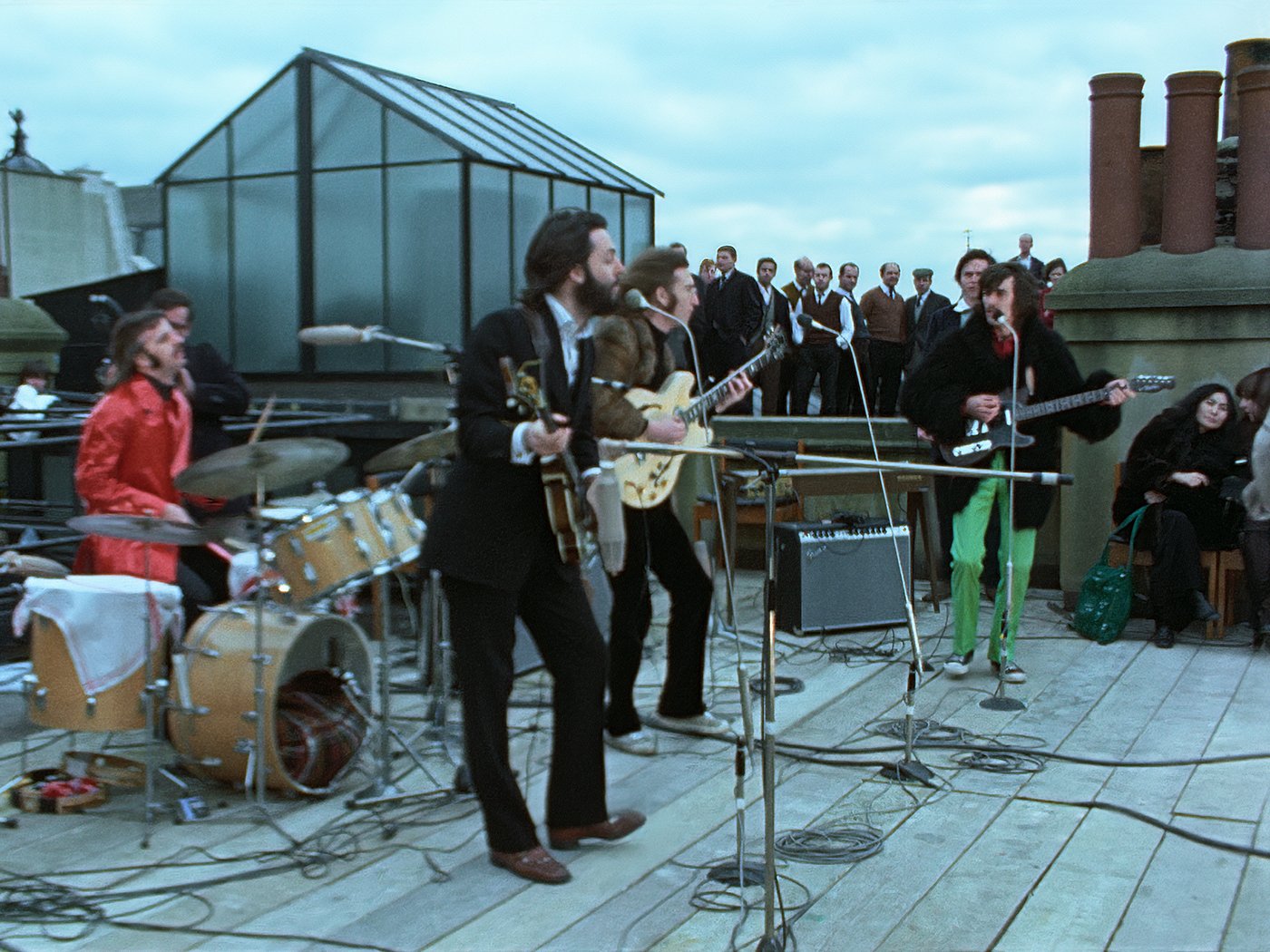
It begins with a close-up of a bass drum head, and the sight of two people moving a piano across an empty sound stage. It ends in central London 81 minutes and nearly a month later: January 30, 1969, with The Beatles playing a short set on the rooftop of their office at No 3, Savile Row. Much as has been the case for the past four years of their working lives, they can be heard clearly by many, but remain very much out of sight to all but a few.
It’s a strange and intermittently joyous film, but Let It Be, the 1970 documentary by former Ready Steady Go! director Michael Lindsay-Hogg, isn’t universally viewed with fondness by those who participated in it. That may be down to the fact that while it includes jokes, affection and great Beatles music, it also contains footage of rock music’s most notorious workplace argument. Sixteen minutes into the film (an event taking place on January 6), Paul McCartney gently suggests how George Harrison might like to approach his playing, thereby providing documentary evidence of the cracks in The Beatles’ hitherto united front.
The part is complicated, Paul concedes, but… Harrison: “…It’s not complicated. I mean, all I’m playing is the chords.” McCartney: “No, no, come on, you always gotta knock me when I say that. I’m trying to help yer, but I always hear myself annoying yer.” Harrison: “No, you’re not annoying me.” McCartney: “It gets so I can’t say…” Harrison: “You don’t annoy me any more.”
“For me, it’s quite painful because it was to do with the breakup. I pissed George off, which I never wanted to do in a million years”
Paul McCartney
“I don’t remember it fondly, because it was a very difficult time,” McCartney told Uncut, in unpublished interview material from 2015. “For me, it’s quite painful because it was to do with the breakup. I pissed George off, which I never wanted to do in a million years.”
Ahead of Paul and George in the coming weeks were the freewheeling recordings at Apple’s Savile Row studios, which 18 months later ultimately became the Let It Be album. At this time, though, the notion receiving deep consideration was that this new music would form part of something more ambitious: an audio-visual spectacular, to be called ‘Get Back’.
Concept: The Beatles returning to live performance. Proposal: a live concert and TV special. Venue/other technical details: to be discussed.
At Twickenham Film Studios and in central London, the band and the project’s director Michael Lindsay-Hogg debated exactly what should occur in ‘Get Back’ and who should be responsible. Relative enthusiasms for the project were gauged (Paul: pro; George: anti; John: noncommittal; Ringo: pro parts of it) and boundaries tentatively marked out. As the month passed, and new songs were rehearsed, film cameras and audio tape rolled every day, recording the project as it took shape, but also tangentially amassing a massive audio-vérité archive of the post-Fab four.
Amid rehearsals of what we will come to know as classic Beatles songs, there grew alongside it a chronicle of a vibrant working rock band: chat, rock’n’roll cover versions, discussion of the news, coughing, pleasantries, puns, lunch and fond reminiscences. The filmmaker Peter Jackson has now gathered all this footage together and dived into it, on a mission to reconsider the evidence. It’s no spoiler to say that in spring 1970 The Beatles will still break up, but speaking to Uncut as he assembled his final cut, Jackson suggested his aim was to free the often delightful ‘Get Back’ footage from its unwanted role in foreshadowing the end of The Beatles nearly 18 months later.
“The movie and album didn’t come out until May 1970 and they were in the middle of their divorce,” Jackson says of the association. “The band was breaking up, they were suing each other and obviously it was a really stressful, unhappy time.” Certainly it’s not a period the band have previously entered into with much enthusiasm. Speaking to Uncut in 2015 about Let It Be’s upcoming anniversary, Ringo Starr was not optimistic about any surviving Beatle celebrating the original film.
“I thought it was a lot one-sided,” he said in previously unpublished material. But would it come out again? “Nobody’s talking about it right now, I can tell you that,” he concluded with not much enthusiasm. And yet due to be released in only a couple of months is a celebratory new archive documentary by Peter Jackson, called The Beatles: Get Back. Ringo’s seen chunks of it on Peter Jackson’s iPad and says it contains “joy”. So what is it that the filmmaker has discovered? And why are The Beatles happy for him to dig it all up again now?
Hard to credit, when you consider the scale of the thing – just scratching the surface here: the raw materials for two Beatles albums, the hours of audio, an album put together by one person and finished by another, the two films, and the 25 minutes of Beatles Anthology devoted to it – but ‘Get Back’ was conceived of as a way of simplifying the way that The Beatles went about things.
In the post-Beatles world of October 1983, the poet Philip Larkin noted that The Beatles’ particular problem was having not been able to conform to showbusiness gravity. They got to the top, “but The Beatles could not get down”. Fourteen years earlier, Paul McCartney may have arrived at a similar conclusion: that the business of being Beatles was becoming less a freedom, more a prison of expectation.
Was it possible, he wondered, to rediscover the essence of the pleasure that they had experienced as young musicians? When you listen to “The Two Of Us”, one of his new songs of the period, it’s clear that McCartney felt a rich and nostalgic affection for the young, scuffling Lennon-McCartney partnership. But as well as finding a lyrical expression for what he missed, McCartney also proposed an action plan to rejuvenate The Beatles. It amounted to a break with their recent past.
Rather than overdubbing their recordings, they would get back to playing live in the studio, with no overdubs. Rather than using the studio as an instrument for more complex creations, their new songs would have a similar spark to the rock’n’roll that first inspired them. The process would re-energise them. If they were getting back to anything in particular, it was an earlier, pre- “Love Me Do” version of themselves, when it was all to play for when all that was required was the world to acknowledge their talent.
“It was Paul’s idea to get The Beatles back together again as a beat combo after the excesses of Sgt Pepper and the ‘White Album’,” says Tony Bramwell, then head of Apple Films. “He wanted to get them rough and ready – not that they were ever rough and ready after being a studio band. And to film the whole thing, and to finish it all off with a concert to prove that they were the fucking Beatles for God’s sake, the greatest band in the world.”
“Paul McCartney may have arrived at a similar conclusion: that the business of being Beatles was becoming less a freedom, more a prison of expectation”
It was an idea simultaneously of great humility (going back to basics) and demented grandiosity (we can conquer time). A plan developed for a TV special with two related components. A concert would provide the focus for the feature-length special, but in the week before (this being McCartney’s idea), there would be an introductory show, where the audience would watch the band in a more candid setting, rehearsing material for the main event.
It was with the latter section in mind that on January 2, 1969, the band moved into Twickenham Studios to film their rehearsals. While they and the camera crews set up and began to play their new songs, ideas were floated about the first element of the project: the venue for the proposed concert. “These conversations would go on – day one, day two, day three, day five…,” recalls Michael Lindsay-Hogg, “and nothing had been decided on. Ringo suggested doing it at the Cavern, where they had begun, which was a sensible idea, but it was too small a space for what I thought we needed to do.”
Discussions of proposed venues ranged from the traditional (a concert hall, much as the 1963 Beatles had played) to the conceptual (a hall full of empty chairs), and with attitudes that vaulted between playing down the cultural importance of The Beatles and flaunting their imperial stature.
“I wanted it to be a big occasion rather than a small occasion,” says Michael Lindsay-Hogg. “I had seen or read about an amphitheatre on the coast of Tunisia. My idea was that it would start at dawn with the instruments being set up, and then they went on and started to play. As the music continues, you see the music as musical notes on the screen go across the landscape… “My idea was that as The Beatles were playing, like Noah’s Ark, by the time we got to, let’s say, ‘Long And Winding Road’ or ‘Let It Be’ at midnight, the amphitheatre would be filled by what you might call the world.
“It would have been great, and that got a little bit of attention for a while. Then John thought, wouldn’t it be great, since they needed to go on rehearsing the songs, why didn’t we hire a boat – he didn’t mean a row boat or dinghy; a substantial boat – and they would go on rehearsing as the boat went from England to Tunisia.”
Ringo Starr was a fan of playing live. A fan of arduous boat trips to North Africa he was not. On the Twickenham audio tapes, Paul can be heard saying, “I don’t think we’ll be going abroad. Ringo’s put his foot down.”
“Then it was going to be the Roundhouse, so they could put together a show for charity,” remembers Tony Bramwell. “Then the charity started to muck about, about who was going to do what. The Middle Earth People got involved, then the Technicolor Dream people. There was a whole balls-up.”
‘Get Back’ was a simple and touching Paul McCartney idea that spread its wings wider than anyone might have thought possible. With hindsight it makes complete sense that the birth of this project should have been occasioned by another touching Paul McCartney idea that spread its wings wider than anyone might have thought possible: “Hey Jude”.
In late August 1968, in the middle of recording the ‘White Album’, The Beatles released a standalone single. To help with promoting it, McCartney discussed a number of complex film treatments with notable directors and artists. On assuming control of the project, longtime Beatles film producer Denis O’Dell gave him some good advice (“forget it”), and assumed control of the project himself, moving the production to more familiar territory: Twickenham Studios, where the band had filmed clips for “Help” “I Feel Fine” and “Ticket To Ride”. To direct, he suggested a known quantity, Michael Lindsay-Hogg.
“It was chaos,” Denis remembers. “Paul wanted it this way, then he wanted it that way. I had offices at Twickenham. We built up a rostrum for them to perform on, then I sent my assistant round with two coaches to invite anybody who wanted to come and see a Beatles concert.”
“McCartney and I talked a couple of days before about how to deal with the problem of ‘Hey Jude’, which was the four-minute chorus,” Michael Lindsay-Hogg remembers. “Then we thought, ‘What if we bring in an audience, but not The Beatles’ regular fan-club type of audience, that it should represent older people, housewives, people of colour, the village postman – a cross-section.’
“After every take we had to reload the reels, which took about 10 minutes each time. On the first break, the band just stood on the rostrum and talked amongst themselves, had a cigarette. Then in the second break, they realised that there were 100 or so people there, just standing around. They hadn’t played to any kind of public since they’d stopping touring in 1966. Slowly, they began to strum and play, Ringo came in with a beat…
They started with Tamla Motown songs, which was always the place they went if they couldn’t think of anything else to do. Things like ‘You Really Got A Hold On Me’. So during every break, they would sort of play for the audience. And everybody had a good time. A little while later, I got a call from Paul McCartney saying would I come up and see them at Apple.”
Beatles equipment manager Kevin Harrington is one of the first people you see in the Let It Be film, moving Paul’s Bluthner baby grand piano with Beatles assistant Mal Evans. “They were all quite excited about it,” says Kevin. “Mal told me what it was like on the US tours, how he would sweat into his boots when the kids rushed the stage. He said to me, ‘You need to stand behind Ringo to make sure he’s not pushed off the stage, and make sure his drumsticks don’t go missing.’”
“We finished up with about 200 people,” Denis O’Dell remembers. “We started to shoot the ‘Hey Jude’ clip with the boys performing and Paul got nervous. He came rushing over to me and said, ‘Denis, what are you doing?’ I said, ‘Go into the video tent and you’ll see how good it is.’ He went in and came out and said, ‘Yeah, it is good.’”
After completing the “Hey Jude” promo, Michael Lindsay-Hogg was directing the Rolling Stones Rock And Roll Circus film when he received a call from Paul McCartney. At a business meeting in his Apple office, McCartney confided his thoughts. “He said, ‘You know, we had a good time during ‘Hey Jude’, playing to a small audience. It really wasn’t so bad. We enjoyed it. We’ve been thinking…’”
“Happy new year!” With festive salutation, Paul McCartney arrived on the sound stage at Twickenham Film Studios around 11am on January 2, 1969 to begin the initial stages of the next Beatle project.
Present also alongside the other Beatles and the technical personnel was the producer George Martin, and a robed disciple of Hare Krishna, both of whom would leave shortly, and John Lennon’s partner Yoko Ono, who did not.
It was almost like ‘Perform!’ but to nobody except studio engineers who were all suited and booted. I didn’t feel a good vibe”
Tony Richmond, director of photography
As we see it on the screen, the mood is decorative, and deceptively spontaneous. Tony Richmond, the director of photography, bathed the walls in warm washes of colour while The Beatles huddled together and worked. As interesting as it might have looked, there was no disguising that this was not a venue in which music was ever intended to be created. “They were plonked in the middle of this huge warehouse,” remembers Kevin Harrington.
“It made EMI Studio 2 seem quite intimate. The sound stage at Twickenham was 10 times as big – there was no intimacy. It was almost like ‘Perform!’ but to nobody except studio engineers who were all suited and booted. I didn’t feel a good vibe.”
As much as the idea might have been innocent and optimistic, that wasn’t in itself enough to forestall the many practical problems. As we listen to the audio tapes of the rehearsals on day one, there’s something highly comic about the gulf between the stature of the people we’re eavesdropping on and the relatively small amount of complaining they do about the situation in which they find themselves. One January 2 exchange finds three Beatles taking stock.
Lennon: “I think we should rehearse in a room or in a corner. They won’t be rehearsing shots for three weeks.” McCartney: “We might lose them after a few days.” Harrison: “It would be nice if we had a PA. I don’t think this is a very acoustically good place.”
“It just wasn’t very clever,” says Tony Bramwell. “It was cold, mid-winter, January, and the place was union-riddled. The Beatles had been used to working at night in their own atmosphere, but because of the ACTT, the cinema and technicians union, the hours working in there were from 10am ’til 4 pm or something ridiculous. It was horrible.”
Yet The Beatles dug in, much of their new material chiming with the raw, unmediated approach they had proposed. On day one Lennon presents the Dylanesque “Dig A Pony” and the unfettered, soulful “Don’t Let Me Down”. For Peter Jackson, this band process has been an eye-opening part of the new Get Back movie.
“One of the guys would bring in a half-finished idea for a song, and then they would just sit down and spend half a day thrashing it out,” he says. “You see all that happening. It is not true that they weren’t writing together, ‘Don’t Let Me Down’, which is one of John’s songs, Paul is very engaged with helping him find a chord structure…”
Dylan and The Band’s recent escape into American musical history was often an overt influence on the rootsy, first-principles nature of the ‘Get Back’ enterprise. Alongside “All Things Must Pass” and “Sun King” on the first day at Twickenham, The Beatles also play “I Shall Be Released” and “The Mighty Quinn”. Serious work is done, if at times more seriously than at others. If you were George Harrison and were free-associating ‘Dig It’, which is very jolly.
Some of The Beatles lasted nine days at Twickenham, but by January 10, George Harrison had had enough. With a short factual statement (“I’m leaving the band now”), he left the studios, leaving the rest of the band to jam with Yoko Ono. At the end of the day, Paul McCartney gave Kevin Harrington a lift back into London, making a small diversion en route. “He said, ‘We’re just going to go and see John,’” Kevin remembers. “When we got to John’s he said, ‘Come back in half an hour.’ So here I am with Paul’s Aston Martin. I went to the pub, and I was about 20 minutes late back – but Paul was there waiting.” Kevin got into the passenger seat as Paul silently resumed their drive into London. “He said, ‘Don’t say anything about this to anybody.’”
Much like the enterprise run from the offices upstairs, Apple Studios, in the basement of 3 Saville Row, celebrated The Beatles as creative artists beholden to no-one. Built by their associate electronics expert “Magic” Alex Mardas, it would be an intimate space where the band could develop their music and record whenever the mood took them. Never mind George Martin and the suits at EMI Studios, here even traditional sound baffles would be replaced by Alex’s innovative new system of sonar displacement. All round, it was an emblem of their ceding from the old way of doing things.
“The new studio didn’t work,” says Tony Bramwell. “And because the studio didn’t work, they had to get a desk from EMI and staff from EMI to work it.” As The Beatles moved into their new studio, they truly entered a new phase. Rather than continuing with their severing of familiar ties that went with their original proposal, circumstances encouraged them to embrace compromise, and to respectfully fall back on their defining relationships, even if they were to be repointed a little. George Martin was present for several sessions, but Glyn Johns (fresh from the Stones’ Rock And Roll Circus) was most often at the controls. Johns had been able to work at Twickenham, being accredited by the correct union. He was also valued for his autonomy. He represented the coming mode of the next decade: the engineer/producer.
“Glyn Johns wasn’t just playing the recording engineer role,” remembers Neil Richmond, one of the EMI staff summoned to Savile Row to assist as second engineer on several sessions. “He arrived in his black E-Type Jaguar with a number plate: GJ1. He was one of the first cool freelance sound engineers. He had long hair. At EMI we weren’t allowed to grow our hair long. We had to wear jacket and tie – we were working with Pink Floyd wearing jackets and ties!”
“It was very flattering to be asked,” Johns told Uncut, “and fascinating to see The Beatles just playing as a band rather than creating a record the way they used to. I’ll never forget when the call came. This Liverpudlian accent introduced itself as Paul McCartney, and I thought it was Mick Jagger taking the piss.”
Cameras continued to roll, capturing the only substantial record we have of The Beatles rehearsing. We watch as John Lennon welcomes Billy Preston to the sessions, the organist having been spotted in the lobby upstairs and invited down by George Harrison.
“Every number has a keyboard part,” Lennon says, explaining the conceptual approach to recording the new songs. “Normally we’d overdub it, but we’re trying to do it live.” What the collected Let It Be footage captures is The Beatles relating as playfully and productively as we might ever have hoped. While Yoko paints a series of Japanese calligraphy characters on Ringo’s drum baffle, John, Paul and George work on harmonies for “The Two Of Us”.
As much as the song casts its gaze to the past, as the band work towards the completion of the song, their voices point forward to the magical polyphony of Crosby, Stills & Nash. McCartney’s “Get Back”, the lodestone of the project, is worked on many times, until it satisfies the composer’s perfectionism. Lennon, meanwhile, seems delighted with his role as lead guitarist on the song. He jokes with Harrison that he’s working (this said with heavy ironic reference to Eric Clapton’s self-described Cream sound) “on my ‘woman tone’”.
Compared to the laborious processes of multitrack studio recording, rewinding and syncing tapes, this new and spontaneous way of working was clearly a liberation. “I guess they wanted to do something more fundamental,” says Neil Richmond. “They would play like they were doing a set. There would be some chat. There would be a take, then they would move on to the next tune. Like a live album, but in the studio. Paul was the vocal energy… a kind of conductor. There was never any argument – it seemed as if Paul was directing.”
Watching all the available footage, you’d say they seem in good spirits. During rehearsals, McCartney tells Lennon that he’s just seen film footage shot of the band while with the Maharishi in Rishikesh the previous year, remembering that during their 1968 visit Lennon had taken a helicopter ride with the guru thinking, as McCartney tells it, “That he was going to slip you the answer.”
George asks Mal Evans to send someone out and buy him a cowboy-style lace tie. John puts in a request for a “false chest”. Over the weekend of January 23-24, Ringo says he’s got the beginnings of a song, and George helps him work out the chord changes that will help turn a good-natured piano sketch into a fully fledged composition, “Octopus’s Garden”. McCartney is at that moment visiting the studio with Linda Eastman’s daughter Heather, and the cameras watch as an innocent and delightful mood fills the space.
Harrison’s “For You Blue” is another prominent success of the weekend. It is, Harrison tells his fellow musicians, “influenced by those old fellas who weren’t really professional at all. It’s a bit of a one-take wonder.” It isn’t, of course. But with its Lennon slide guitar and gentle groove, it completely nails the rootsy and unassuming ethos of the ‘Get Back’ project.
At one playback of “Get Back” itself, Paul is clearly delighted with progress made on his keynote song. Interestingly, he then has his bluff expertly called by George, who proposes a way of releasing the song that will be spontaneous and rejuvenating in just the kind of way McCartney has said he wants.
Harrison: “We should just knock it off as a single.” McCartney: “Well…” Harrison: “For the concept of it, to just knock it off as a single. What was the last one we had?” McCartney: “…’Hey Jude’”. Something has clearly occurred since Twickenham that has subtly shifted the balance of power. Whether it’s the presence under his agency of Billy Preston, the success of his songs in the room, or the new studio-focused nature of the project, the change in mood seems to have George at its heart.
“George was starting to come up with some wonderful songs,” says Michael Lindsay-Hogg. “He was becoming his own man, in a way. The idea of uprooting everyone to go to Tunisia or wherever didn’t sit with his plans.” Even if the TV spectacular was now off the cards, as far as Lindsay-Hogg was concerned, his footage needed to be brought to some kind of conclusion, if a consensus could be found. His proposal is summarised by George as “on the chimney with a lot of people”. “I don’t want to go on the roof,” Harrison continues. “I would like to go on the roof,” Ringo counters. “We’re diverse people,” shrugs McCartney, as if this needed pointing out.
To get The Beatles up to the roof again for Peter Jackson’s new documentary took the best part of 20 years. Somewhere between 2000 and 2005, thinks Michael Lindsay-Hogg, the subject of work on the Let It Be movie and its attendant archival footage came up again, but nothing came of it.
Eighteen months ago, however, he went for a meeting at Apple and heard a proposal: for an alternate documentary using the original footage, to be made by Lord Of The Rings director Peter Jackson. Apple hoped he would think it was a good idea.
“I couldn’t have been happier,” says Lindsay-Hogg. “He’s a wonderful filmmaker.” The two directors have met and talked at length and the impression Lindsay-Hogg has been given from the sequences he’s seen so far, and from Jackson himself, is that the new film on one level will be a documentary about a documentary, though Jackson is still working out precisely what the story is that he wants to tell.
Today, Lindsay-Hogg remembers the conversations he himself had with The Beatles at the time he was editing his own film. What they wanted out (“originally there was more John and Yoko interacting”), what the distributors wanted out (“they wanted more music, less talking – we had to cut out half an hour”) and what The Beatles were, to his relief, ultimately content to leave in (George and Paul in Twickenham, particularly).
A guiding principle of the original ‘Get Back’ had been to reject sophistication and over-editing, and it was a relief to him The Beatles made no effort to cover their tracks, however uncomfortable it may occasionally have been for them. “I’m glad it exists,” Paul McCartney tells Uncut. “I’m glad any film exists of The Beatles, because it’s these wonderful, handsome young boys all being wonderful. Immaculately dressed. All Beatles things are good, period – it’s a body of work. I love seeing the stuff.”
As much as the Let It Be documentary might be problematic for those who prefer The Beatles to remain forever chirpy moptops rather than complicated adults, the film is still a coherent piece: a warm and gradual movement towards harmony from the crotchety abstraction of the initial rehearsals. At around an hour in, The Beatles are by now refined and accomplished, playing McCartney’s “The Two Of Us”, “Let It Be” and “The Long And Winding Road” in a intimately lit studio setting. As the film continues, the concluding rooftop concert breaks this domesticated mood for a return to raw and instinctive interaction – much as they hoped would be the effect of the whole project.
“They never had an exact plan, Which is one of the entertaining things you see in the footage”
Peter Jackson, ‘Get Back’ director
At the end of their 42-minute set, Lennon jokes to the small roof congregation, “I hope we passed the audition”, which of course is pretty funny. But for the project to succeed at all, it did require The Beatles to unlearn much of their professional judgement and allow it to be overruled by naïveté and enthusiasm of their earliest, auditioning, days. “They never had an exact plan,” says Peter Jackson. “Which is one of the entertaining things you see in the footage.”
They certainly cut things fine. On January 30, the weather was bad, and the mood was not buoyant in the camp. To catch the lunchtime crowds, Michael Lindsay-Hogg wanted the band on the roof and playing at 12.30 pm, with cameras rolling. His team had built a concealed spot to film any policemen who should happen to enter the Apple building on noise abatement business. At 12.20pm, however, The Beatles were still downstairs, unconvinced about continuing. Ringo said it was cold. George wasn’t keen at all. “Then after a little bit John says, ‘Oh fuck it, let’s do it.’ And that was it.”
Whatever had happened in recent days, or happened next, for The Beatles, the rooftop concert wiped the slate clean of any bad feeling – a power it retains even now. “The great thing about it,” says Ringo Starr, “once we were up on the roof, once we played music, none of that ever got in the way.” “It was a terrific occasion,” says Michael Lindsay-Hogg. “You can see it, they are having a wonderful time. It’s a release, it’s playing for a distant crowd. They were doing what they did best, which was playing rock’n’roll music. You can see them all having a good time, and engaging and smiling with each other. It was wonderful.”
As it was always intended to, ‘Get Back’, Let It Be and its miles of unused footage ultimately re-emphasised the right thing about The Beatles. “We knew there was good stuff,” says Ringo Starr. “The music is the important thing. It always is.”