

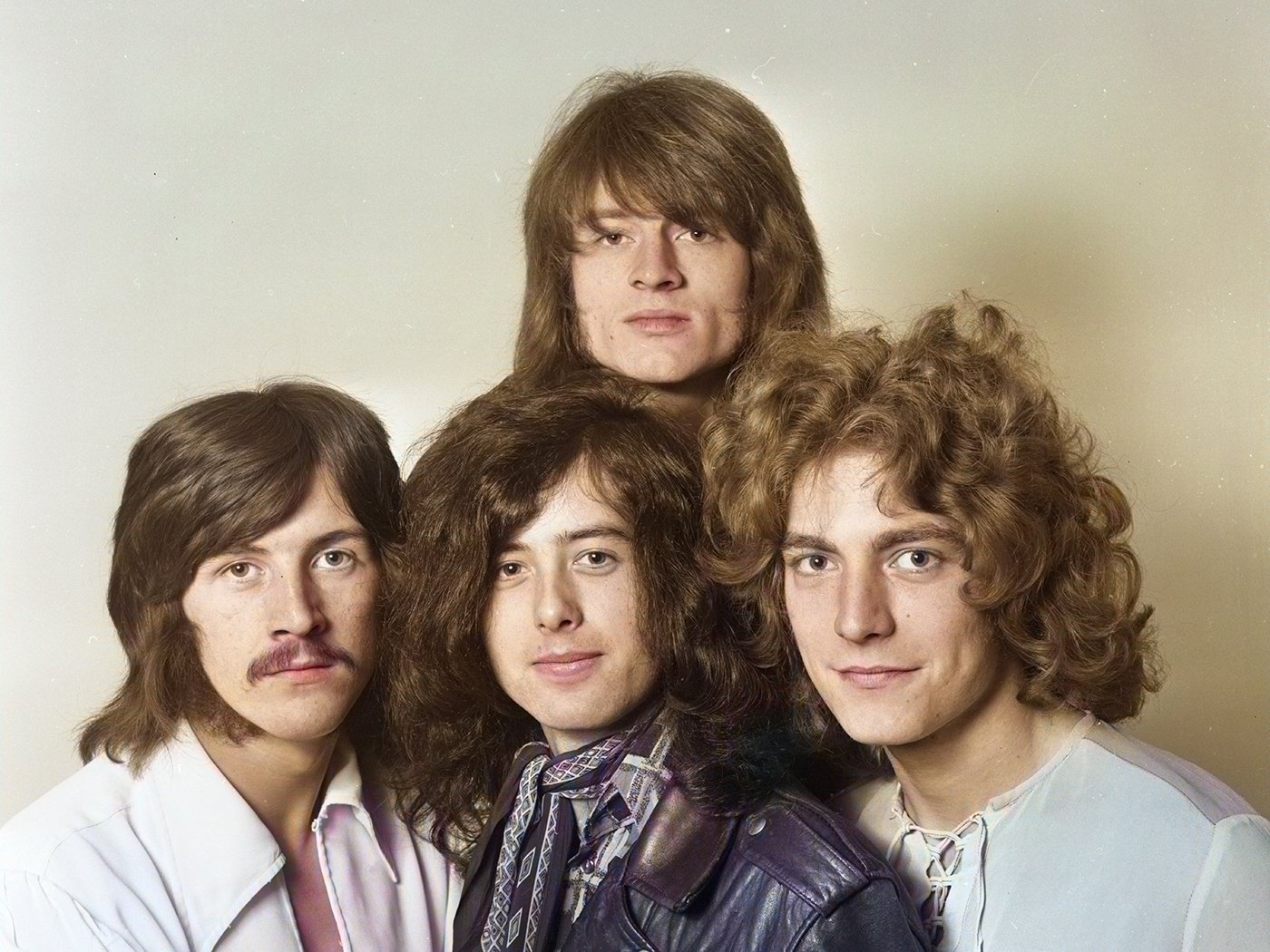
Led Zeppelin became mythic because they left so much space for myth. For much of the 1970s, they were the world’s biggest band but they retained an air of mystery: no singles, few TV appearances, very few interviews and little explanatory chatter. Their album sleeves were full of runes, their concerts stretched songs into rituals while their fearsome manager, Peter Grant, cultivated an intimidating, us-against-the-world organisation. As a consequence, they seemed to generate a complex series of lores: occult rumours, depraved touring stories, backstage decadence, private jets, bootlegs, groupies, violence, theft, curses and more. The more the band refused to demystify them, the more fans, enemies, journalists and biographers did the job for them.
1
Jimmy Page and Aleister Crowley
Aleister Crowley (1875-1947) was an English occultist, ceremonial magician and poet, dubbed “the wickedest man in the world” by the British press. Jimmy Page’s interest in him gave Led Zeppelin’s mythology its occult engine. Page collected Crowley’s books and artefacts; he inscribed Crowley’s dictum “Do what thou wilt” into the run-off grooves of the original vinyl pressings of Led Zeppelin III; and, in 1971, bought Boleskine House on Loch Ness, a house that Crowley lived in between 1899 and 1913. In 1973, Page even opened an occult bookshop in Kensington called The Equinox Booksellers and Publishers. This was all enough to turn Page into some kind of dark lord in the public imagination. In reality, there is some distance between active sorcerer and erudite collector, but that ambiguity was crucial: it helped to create the idea that Page, like his hero Robert Johnson, had made a Faustian bargain in exchange for stardom.
2
The Mystery Of The Four Symbols
The fourth album was released without the band’s name or a conventional title, replacing identity with four cryptic symbols, one chosen by each member. John Bonham’s three interlocking circles, John Paul Jones’s circular knot, Robert Plant’s feather and Page’s “ZoSo”-like mark gave the album the air of a grimoire. Some of the symbols can be traced to older sign-books, while Page’s remains deliberately resistant to explanation. This anti-marketing became supreme marketing: by refusing a title, they created several – Led Zeppelin IV, Four Symbols, Runes, ZoSo – and turned a sleeve into a puzzle fans still try to solve.
3
Did Stairway To Heaven Contain Backwards Messages?
In the early 1980s, a moral panic emerged in the US bible belt, with prominent televangelists like Paul Crouch claiming that Led Zeppelin were among several rock groups placing satanic backward messages, or “backmasking”, in their songs. In April 1982, the California State Assembly’s Consumer Protection and Toxics Committee held a bizarre public hearing where “Stairway to Heaven” was played in reverse, to test claims that the acoustic section (“if there’s a bustle in your hedgerow”) sounded like “here’s to my sweet Satan” or “I sing because I live with Satan” or “He will give those with him 666” when played backwards. The label dismissed the claims (“our turntables only play in one direction”) as did Robert Plant (“who on earth would have ever thought of doing that? How much time would you have to have on your hands?”). But the rumour stuck because “Stairway…” already felt like a sacred text.
4
The Starship
The Beatles and Elvis had previously chartered their own private jets for tours, but Led Zeppelin were the first rock stars to buy their own plane. In 1973 they spent $750,000 on a former United Airlines Boeing 720B passenger jet. They then spent $200,000 to transform it into a private flying palace – with a cabin bar, an electric organ, guitar amps and numerous double beds. This was no longer a bluesy rock band working the circuit: this was an imperial power crossing America, city by city: a mobile corporation, insulated from ordinary life by money, security and velocity.
5
The Riot House Years
The Continental Hyatt House on Sunset Boulevard was already the home of rock ‘n’ roll legend by the time Led Zeppelin took residence in the mid-1970s. Founded by country singer turned business mogul Gene Autry in 1958, the Continental was where Jim Morrison was evicted from in 1966 after taking so many drugs that he was caught hanging by his fingertips from a top-floor balcony; where The Who were banned after trashing rooms and putting cherry bombs down the toilets; where Keith Richards threw a malfunctioning TV from a balcony onto the pavement below; and where Alice Cooper’s entourage played naked football games that took over entire floors.
But it was also Led Zep’s playground and bunker. It’s where Robert Plant screamed “I am a golden god” from a balcony window, where Jimmy Page reportedly entertained girls from Laurel Canyon and, most famously, where John Bonham and tour manager Richard Cole drove their Harley-Davidson motorbikes through the upper-floor corridors. These tales of the sheer boredom of young men with too much money made private excess semi-public: fans knew where the gods were sleeping, journalists heard whispers and staff remembered everything.
6
The Origin Of Hammer Of The Gods
The phrase comes from “Immigrant Song”, the opening track on Led Zeppelin III, with its Nordic imagery of ice, snow, Valhalla and Viking conquest, apparently inspired by Robert Plant’s 1970 trip to Iceland. It then became the title of Stephen Davis’s notorious 1985 biography of the band where it seemed to chime with other connotations associated with Led Zeppelin – loud, pagan, violent, melodramatic and decadently grand: a rock ‘n’ roll band who seemed to arrive in Viking longships, accompanied by thunder, lightning, brutal armies and mass weaponry.
7
Were Led Zeppelin The Loudest Band Ever?
Plenty of bands lay claim to the label of “the world’s loudest band” – Deep Purple famously played so loud that three fans near their loudspeakers were rendered unconscious; The Who entered Guinness World Records with a 1976 show at Charlton Athletic’s ground which was measured at 126 decibels, 100 feet from the speakers; while Manowar, Motorhead, Kiss and Leftfield all exceeded volume regulations. But, even as early as 1969, Led Zeppelin had become legendary as purveyors of “an earthquake of sound”, with the American Speech Language Hearing Association – a healthcare group with an interest in preventing hearing loss – recording a decibel level of 130 during Led Zep’s performance of “Heartbreaker” at one US show. Tour manager Richard Cole was aware that such reports might be used to prevent them touring: he once grabbed a decibel meter from the hands of a city council official in Vancouver in March 1970 before smashing it up.
8
The Curse Of Led Zeppelin
Less a supernatural theory, more a way of organising a brutal sequence of misfortunes. In 1975, Robert Plant and his family were injured in a car crash in Rhodes, forcing the postponement of a US tour. In 1977, the band cancelled the final dates of its US tour after the death of Plant’s five-year-old son, Karac. In 1980, John Bonham died after drinking 40 vodka shots, and Led Zeppelin ended rather than continue without him. Add Page’s occult reputation, violence around the touring organisation, Peter Grant’s notorious capacity for violence and the general darkness of the late 1970s, and “curse” became an irresistible shorthand – even if, in reality, these were just tragic accidents, addiction, exhaustion and bereavement.
9
The Bootleg Empire
Led Zeppelin were a bootlegger’s dream, because their studio LPs only hinted at what the band became on stage. Every show promised brilliance and chaos: songs stretched, medleys mutated, Page entered exploratory improvisations. But the band made strenuous efforts to make sure that none of these concerts were ever made available to the public. Peter Grant saw someone recording their 1970 Bath Festival show on a reel-to-reel tape recorder, which Grant destroyed with an axe. Grant also appears on a 1971 BBC documentary on bootlegging, saying that he frequently entered record shops around the world, where he’d find live bootleg albums: he would then demand that the store managers hand over their entire illicit stock to him.
Nevertheless, some recordings have survived, most notably a September 4, 1970 show at the Inglewood Forum in LA called Live On Blueberry Hill, recorded by two notorious West Coast bootleggers using a sophisticated Uher 4000 reel-to-reel tape recorder and a Sennheiser shotgun microphone smuggled close to the stage. Bootlegs made Zeppelin more mysterious, not less. They suggested there was always another Zeppelin out there: heavier, looser, longer, stranger than the albums.
10
How Much Of Led Zeppelin’s Music Was Borrowed?
Led Zeppelin emerged from a British blues culture built on adaptation, quotation and electrified homage. But they were also inspired by earlier sources without always crediting them properly. Over the years, claims and settlements involved songs connected to Willie Dixon, Howlin’ Wolf, Anne Bredon and Jake Holmes, while the much-publicised “Stairway to Heaven” case brought by the estate of Spirit’s Randy Wolfe ended in Zeppelin’s favour. Zeppelin’s greatness lies partly in alchemy: through scale, arrangement and performance, they made old material sound apocalyptic.