

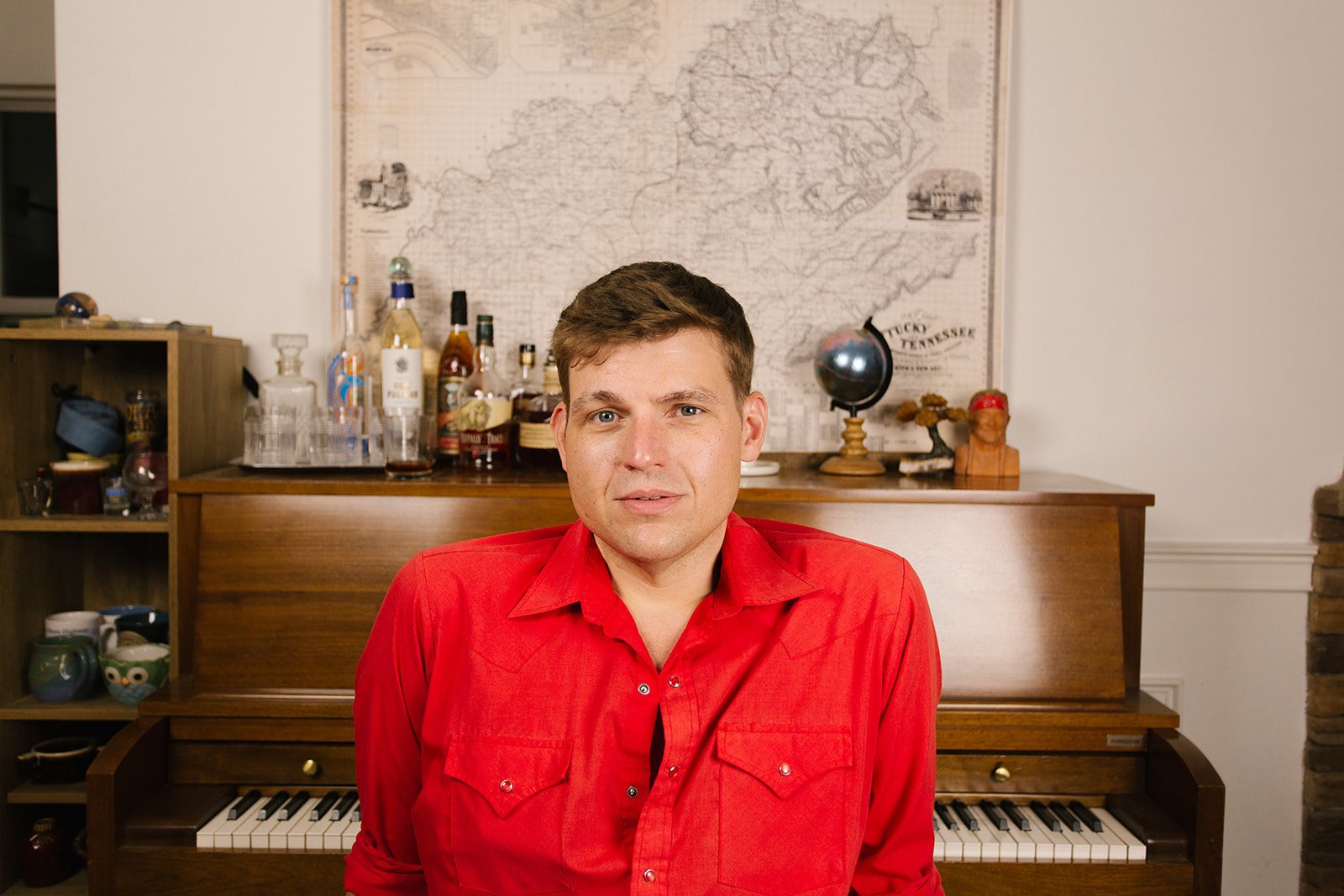

As one of the most resourceful songwriters in americana, Adam Chaffins welcomes you to the latest from his wacky, witty world in Trailer Trash: Doublewide (Spirit Nashville Recordings, 2026), a collection of narratives about schemers, dive bars, flea markets, glue, dogs named Whiskey, cats named Wine and good country song lyrics. Everything is there except his grocery list. I, for one, am sorry he left it out.
In his second album following 2020’s Some Things Won’t Last,a 5-song EP, this madcap at the frets of rural life writes without any sense of restraint or convention, using his innate ability to craft powerful descriptions. This collection of songs proves that the man can portray anything with more imagination and passion than most. Remarkably clever with a phrase, his songs recall the writings of the iconic Southern author Charles Portis, best known for True Grit and The Dog of the South. Similarly to Portis, Chaffins captures rural and country life with deadpan wit, honed lyrics, and peerless timing.
In his song Dive Bar Moses, Chaffins depicts a messed-up Vietnam vet talking to anyone who’ll listen about the bar they frequent: “No I ain’t been to the promised land / but I bet it looks something like this.” Stepped Over the Pieces sounds as if it has been strained through George and Tammy’s honeymoon sheets and then hosed down with Jack Daniels.
He looks for belt buckles in flea markets and wears them like some billionaire wears his Rolexes. He finds larger-than-life characters at these flea markets as well as from his years residing in the Bluegrass State, like King of Coal Dust County, a tale of a Robin Hood-style figure inspired by real-life East Kentucky schemers. His song Sugarcoat It takes you inside the contemporary world, where people have an aversion to the truth. But mostly, he’ll amaze you with his ability to entertain on any number of topics.
Americana UK: You are from rural Kentucky, I understand, and by some pictures I saw on Facebook, there are farm animals involved. You are pictured sitting on a rock with a guitar, and the goat was wanting to participate.
Adam Chaffins: Yes, I have goats, donkeys and chickens. One goat is named Memphis. He has far more celebrity than I do. He has a video on Instagram that has 10.6 million streams or views and almost 100,000 likes. It’s crazy. So anytime I do something with Memphis on those videos, it does pretty well.
AUK: The King of Cold Dust County is one of the songs on the new record. Is that your area? Did the heavy storms and flooding that just moved through Kentucky hit where you are?
AC: No, we are in Eastern Kentucky, and those storms went through the western part of the state. But a hurricane came through here a couple years back, and my wife’s hometown experienced a lot of damage. We have had some biblical-sized storms. Anyway, that song is based on a few different characters, probably one in particular that sparked the whole thing. I always felt like there was some larger-than-life characters and some rich hillbillies from around there who try to run the show. Always changes when they get busted.
AUK: There was a very slick transition between that track and Dive Bar Moses.
AC: Nice to get you into that; it felt natural. There are a couple spots on the record where we do that kind of thing when it makes sense. When we do that whole transition live, it turns into a really fun moment. The whole idea for that is, dive bar is the party, then the sun’s coming up, and there’s the Holy Church of the Kentucky girl. It’s the segue from Saturday night to Sunday’s repentance with your love.
AUK: Moses is something of a street prophet.
AC: Yeah, he’s from Kentucky. That was the first song I wrote together with Bobby Hamrick. We had just met, and I had a different title that had a different character from the Bible. Both of us had spent a long life traveling in and out of honky-tonks and surrounding ourself by those characters, whether we wanted to or not. I spent a ton of time in Key West and played a show, a writer thing down there, and this fellow came up to me and asked if I said Ho Chi Minh? And he literally had a Ho Chi Minh Vietnam hat on. He was like, “I just loved that song, man.” That spoke to me, and I said, “I think we wrote the song about you, though I just met you in the flesh here.”
AUK: Where did you meet your Kentucky girl?

AC: What’s funny is we grew up about 45 minutes from each other, but we didn’t meet until we both were in Nashville. We had a mutual friend who was from Alaska who, for a couple years, was like, “Man, you should meet this girl I’ve been making music with.” He was in a band with her, and I was introduced to them because they needed a bass player for some shows. I ended up playing on their first record, so I’ve gotten to be a part of every recording she’s done in her career. But that was a whole different part in our lives. She was actually married at the time, and I was in different relationships. We didn’t really become romantic till years later, far after that, when we kind of reconvened about writing songs. We really identified with each other from chasing hillbilly dreams, and we spoke the same language being from East Kentucky. Being from East Tennessee, you understand there’s a whole different cadence to the conversation, and you say a lot in the pause, as it were.
AUK: How does it work combining what you do for a profession with your wife and yet having a home life? Does it all blend together? I mean, do you have something you do just for yourself?
AC: I love the outdoors, and in Middle Tennessee, there’s lots of options like state parks. I love to take my dog hiking. I live close to a lake here and go kayaking, and we do all that stuff as a family too. I also love to road bike and mountain bike. It’s what I do to turn everything else off in those moments, being in nature, I’ve got a garden out here; my wife grows the flowers, and I grow the veggies.
AUK: Thinking of your song Lucky Me, do you feel lucky doing what you do?
AC: For sure. That song is mostly about counting your blessings. It’s like the rest of the world is on fire, and if you think about it, it’s probably always been on fire, today more than ever. We’re just more aware of all these fires happening everywhere, proverbial fires and sometimes real fires that we can’t control in any possible way. And since we were speaking earlier of Willie Nelson, I feel like Willie’s mantra is always: whatever’s happening around you, you got to be at peace with your moment, whatever it is. I think that if you can get up every day and know you’re lucky to be alive, you should find some inner peace in that.
AUK: So, you are more of a half-full guy instead of half empty.
AC: I try to be, though I can’t say I always practice what I preach. Being a creative in the music industry, I like to say no matter how big the high is, I’ve been doing it long enough that there’s always going to be a low. And that’s kind of with anything in life. That’s what the song speaks to. The first verse is like everything’s great, peachy. But the world is so crazy. That’s where the last verse is redeeming, saying, I’m holding my own ground / this world can’t bring me down. As long as the sun is still shining and there is air in your lungs, it’s a good day.
AUK: You play bass. Are you doing some session work in Nashville as well as your own thing?
AC: When I moved to town, I was playing bass in bluegrass bands between Boston and North Carolina and doing some freelance and session work. But the reason I moved to Nashville was to write songs, so I wrote and worked on the first record in the midst of touring with bluegrass bands. But I guess the vessel to all of it has always been playing bass and singing.

AUK: All the songs on the record except for one are co-writes. Is it more comfortable for you to write with someone else?
AC: On my first record, I pretty much wrote everything because I didn’t have anyone else to write with at the time. It was like, well, I want to record songs and do this thing. I better have the songs. And of course, years of writing stuff that the world will never hear led to putting those songs together. All the cuts on that record were people from my tight crew, ones that I write with all the time who are really genius and gifted. The perspective of someone else gives you a lot of confidence-building songs, things you might’ve not thought to put in there.
I have a co-write on Kenny Chesney’s upcoming record, and that’s a song maybe I’d release myself, too. When you’re recording music, not every song, even if it’s a great one, might fit into that collection of songs that you’re putting together. Sometimes you’ve got to wait a while. I have hundreds of songs that are still waiting to see the light of day that I feel as proud about as the songs on this record.
AUK: It would seem the songs on this record needed to fit into the overall theme, not that every one is about trailer parks, but they have a rural ring.
AC: I feel like I have a pretty unique Appalachian perspective. I grew up in a double-wide trailer in very rural East Kentucky. My dad was a coal miner, and my mom was a social worker, and my parents always made sure that I was taken care of to the best of their means. I never felt that I did without. They were very hardworking people, and it inspired me to work hard and chase my dreams. At this stage of my life, it’s just a cultivation of all that. It all came together with this project, and those songs just seemed to fit the narrative.
AUK: That is a cool spoken word intro on Trailer Trash. Kind of Barry White-ish.
AC: Yeah, I feel like there’s not a lot of Conway Twitty action in country music anymore. All the songs have about the same narrative, and there’s no real stories in the music. I was a big fan of the great songwriter Dennis Linde, and with the exception of some, there’s not a lot of story songs. That’s why the country radio that I grew up on was so near and dear. That era is what people consider now the golden age of country music. I’ve never shied away from writing those kinds of songs, and it seemed like a perfect opportunity working with Frank Rogers, who just knows songs inside and out and what a hit sounds like and what songs that support a hit sound like. Honestly, even with all that knowledge, I never wrote any of these songs thinking this has to be a radio hit or I have to check these boxes or anything like that. I mean, especially King of Coal Dust County, we never considered that, and the song has been on the commercial radio charts and moving up on the true indie radio charts. I grew up listening to the radio, and I always wanted to have music that fit in it, but I’ve never wanted to do anything to adjust myself to the current format.
AUK: What is the worst advice you’ve ever received?
AC: This ain’t for you; you shouldn’t do this. Anything like that. This town’s full of people trying to do it. Sometimes people see you, and they’re intimidated, or they’re already so negative because the odds are it probably won’t work out in the grand scheme of it all. But, like I said, I’ve been lucky to keep writing songs and playing with so many people that my day-to-day life involves making music and talking to people about music. I’m very fortunate for that.
AUK: You mention going to a first country show in Get Rich.
AC: That’s a true story. My mom was always winning tickets to radio shows. The first show I remember seeing was Marty Stuart at Camden Park in Huntington, West Virginia. And I have a photo with him. She also won tickets to Billy Ray Cyrus on the “Achy Breaky Heart Tour” in Huntington as well. Those are the earliest shows I remember. WTCR was a country radio station in Ashland, Kentucky that I listened to daily. That was how you heard music, and I went to sleep every night listening to late-night DJs.
AUK: Let’s say the Ryman; if you were to open for someone there, anyone you can think of, who would it be?
AC: Marty Stuart would be great. If you’re asking me, Marty Stuart can do whatever he wants. I saw them back up Laney Wilson during one of his Midnight Jamborees during CMA Fest at the Ryman. I’ve also been a huge Chris Stapleton fan since way before the world knew about him. Growing up in East Kentucky, I studied with a lot of people that grew up with him, played music with him and got to meet him way before. He had just departed a band called the Steel Drivers and came to Morehead when I was a senior and just graduated college. There was a little music festival, and he came to town. We got to hang that night and pick music. And when I moved to Nashville, I’d go see him play shows for a handful of people, literally, at the Basement in Nashville. Years later, I found out that my producer was in that room too, because he had signed Chris. He is a true icon.
AUK: Thinking of Sugarcoat It, at the recent July 4th holiday is it kind of disappointing there seems to be so many people in the country that don’t have patriotic views?
AC: Well, I don’t know if people don’t have patriotic views as much as they’re just confused by what patriotism is in 2026. There’s a lot of things happening that don’t seem right. That’s what that track is about. I feel like we’re so overmarketed to the point everything is marketing. As a recording artist, you’re just marketing and getting marketed to, and I’ll probably get another spam call before this interview’s over. What is real anymore? What is the truth, and what is false? With AI, you can’t even believe what’s happened or not. It seems really hard to find the cusp of it all. And we’ve gotten so content and so comfortable by sugarcoating everything. We seem to enjoy it.
AUK: One of your songs is Flea Market. Do you own anything you bought at one of those?
AC: Yeah, I’ve got tons of stuff I bought at flea markets. My favorite things are belt buckles. These days, if I go to a flea market, I’m looking for belt buckles, bolo ties, leather belts, stuff like that. I have so many belt buckles over the years from playing county fairs. And I have lots of random things, like some stuff in here that I bought at the Nashville flea market. I feel very comfortable at a flea market; it feels like my people.
AUK: You mentioned Elmer’s Glue in Stepped Over the Pieces. Was that old white, pasty glue a staple in your family?
AC: I think Elmer’s Glue is a staple in every American family. Seems like the most conventional method, at least in my mind, when I think of glue, right? Maybe fix a broken heart.
AUK: Are you a patient kind of guy like in Little Bit at a Time?
AC: I’ve learned patience and to accept it because I’m lucky in that everything has kind of happened that way. Some people moved to Nashville thinking, “I got this song, and I got this thing, and I’m going to do this.” I moved to Nashville with the intent of trying to be just as good as I possibly could and learn from everyone, try to create something that hasn’t existed before that would inspire people to do different things than they did before.
AUK: Who is the patient one in your marriage?
AC: It depends. I’m patient on day-to-day tasks. My wife is saying those clothes need folding. I could wait until the evening to do it, but when she has it in her heart that the clothes need folding, they need to be right then and there. I think we’ve both been very patient in our music careers by not taking any shortcuts musically or professionally, making sure that we get to do things the way we want to do them and the world sees through our lens the way we want them to see it.
Related