

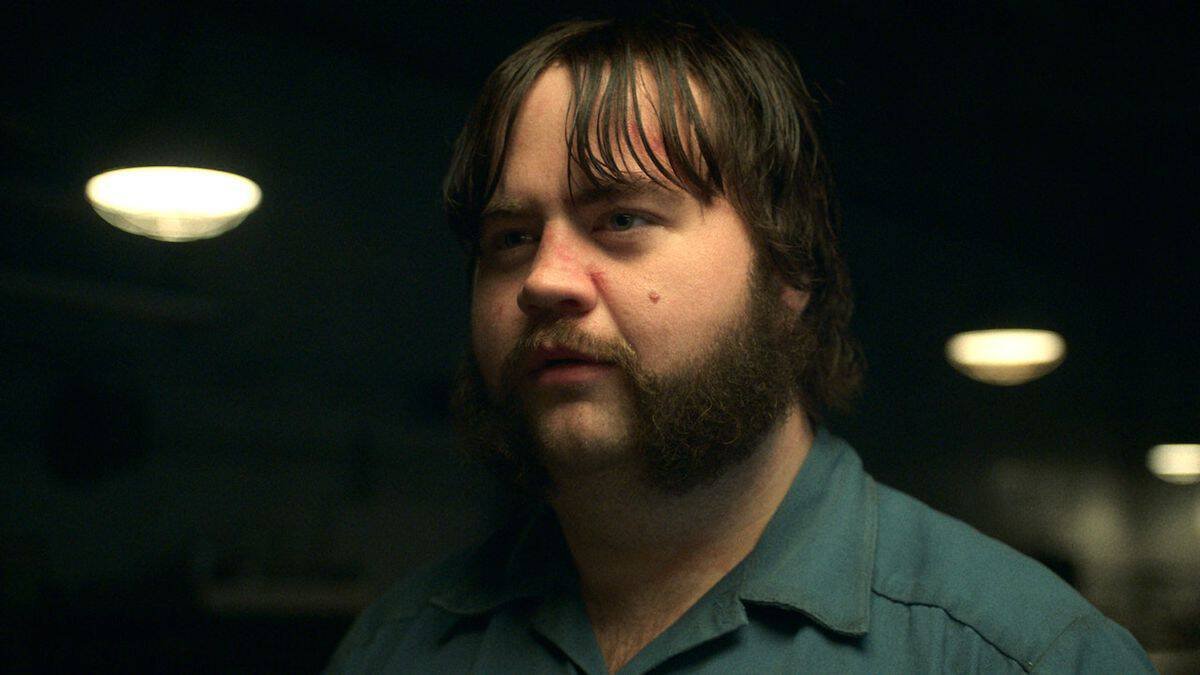
He’s an actor.
You’ve probably heard of him. If you don’t know him by name, you at least know his face. He’s “that guy” from “that thing” and there are a lot of “things” to choose from.
Paul Walter Hauser is an Emmy and Golden Globe-winning actor whose presence in television and in movies rivals any other actor on the scene today. He was the titular lead in Clint Eastwood’s Richard Jewell. He was the star of Apple TV’s Black Bird, in which he played real-life serial killer Larry Hall, opposite Taron Egerton. He was Stingray in Cobra Kai. He was the voice of ‘Embarrassment’ in Pixar’s Inside Out 2.
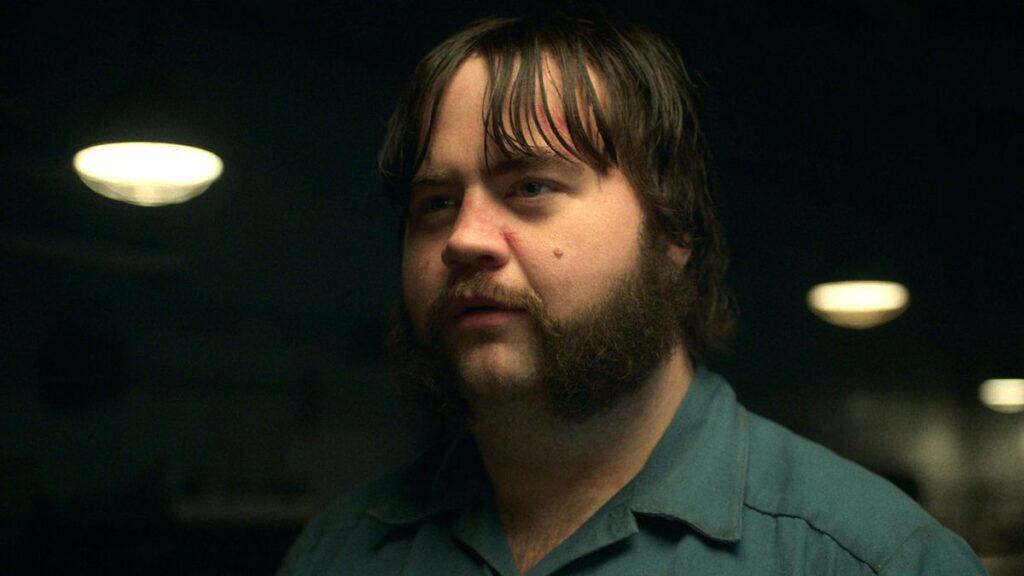
Paul Walter Hauser in Black Bird. Credit: Apple TV+
He was the goddamn Mole Man in a Marvel movie.
Paul Walter Hauser is an actor but, even more than that, he’s an actor’s actor – the kind of character actor that absolutely envelops himself in a role, whatever that role may be. He can do comedy. He can do drama. He can do horror. He can, hopefully, do biopics (a Chris Farley biography is currently in the works, and Hauser has long been rumored to play the legendary comedian in the film). He can do it all and, when he does, he makes sure that you remember it.
Hauser has been a fan of acting for, well, his entire life. It started in high school.
“I was a middle-of-the-road athlete,” Hauser recently told Soundsphere. “I could do a layup. I could block for the quarterback a little bit, but I never had a natural athletic talent, nor did I have a killer instinct. And that became really crucial and obvious around the age of 13, when you’re playing tackle football and you’re getting ready for high school.”
Hauser said he just didn’t have “the constitution for it,” so he turned to other hobbies.
“Around that time, I really got into filmmaking,” he said. “I started watching movies from Rob Reiner, Martin Scorcese; these kinds of adult filmmakers. I started watching non-family entertainment, and I just became obsessed.”
Hauser said that, in addition to those “grownup movies,” like Reservoir Dogs and Goodfellas, he also discovered comedies and, in particular, comedians that would shape both his life and his career for years to come. He said that he “became obsessed” with the comedians of the 90s, including Jim Varney, Jim Carrey, Robin Williams and, yes, Chris Farley. But, unlike some of his predecessors, he didn’t want to just play the clown. He wanted to demonstrate some real acting chops.
He got the opportunity to do so in a television show called Kingdom, on the DirecTV Audience Network in America. The cast featured the likes of Frank Grillo, Nick Jonas, Jonathan Tucker, Matt Lauria and more. He was cast in two episodes of the show, and he says he only had five or ten lines of dialogue, but he fell in love with it. Absolutely fell in love with it.
“I took it so deathly seriously, and I improvised,” he shared. “I did a bit of method acting and, at first, I think people thought I was a weirdo. Like, ‘What’s this guy doing, trying to win the peripheral Oscar? Doesn’t he know he’s a co-star?’ But they liked me so much that they wrote me into seven out of 10 episodes in the first season, I think it was.”
Those seven episodes turned into 24 out of the 40 episode entirety of the show, and Hauser continued to fall in love. He calls that show his first, real “big break,” and it was an opportunity he never forgot. He also didn’t take it lightly.
“It allowed me to quit my day job and help me pay off some student loans, eventually,” he said. “And it was a moment of me betting on myself. I did my thing and now look where I’m at. I don’t have a day job anymore and people are coming up to me on the street saying, ‘Hey, are you Keith from Kingdom?’ That was my first big break.”
Hauser said that if Kingdom was his Associate’s Degree, then he earned his Bachelor’s degree on ‘I, Tonya’ and ‘Black KKKlansman,’ and he earned his Master’s Degree on ‘Richard Jewell’ and ‘Blackbird.’
In ‘Richard Jewell,’ directed by Clint Eastwood, Hauser portrayed the titular character and he did so with such heart, such earnestness, that when, in the film, Richard finally, finally sheds a tear, the audience does too. For 90 minutes, it seems like Jewell’s world was caving in and he never got to let it out; he spent the whole film waiting to exhale. But when he was finally able to breathe in, and then out, the audience let out its collective breath as well. And then, Hauser did something subtle. If you weren’t paying attention – if you were on your phone or yelling at your kids or getting a snack – you would have missed it. Richard smiled. For the first time in the movie, since being accused of an awful, awful thing, he smiled. It wasn’t a smile of joy, not really. It was a smile of relief. It was a smile of an awakening. It was a smile that said maybe, just maybe, my life isn’t over.
And it was the performance of a really, really good actor.
In Black Bird, Hauser played the complete opposite type of character. Instead of playing a kind, affable, simple human being who just wanted to be good, he played a character that was just. so. bad. Playing a serial killer is not an easy job, especially when it comes to one’s mental health. But Hauser understood the role he was taking on and, like every other role, he just wanted to do a good job.
“Here’s what I thought going into it,” he said. “I thought, ‘Well, I’m playing a real guy and, just like in Richard Jewell and I, Tonya, I’ll be able to draw from all the real footage.’ But there was no footage of Larry Hall, the serial killer I played. So I didn’t have much to go off of. I kind of just had what was on the page, and I had to draw conclusions from dialogue and characteristics. And I just added things, like making him child-like. Like, there’s a moment where I eat the middle out of a piece of white bread in the dining hall at prison. I just bit a hole in the middle and set it down and it’s like, ‘what is that?’”
That example wasn’t just Hauser, or Hall, being a weirdo. It was a key piece of his character.
“At the outset, it’s me being playful and weird,” he said. “But then, upon further reflection, I realized, ‘Oh man, that’s a great analogy for what he did to these young girls. He bit the middle out of them. He took the best part of the bread and left the crust to be thrown away. It’s a dark thought, but it’s a really, weirdly accurate visual analogy.”
There were other moments too; moments that maybe even garnered sympathy for Hall. That was part of the performance. Hauser wanted audiences to feel bad for Larry Hall, because when it’s revealed that maybe he’s not as “innocent” as originally thought, that’s what makes him that much scarier.
“It was hard to wash off,” Hauser said of the role. “I think it took a while to realize how dark I had gone. A lot of people pulled me aside, when the show was coming out, and they said ‘Yeah, we were all really worried about you.’ I don’t think I knew at the time that they were worried, but a role like that takes a toll on you.”
He’s a recovering addict.
Larry Hall was the role of a lifetime and it ended up garnering Hauser a Primetime Emmy Award and a Golden Globe Award. If Black Bird was Hauser’s Master’s Degree, he didn’t need a doctorate to prove that he belonged at the table of Hollywood’s greatest actors. The role was a good one, but it wasn’t without its consequences. It really forced Hauser to confront and deal with his own mental health and addiction issues.
“I think people with mental health problems probably make better actors,” he shared. “For better or worse, being emotionally disturbed or having unresolved conflict or trauma – just having a curious, creative mind that races and thinks of things, and having an overactive imagination – that can be useful. But I’ve found in my career that, when I got sober about four-and-a-half years ago from marijuana and alcohol, I wondered, like, ‘Am I going to be less of an actor if I go to therapy? Am I going to be less of an actor if I’m not using these substances?’ And the truth is, I’m the same actor. I’m just more confident.”
Hauser said that he’s a proud Christian, but not the kind that one might see on television, praising Donald Trump as the second-coming. He’s more of a Christ-follower, he emphasized. And, to him, Jesus’ teachings are still lessons that can be taught, and learned from, today. He’s still learning them, himself.
“I tell people I’m a Jesus guy, and I felt back in 2017, I heard the Holy Spirit tell me that I needed to get sober,” he revealed. “And the voice that said that wasn’t my own. And it wasn’t audible. You don’t hear it, like you hear somebody yelling your name from behind you. But I felt this voice tell me that you have to get sober because there are people who cannot be blessed until you get sober. It was almost like God was saying ‘There’s a storehouse of good moments and riches for all these people; and they don’t see them if you don’t set yourself straight.’”
Hauser said he was first called to get sober in 2017, but he kept drinking and he kept using marijuana. “So clearly, it didn’t move me the way it should have,” he said.
But in the summer of 2021, Hauser was shooting Black Bird in New Orleans and, in his words, “things got really dark.”
“I realized I needed to change something,” he admitted. “Something has to give. It started with giving up pornography and alcohol. And then, three months later, I gave up marijuana. And those are some of the best decisions I’ve ever made. I don’t miss any of them. I still have fun. I live a full life. Some of my relationship dynamics have changed, but the most important relationship that changed was my relationship to myself. I now love myself and accept myself. I know who I really am now, versus me being in performance mode all the time, which I think guys like Chris Farley, Jim Carrey, Robin Williams – they all suffered from that, you know?”
He’s a Christian
There’s a tentativeness in Hauser’s voice when he speaks about his religion. It’s not that he’s ashamed of God; far from it. He’s just ashamed at what the word ‘Christian’ has become. Oftentimes, when one thinks of Christianity, they think of bigotry and racism and sexism and homophobia and meanness and ugliness and hate.
In short, they think of everything Jesus himself stood against.
“Just go back to what Jesus did in the New Testament books,” Hauser said. “Matthew, Mark, Luke and John – they give a pretty great depiction of all that stuff. And what you learn is that being legalistic is something of the Old Testament, not the New. To believe you can corner the market on having empirical wisdom or a perfect understanding [of the Bible] is stupid. The best thing you can do is realize that Christ summed up the Ten Commandments by saying ‘Love the Lord your God, and love your neighbor as yourself.’”
It’s that simple, Hauser shared. Love God, love your neighbour. And loving God does not mean just saying you love God in order to commit atrocities in His name. It means actually loving Him by loving your neighbours.
“You don’t need to worry about whether or not you’re eating pork on a certain day and you don’t need to worry about somebody’s suicide pact or abortion operation,” Hauser said. “You’ve got to worry about what you are doing every single day in the name of love. Did you love your neighbor? Did you love your enemy? Did you pray for your enemy? Did you want to yell at your wife and chose not to? Did you want to coerce someone into doing something you want to do, and you decided to surrender and to love them in that moment? All of these things are just attitudes of the heart. And the heart can be deceptive, but it can also be pure. Christ is calling us to a purity of heart and to a consciousness of living, to love and to serve other people.”
He’s a husband, a father, a friend.
Hauser has been with his wife since 2020. They met shortly before the pandemic hit the world and, minus a short break when Hauser was making some very tough, but very necessary life choices, they’ve been together ever since.
“As a man, what I’m most proud of is my marriage and my three kids, for sure,” he said. “That’s number one. I have a healthy marriage that’s thriving. I have three kids who I love and have been developing wonderful relationships with. After that, I’d say that I have a great group of friends. I have people that I can rely on, and that can rely on me. I have friends I’ve known for 30, 35 years who I still text and see on occasion. I think, on my death bed, my Golden Globe and my Emmy aren’t gonna mean much. But hopefully my hospital bed will be surrounded by people of substance, who love me and whom I love.”
Paul Walter Hauser is a lot of things. Above all, he’s a husband and a father. He’s a friend. He’s a son. Paul Walter Hauer is a man – a good man, trying every day to be better. He’s a recovering addict. A Christian. He’s an actor, currently one of the best in Hollywood. He’s all of these things and so many more. He contains multitudes. But there’s something else, too. Something he never, in a million years, ever thought he would actually do, or ever be.
Hauser has loved professional wrestling for his entire life.
He was a bit too young for the heydays of Hulkamania, but he was there for the rest of it. He was there for the Attitude Era and Monday Nitro and ECW and Stone Cold Steve Austin and the nWo and all of the other matches and moments that still, arguably, make up the most popular era of pro wrestling. He was there for all of it.
He was there for the…less popular stuff…as well.
“For me, it was being five or six years old, visiting my mom’s brother, Robert, in Florida,” Hauser remembered. “They lived in North Port; I think it’s near Sarasota, the home of the Macho Man. He showed me Clash of the Champions and the first match I ever remember seeing was Brian Pillman and El Gigante versus Arn Anderson and Barry Windham.”
While that match may not go down in the pantheon of ‘wrestling’s greatest moments,’ it made a believer out of Hauser.
“I have a vivid, vivid memory of Arn Anderson running around the ring to stay away from El Gigante. And I think the idea was that this scary looking guy, Gigante, was a babyface and the guy who looked a little more normal, like one of my friend’s dads or something, or like a football coach from one of our schools – that being Arn Anderson – was the heel. And it was this interesting thing of the guy that looks normal is the bad guy, and the guy who kind of scares me is the babyface. That striking visual stayed with me my whole life, the last 34 years or so.”
Hauser said he watched it all – the good, the bad and the ugly. He watched WWF on Saturday mornings, and WCW on Saturday nights.
Hauser said he watched from 92-93 but he says 1995 was the year that he really became a fan, thanks to the debut of WCW Monday Nitro on TNT.
‘I was really interested in watching it, even though I’m sure my parents didn’t love it,” Hauser laughed. “But by 1995, Monday Nitro happened, and that was a big turning point for me. I was like, ‘Okay, I’m about to be 10 years old and I can stay up an hour or two and watch this before bed.’ Pre-nWo, WCW, when it was Luger and Sting and the Road Warrior and Harlem Heat, I was watching a lot. And then, of course, in 1996 the whole wrestling world changed with the nWo and suddenly the Monday Night Wars.”
Hauser remained a fan for many, many years. And while he never imagined he’d one day fight for a world championship, he kept it in the back of his mind that maybe, just maybe, one day he could at least stand inside of a wrestling ring.
That happened, finally, in 2023. Fresh off a run of movies and television shows that any actor would kill for, Hauser didn’t retreat to the Hollywood hills. He found himself in Los Angeles, wrestling for Pro Wrestling Revolver. He was victorious in his debut match, defeating Matthew Palmer. For Hauser, it wasn’t just a dream come true. It was a pinnacle. The pinnacle, really. While not as grandiose as an Emmy or as awe-inspiring as a Golden Globe, being able to wrestle an actual, honest-go-God match in front of a live crowd? That was the number-one bucket list item.
Hauser admitted he had less than 10 hours of training before his first match. He said he was originally trained by independent wrestler Darian Bankston, as well as Anthony Ogogo and Paul London. It hurt, at first. And it continues to hurt, with every bodyslam, and powerbomb, and Diamond Cutter through a glass-covered table.But guess what? He loves it. He fucking loves it. And he’s going to keep doing it for as long as he physically can.
In addition to his matches in Pro Wrestling Revolver, he’s also wrestled for Major League Wrestling, Defy Wrestling, Progress Wrestling, and even All Elite Wrestling/Ring of Honor. He’s wrestled the likes of Joey Janela, Danhausen, Simon Miller, Adam Priest, Effy and more. It was while wrestling in MLW that he got to meet Eric Bischoff, the former president of WCW and one of the people, Hauser believes, that changed the wrestling world forever.
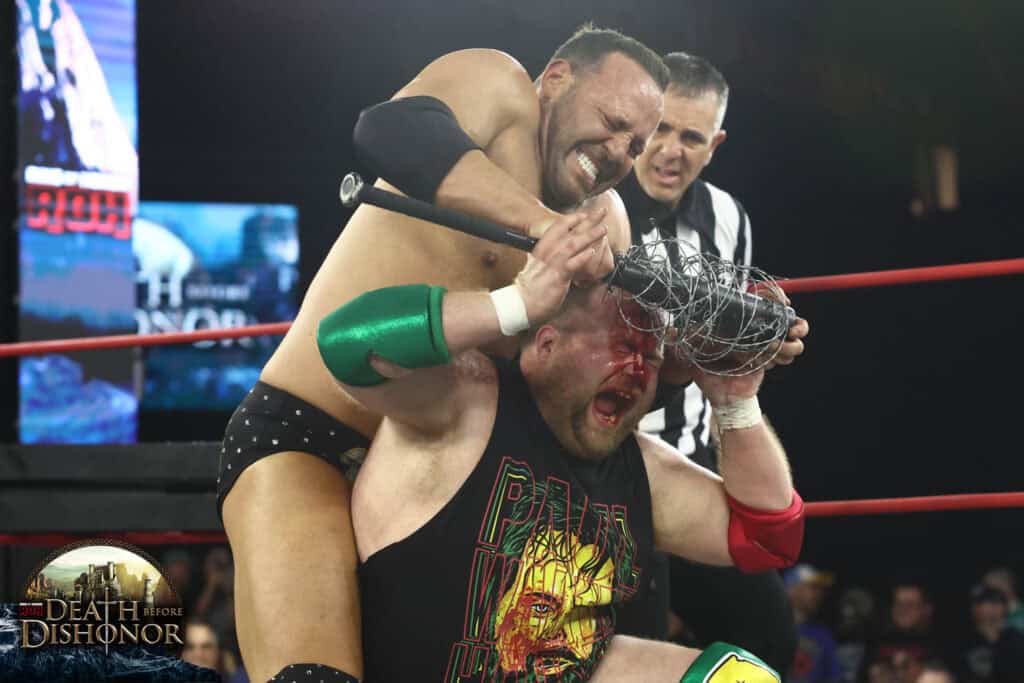
Credit: Ring of Honor
“It was fun working with Eric in Major League Wrestling,” Hauser shared. “I think we just had a mutual respect, where he was like, ‘Hey, you’re a legitimate, great actor,’ and I’m looking at him like ‘you’re legitimately one of the 10 people responsible for the wrestling boom in the nineties, with some great storylines and programming.’ We just had a great mutual respect for each other.’”
Speaking of respected announcers from WCW, Hauser said that meeting and working with AEW commentator Tony Schiavone was a bucket list move in its own right. Hauser actually got to call a match with Schiavone in August of 2025.
“The relationship that really blows my mind to this day is Tony Schiavone,” Hauser beamed. “He and I have grown a bit closer and I’m friends with his daughter, and we see each other around a lot, a couple times of year. And that’s just…he’s the voice of my childhood, you know? Even before Jim Ross, Tony Schiavone was my guy. So being friends with him and getting to call Collision with him and Nigel McGuinness – that was a top five moment in my wrestling career, and I wasn’t even in the ring.”
Another top five moment, Hauser shared, happened in Ring of Honor, which is owned by AEW’s Tony Khan. It happened on August 29, 2025 at Ring of Honor’s pay per view, Death Before Dishonor. In that show, Hauser took on AEW wrestler QT Marshall in a “Fight Without Honor.”
It was, arguably, the most memorable match of Hauser’s career. He and Marshall had a brief feud leading into the match but, judging by the match itself, you’d assume that the two were in the middle of a blood feud. They wrestled for nearly 20 minutes. There were tables, ladders, and chairs, oh my. There was glass. There were thumbtacks. But there were wrestling moves, too. There were hip tosses and Russian leg sweeps and headlock takeovers. There was, truly, something for everybody and it was the dream of a lifetime for Hauser (and for Marshall).
“I really enjoyed that match,” Hauser reflected. “It was a proving ground for me to do something a bit more violent, and it was in the 2300 Arena, which is known for such matches. I think I did the company proud. I think I showed up and I’m proud of how it turned out.”
Hauser said that being able to wrestle in the 2300 Arena, the former home of both Extreme Championship Wrestling and Ring of Honor, was the experience of a lifetime.
“It was absolute bucket list, dream-boat type of stuff,” he said. “I was a fan of ECW, though I’m sure I didn’t play it when my parents were in the room. We were trying to honor the building and honor Ring of Honor in its recent history. ROH is known as a company full of great technicians and high flyers, and we’ve seen so many epic matches and brilliant performers. It’s the place where Kevin Steen and El Generic had a ladder war. It’s where you saw guys like Homicide and Eddie Kingston do battle. So I was really trying to give something that felt new, but familiar.”
There was nothing familiar about seeing a 300-plus pound, Emmy award-winning actor get powerbombed onto a pile of thumbtacks. There was nothing familiar about seeing that same actor perform a super kick. But the match, itself, was something to behold. It was something to take in. And it was a match that both men should be absolutely proud of.
That match, if no other, demonstrated what Paul Walter Hauser wanted to do. He didn’t want to just be an actor that showed up, threw a hiptoss, and got nice words written about him because he didn’t embarrass himself. Hauser wanted to learn. He wanted to hurt. He wanted to wrestle, goddamn it, because how dare he come into this world and not try his absolute hardest. That was the attitude that he had, in that match and in every single other match he ever wrestled.. And it earned fan’s respect.
They started to chant. They chanted his name, of course. They chanted ‘Holy Shit.,’ because of course they did. They even chanted ‘Fight Forever.’ But it was one chant in particular that he pays the most attention to, that he holds closest to his heart. He didn’t even notice it, immediately. Not during the match, anyway. He was too busy fighting for his life. But he heard it after.
“I don’t even know if it registered with me during the match, because I was so tunnel-vision focused on the finish at that point,” Hauser said. “And I didn’t do the finish perfectly, like I wanted. I wanted to get some more air. But I think I was too gassed up and I just collapsed, taking the cutter on the table. But I remember my videographer, my buddy Caleb Wall – he’s my camera operator and producer on this documentary I’m making about my wrestling journey; we’ve been collecting footage for over two years – he came up to me and told me after that match that he started getting choked up when then started chanting it.”
Hauser said he, too, got choked up when he was told about it. He got choked up again, just remembering it.
“That’s when it hit me,” he said. “When he said that, I was like, ‘Oh my God.’ It wasn’t provoked by anything I said or did. It wasn’t a proving ground that I thought was being voiced. But for them to say that, and do that, that was pretty cool. That’s probably a top three moment in my short wrestling career.”
The chant itself was nothing special. It was three words, four syllables. But for Paul Walter Hauser, it meant so much more. It was affirmation. And for a big kid that was never very athletic, affirmation goes a long way. It was recognition; recognition of how much time he put into being a wrestler, how much work he put into it. It was the recognition that he was more than just a “celebrity performer” who showed up to cash a check and play big-time babyface. It was more than that, for Hauser. It’s always been more than that. It was ammunition. It was exactly what he needed, when he needed it – not just to finish the match he was currently in, but to keep wrestling, period; to keep going down the roads, to keep fighting for his dream. For PWH it was a chant that changed his life, and reminded him that he was doing everything he could be, should be, would be doing. He’s a lot of things. An actor, a writer, a producer. He’s a husband. He’s a father and a friend. He’s a Christian. He’s a lot of things to a lot of people, but the crowd knew what he really wanted to be, for more than 30 years. Three Words. Four Syllables. The sweetest words that Paul Walter Hauser could ever hear.
He’s a wrestler.