

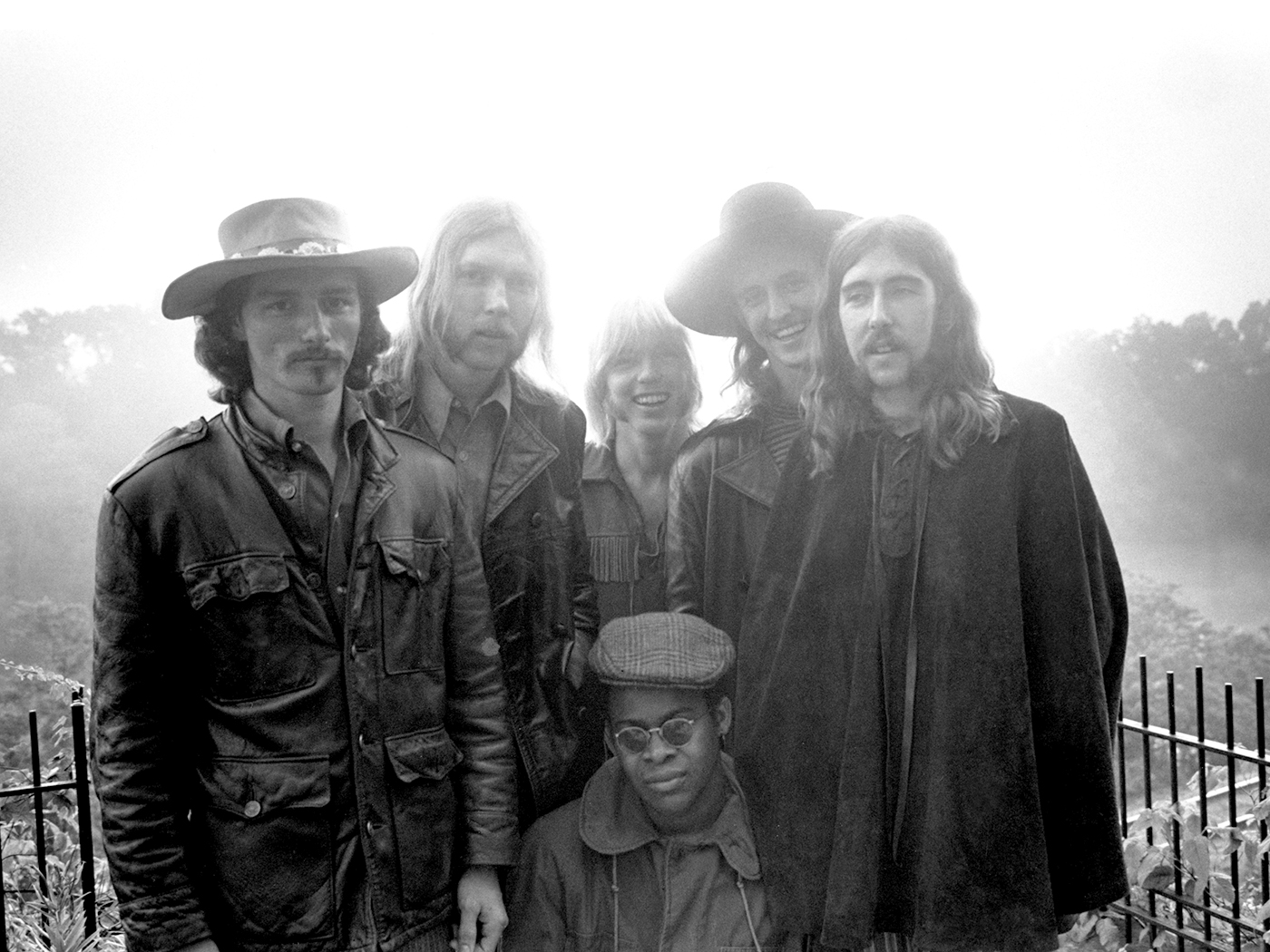
Originally published in Uncut Take 165 (February 2011 issue)…
It had been an auspicious day for Duane Allman. After more than two years of non-stop touring, he had received and cashed his first royalty cheque, for a useful $5,000.
As dusk was closing in over Macon, Georgia, he left The Allman Brothers Band’s Big House and swung his beloved Harley Sportster, Melissa, onto the highway. Just minutes later, according to news reports, he swerved to avoid a truck and lost control of his bike. It flipped over, pinning him beneath it, sliding down the roadway for 50 feet.
Following some distance behind, Allman’s girlfriend Dixie Meadows and Berry Oakley’s sister Candy found him lying motionless on the asphalt and stayed until an ambulance arrived. After three hours of emergency surgery at Macon Medical Center, he died that night; Friday, October 29, 1971. He was just 24 years old.
At the funeral the following Monday, the rest of the band played a bunch of the songs they’d been performing with their fallen leader during the previous two years – “Stormy Monday”, “In Memory Of Elizabeth Reed” and “Statesboro Blues”. Delaney Bramlett led the crowd – including Dr John and the entire Muscle Shoals rhythm section, with whom Duane had done so many memorable sessions – in a tearful rendition of “Will The Circle Be Unbroken”. Atlantic Records’ Jerry Wexler, meanwhile, delivered a heartfelt eulogy.
“Those of us who were privileged to know Duane,” Wexler said, “will remember him from all the studios, backstage dressing rooms, the Downtowners, the Holiday Inns, the Sheratons, the late nights, relaxing after the sessions, the whiskey and the music talk, playing back cassettes until night gave way to dawn, the meals and the pool games, and fishing in Miami and Long Island, this young beautiful man who we love so dearly but who is not lost to us, because we have his music, and the music is imperishable.”
Duane Allman’s death left the band, their adopted hometown of Macon and the entire music world in a state of shock. In a short couple of years, the Allmans had perfected a freewheeling Southern rock music that was at once adventurous and rootsy, expansive and downhome. Their gigs, epic intuitive jams where single songs would roll on for hours, were already the stuff of legend. And Duane himself, their driving force, had swiftly become a pyrotechnic, soulful guitar superstar. It was reasonable to wonder how they could possibly continue without him.
“When he died, the idea of just walking away crossed my mind,” says Gregg Allman, the band’s singer and Hammond B3 player, and Duane’s younger brother by one year. “But I figured, if I don’t keep playin’, I ain’t gonna be worth a shit. It’s hard to believe the chops he had at that age, and how much of a fucking footprint he left.”
The band had taken shape during an impromptu jam two-and-a-half years earlier, in Jacksonville, Florida. “Duane started this band in March ’69,” says drummer Butch Trucks. It’s autumn 2010, and the Allman Brothers Band are heading out on the road once more with a lineup that includes original members Trucks, his fellow drummer Jaimoe Johanny Johanson and Gregg Allman, with Butch’s nephew Derek Trucks and Warren Haynes (who also stands in for Jerry Garcia in the Dead) trading off on lead guitars. “From the start, we were locked onto the knowledge that we were on to something new, intense and exciting, before Gregg even got there. It was the five of us and Reese Wynans, a keyboard player who went on to play with Stevie Ray Vaughan and Double Trouble. But he was in the band Dickey [Betts, guitar] and Berry Oakley [bass] were in [The Second Coming].
“He played organ, and we got into this jam that started out as a little shuffle and lasted about two hours. And I mean, it just went everywhere. We were all playing so far above any level that we had ever played before, and all this communication was flyin’ around. We finally finished, and I’d been through all these changes of chill bumps and tears, just feelings that I’d never felt before. I looked over at Jaimoe and I said, ‘Man, did you get off on that’? He just smiled. Then Duane walked to the door and said, ‘All right, anybody in this room who ain’t gonna play in my band, you’re gonna have to fight your way out the door.’
“Duane was this messianic character,” Butch continues, “and if I hadn’t met him, I’d probably be teaching math at some junior high school. He reached inside me and flicked the switch that turned me on. He just completely changed my whole attitude about music, life, everything.”
After the nascent band’s collective epiphany, “my brother called me up in LA and told me to get my ass back to Jacksonville”, Gregg Allman recalls. “He said, ‘I’m tired of bein’ in the studio. I got this black guy Jaimoe and Butch Trucks to play drums. I got a hell of a bass player, and with him I got a lead guitar player. I’m gonna send you a plane ticket.’ I said, ‘Don’t do that, man. You ain’t got the dough. I’ll just hitchhike.’ He didn’t want me to hitch ’cos that’s how our dad was killed. But I got a ride all the way.”
Gregg got dropped off, and Duane took him straight to the dilapidated Victorian house where the band were crashing and rehearsing. “They blindfolded me and led me into this room, and there was this brand-spankin’-new 1969 Hammond B3. They said, ‘We’ll see you in about a week. You learn all you can.’ And there was a boombox and all kinds of cassette tapes. After I’d been there a couple days, we went straight down to this makeshift studio and cut ‘Dreams’, and even then it sounded just like it does today. We’d hit this spontaneous shift and we’d all look around at each other and go, ‘Whoa, where did that come from?’ We just flat knew. So I was in, dig? I belonged. Boy, it felt so good. The next week I wrote ‘Whipping Post’, ‘Every Hungry Woman’, ‘Blackhearted Woman’ – I was just spittin’ ’em out. Most of the first album I sat there and wrote in the third storey of that house.”
Butch picks up the plot. “So we got this band going with those kind of feelings and with absolutely no expectations of making any money. Atlantic Records was telling us, ‘You gotta be kidding. A bunch of white guys just standing there playing – forget it. Get that blond-headed kid out from behind the organ, stick a salami down his pants, let him jump around onstage and maybe you got a chance.’ But we just went, ‘Fuck it.’ We didn’t care, we were havin’ so much fun playin’ this music. We were going back and using the blues and rhythm and blues, and then looking for new horizons. Jaimoe turned us on to Trane and Miles. I mean, ‘Dreams’ is ‘My Favorite Things’. ‘In Memory Of Elizabeth Reed’ – what rock’n’roll band was playin’ that kind of stuff?
“We were also taking a lot of acid and any other mind-altering things we could find, and that opened us up to be able to go for it. We were stretching the limits of what had been done in rock’n’roll. There’d be a very loose structure, but for the most part it was wide open to do whatever the fuck you wanted to do. Half the time it’d be a trainwreck, so we’d shut it down, let it drift around for a while and eventually we’d find something that would click, and it would take off.
“And that weekend in March of ’71 when we recorded At The Fillmore East, most of the time it clicked. We were finally starting to catch up with what we were listening to. We had lived together, fucked together, done drugs together, got in trouble together; we all just moved as a unit. And then, when we got onstage to play, that’s what it was all about – and it just happened to all come together that weekend.”
“We were not the closing act for that weekend,” Butch points out; “we were the special guests for Johnny Winter, which meant that, if things had stayed that way, we would’ve only had 90 minutes to play, and some of our songs lasted that long. And believe me, Bill Graham was a stickler. But Thursday night, after we finished playin’ – and this was like our sixth or eighth time at the Fillmore – about half the crowd got up and walked out. And Johnny Winter’s manager went back to Bill Graham and said, ‘Well, I don’t guess Johnny’s gonna be closin’ for the Allman Brothers any more.’ So we flipped with Johnny and got to close and play as long as we wanted to, at least on the late shows.”
The four remaining shows would be recorded by veteran Atlantic engineer/producer Tom Dowd, who’d not only produced the Allmans’ second album, Idlewild South, but also the sessions for the Derek & The Dominos project, putting Duane together with Eric Clapton for some mind-blowing extended guitar duels. That LP, Layla…, dramatically backed up those who’d been calling the upstart Allman Brothers Band the most exciting live act on the planet, and its little-known 24-year-old leader a fiery six-string virtuoso to rival Clapton, Beck and Page.
Dowd and Atlantic, consequently, wanted to put out a live album to capture a skilled and adventurous band in full flight, the two guitars circling each other like killer falcons, stretching the material into thrilling, electrifying shapes. No matter that the Allmans had yet to tackle most of their live material in the studio – this band wasn’t about the studio. “If we could just get people to come out and see us,” Duane Allman told me on the Friday afternoon, before their first pair of headlining sets, “I know they’d like what they heard.”
By the end of June 1971, the Allmans were back at the Fillmore, the night before the venue closed down. “That may have been the greatest night of music of my life,” says Trucks. “We came onstage around midnight and played ’til seven or eight in the morning. ‘Mountain Jam’ was the encore, and the damn thing must’ve lasted three or four hours. Everything I went to play that night, two or three guys in the band were already playin’ it. We were all so absolutely in the same space at the same moment, and that audience was right there with us. When we finished playin’, everyone just sat there. Then someone opened the doors, the sun came pourin’ in, and people started quietly leaving. Duane was walking in front of me, dragging his guitar behind him. He said, ‘Goddamn, it’s like leavin’ church.’ That night was the epitome. And it wasn’t but a few months later that Duane was dead.”
“Record sales took off right after the funeral, man – they hit the sky,” Gregg says. “At first I thought Duane really got short-changed.” The Allmans somehow managed to keep going as a five-piece, with Dickey Betts the lone guitarist. Brothers And Sisters, the first album completely recorded without Duane, was the band’s first LP to top the US charts. Meanwhile, Duane’s spirit had spread across the South like a storm off the Gulf of Mexico. Lynyrd Skynyrd, also out of Jacksonville, wrote “Free Bird” about him, Gary Rossington playing that unforgettable slide solo on his own vintage Les Paul with a Coricidin bottle on his finger, just like Duane, in an act of devotion as well as emulation.
On November 11, 1972, Berry Oakley would die in an eerily similar motorcycle crash, three blocks from the spot where Duane had crashed. “For that entire year,” Butch recalls, “everybody had been floundering around, Berry especially – he just couldn’t be in a world without Duane Allman. It hit him so hard. I mean, it devastated all of us, but Berry most of all. He was this kind, genuine, loving person who couldn’t believe that this could happen. And every once in a while, when it started hittin’ him, he’d get fucked up ’cos he couldn’t deal with the reality of it, and it just got worse and worse. When he had his accident, as hard as this may sound, it was almost a relief. The pain was gone.
“Then, the next few years, we started makin’ a living, all the success came, and it went from a rock’n’roll fantasy to a fucking nightmare. Those three years we were the No 1 band in the country I spent drunk – I don’t remember a thing. Fortunately, in ’75 I met a woman who had the guts to tell me what an asshole I was. Then, in ’76, it all fell apart – it had to.”