

The disenchanted soldier holds the key to this anti-war Homer adaptation.

Courtesy of Universal Studios.
The debate over the accuracy of Christopher Nolan’s latest offering to the IMAX gods, The Odyssey, has started long before the film hit cinemas this weekend. Yet, despite all the backlash, it’s a character who isn’t even mentioned in the Homeric tale who holds the writer-director’s anti-war manifesto together, saving it from being a sauceless, grey adaptation of the most vivid homecoming in classical literature.
The fidelity discourse has accompanied The Odyssey’s every marketing step since 2025. First came Matt Damon rocking a historically inaccurate boar’s-tusk helmet as Odysseus after the first-look images were released last year, then the movie’s supposed modern language was slammed when the extended trailer landed in May.
The clip came under fire for Robert Pattinson’s freaky take on Antinous as Penelope’s (Anne Hathaway) suitor taunts Odysseus’s son, Telemachus (Tom Holland), about pining for a “daddy” he never knew. The Tenet star’s Antinous is possibly the most hilariously pathetic, so-bad-he’s-good villain in Nolan’s ‘Hollywood does Ancient Greece’, with his performance standing out as deliciously amusing.
Still, it’s Elliot Page’s Sinon, a soldier grown up during the Trojan War and fully committed to the cause, who delivers the fatal blow, exposing the cracks in Damon’s heroic Odysseus. And no, there’s no trace of him in Homer (although he did appear in Virgil’s The Aeneid).
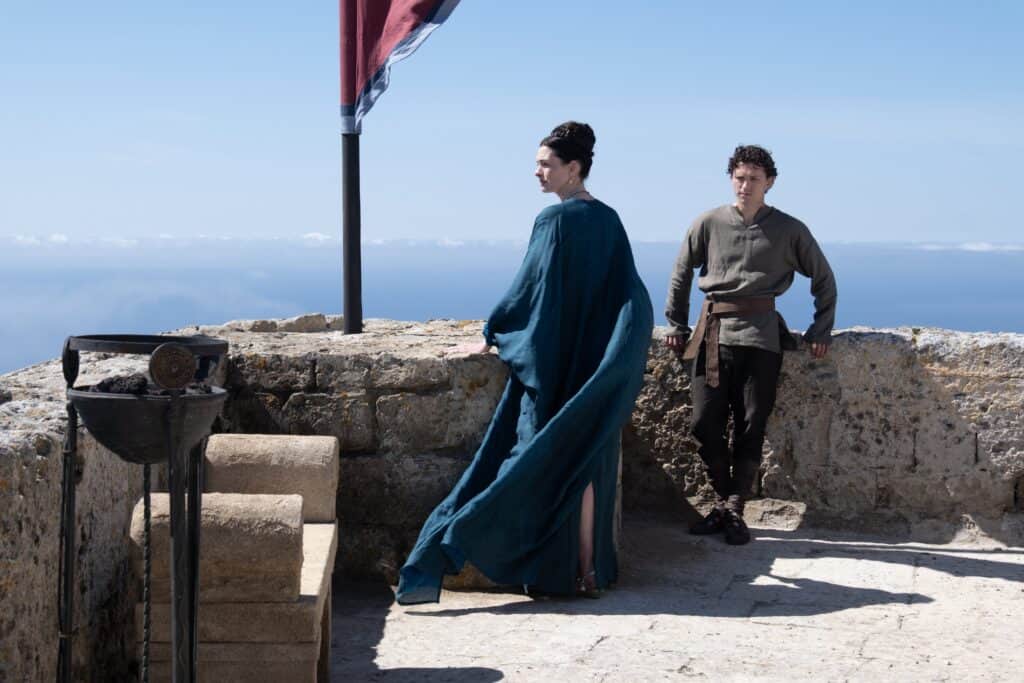
Courtesy of Universal Studios.
Damon comfortably wears his all-American hero screen persona like a cape, with Nolan’s Odyssey seeing its protagonist shed any layers of cunning he possesses in Homer’s original — whatever that means for a story that was performed orally for centuries as its only way to be passed down to the next generations.
Nolan’s King of Ithaca is a sound man, brave veteran, and loyal husband to Penelope. Most importantly, he’s a reluctant warrior who’s weighed down by his own crimes throughout his journey. And that’s the most significant departure from the Homeric epic.
Years after the Trojan War ended in unspeakable destruction, Odysseus opts to take the scenic route home, an ill-fated decision condemning his crew to certain death. Meanwhile, his wife Penelope is fending off suitors who’ve installed themselves in her palace, delaying the moment she’ll have to remarry to secure Ithaca’s stability.
As her son Telemachus sets off for Sparta on a mission to find his father, Nolan’s film relays the hero’s years-long ordeal in a non-linear narrative that drags along till a spectacular third act.
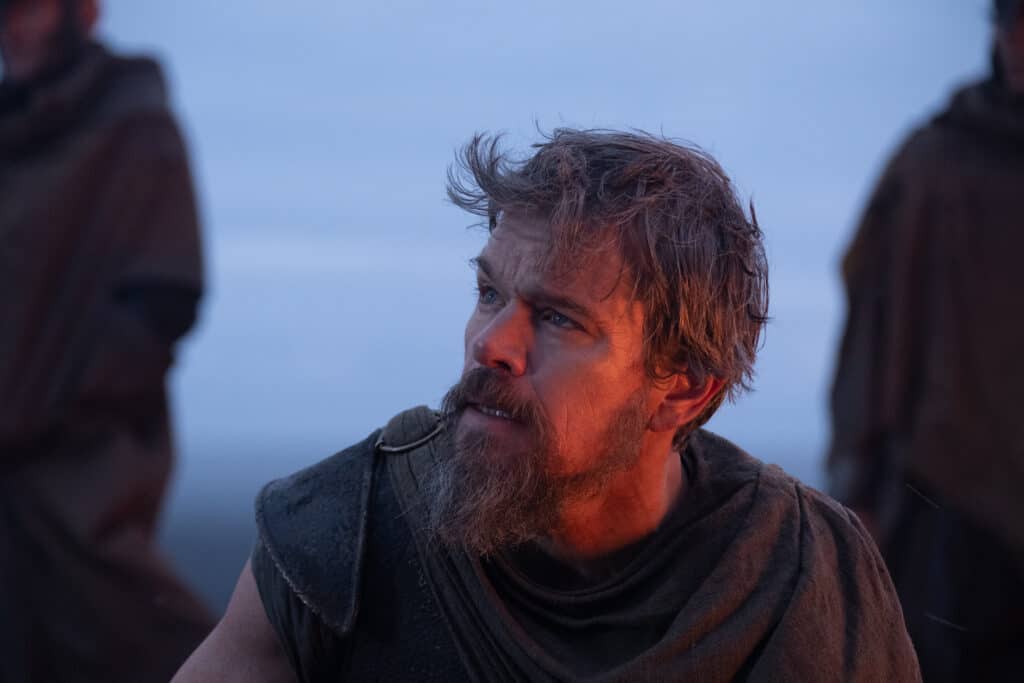
Courtesy of Universal Studios.
His smug confidence shattering at every hurdle the gods put on his path, Nolan’s Odysseus steers from Homer’s as he grapples with survivor’s guilt and PTSD stemming from a conflict he didn’t even want to fight in the first place.
A third chapter in Nolan’s unofficial no-war trilogy, The Odyssey follows in the footsteps of Dunkirk and Oppenheimer by spinning Odysseus’s journey with a decidedly moral approach to the end of a civilisation and the not particularly innovative reveal that the real enemy is the one smiling back at you in the mirror. Here, Zendaya’s firm Athena accompanies Damon’s protagonist with her stern gaze, a visual reminder of the consequences of his actions.
Nolan tweaks some elements to fit the message — we won’t spoil the ending here — while maintaining Homer’s most exhilarating events virtually untouched, with the grand finale of this nearly three-hour-long voyage being the most conventional, and the most rewarding.
This is a movie about manhood filtered through a present-day sensibility, but also features an array of women who are as strong-willed and flawed as Odysseus — and that’s more than can be said for any other film Nolan has written before.
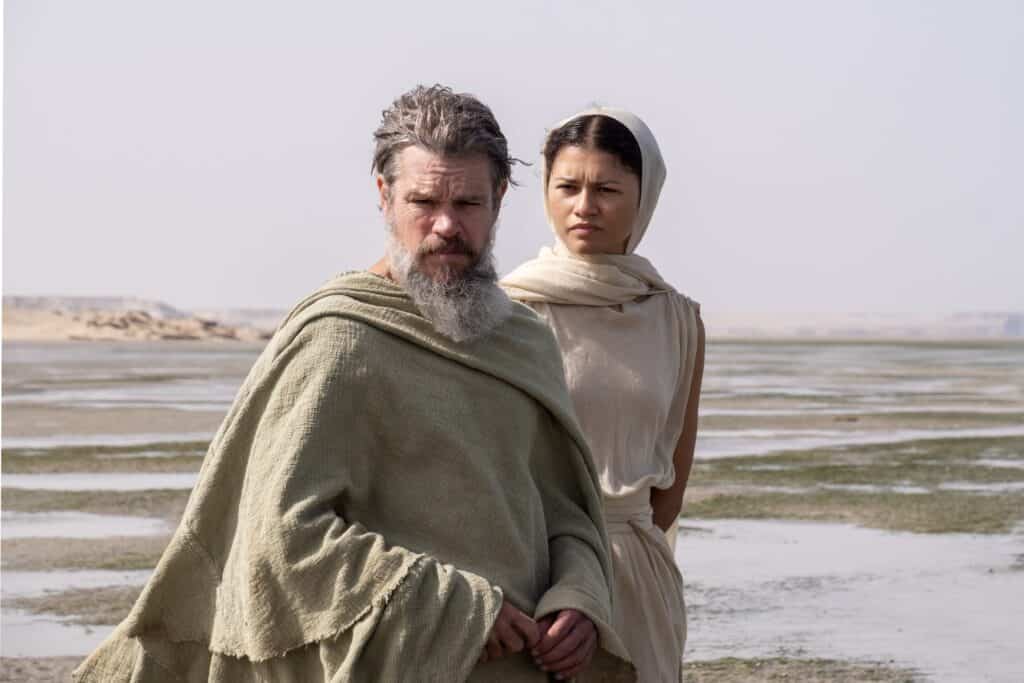
Courtesy of Universal Studios.
Lupita Nyong’o steals every scene she’s in as Helen and Clytemnestra, each bearing the literal and figurative scars of men playing gods. The filmmaker doesn’t romanticise Odysseus being coerced into a relationship with Calypso (Charlize Theron), though he cuts his dalliance with Circe, here played by Samantha Morton. The witch remains a powerful, all-knowing ally for the protagonist, with the pig transformation scene emerging as one of the most horrifying sequences in the movie and a rightful callout of toxic masculinity.
In this study on what it means to be a man, Nolan entrusts Page’s Sinon with a crucial arc of disillusionment with performative violence. Tricked into delivering the horse that would win Agamemnon (Benny Safdie) the war, Sinon, unlike his Aeneid equivalent, has no clue that Menelaus (Jon Bernthal), Odysseus and his men are hidden inside, waiting for nightfall to strike, burning Troy to the ground and killing its people.
Betrayed by the man he’s looked up to his whole life, Sinon haunts Odysseus in this world and the one under — and will likely haunt audiences too as the film’s tether to our present.
As Nolan concludes that mistakes are bound to be forgotten and history to repeat itself, Sinon’s plea to remember becomes the most impactful, rageful prayer in an otherwise lukewarm adaptation that is content to swim in shallow waters.
The Odyssey is in cinemas now.