

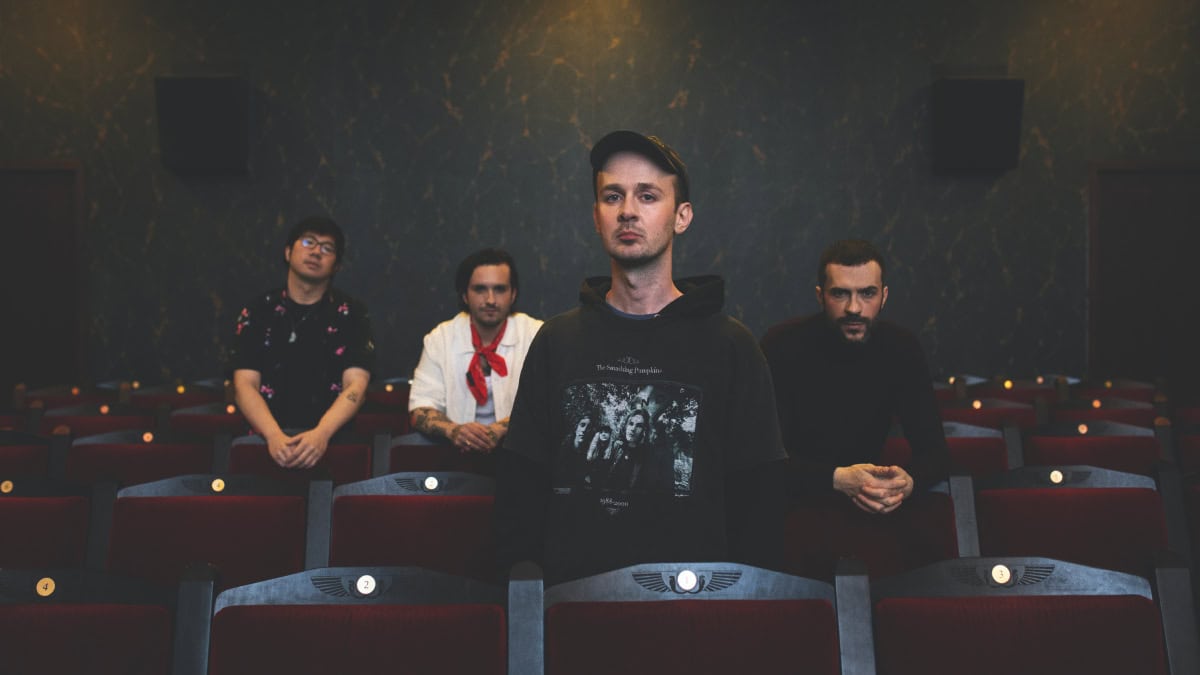
There’s a clock tower in the South of France that Mathias Court could see from his bedroom window as a child. It shouldn’t have anything to do with a month spent screaming into walls of feedback in a freezing Philadelphia January, but that’s the strange geometry of Rita,the fourth album from French rock four-piece Paerish, a record about Mediterranean summers built entirely in the snow, and comfortably the loudest, most restless thing the band has ever put its name to.
It lands on October 16th, produced once again by Will Yip. And when Paerish’s frontman sits down to talk about it, the first thing he wants to do is look backwards.
The country that was listening all along
You’re In Both Dreams (And You’re Scared) did what good records do: it moved the band somewhere new. Chiefly, it moved them to America, properly, physically, for the first time.
“Even though we’ve been recording quite a few albums in the US now, 2024 was our first time touring the United States,” Mathias says. “So we finally got to see the country that has been streaming us the most since 2016.”
There’s a quiet absurdity in that gap, nearly a decade of being heard by a country you’ve never played to. And having spent their early years gigging mostly in France, arriving in the place their record collection came from was disorienting. “To go to the country [America] where all our influences come from, it’s crazy,” he says. “You go to the merch table, and any person in the audience can tell you your influences. Straight away, it’s very simple for them, because if they want to talk to you about Sunny Day Real Estate, it’s very well known over there, which in France, no one knows about.”
They crossed something like 30 states. “We saw places that we never thought we could see,” he says, describing it as “an incredible moment to live with your bandmates and brothers, basically.”
The weird thing, though, is that America made him feel more European rather than less. “The more time I spend in the US, the more I love playing shows over there, but the more it makes you feel connected with fellow Europeans around you. Especially with Germany, UK, Italy, Spain. I realised how the European mentality, we’re not that different from each other, because we’re actually super close. I felt super grateful for that when I came back to Europe and France.”
A French coming-of-age story
Rita is a memory record, and it didn’t arrive by design. Mathias wrote a staggering volume of material for it, somewhere between 50 and 60 demos, and the more he wrote, the further back he travelled.
“The more I was writing these 20, 30, 40, 50 different songs, the more it brought me back to childhood feelings of being in the South of France with my parents, being next to the coast, and as a teenager wanting nothing more than to become a songwriter, listening to bands while looking at the Mediterranean.”
He hadn’t fully interrogated why until this conversation, and the answer he arrives at is defensive rather than nostalgic. “Maybe it’s because of the world we live in, and with everything that’s going on right now. My creative process goes more and more into digging into childhood to somehow protect me from that, and to find honesty, in the world of social media and AI and being an influencer. The thing that inspires me the most is to come back to that state of mind where none of that existed, and I was just a 13-year-old apprentice guitar player, just wanting nothing more but to write songs. And it was so freaking hard for me back in those days, looking at the coast and being like, ‘Damn, I just want to write songs, but it’s hard.’”
Underneath it sits a very European envy of American myth-making. “We grew up with American movies that occur in California, and I wanted to have my own California memories, which are the French Riviera,” he says. “Bands like Weezer, and the Beach Boys, they romanticise it so much that I envy that passion they have for their own place.” So there is a film running behind Rita, but “it’s a movie about the French Riviera and being a kid, a coming-of-age story like you can see in the U.S. But I wanted a French one, even though it was recorded in the US.”
Paerish have long buried film and video game references in their work: “it’s our little game,” he says, “always a good icebreaker at the merch table with fans.” The John Carpenter nod on “Prince of Darkness” was both tribute and self-mockery. “It’s one of my favourite movies ever made. It’s about toxic work relationships where I felt very left alone by toxic colleagues. So I kind of felt like a demon to them, like a Prince of Darkness. That’s a joke I’m making to myself.” This time, he says, the references are fewer: the only real film is the one in his head.
The fear of stopping
The album’s emotional hinge is “Vapor Cloud”, the last song written for the record, and, he notes, one nobody had asked him about until we raised it. It’s about watching creativity quietly leave the people you grew up with.
He wrote it in a bleak frame of mind, in the very ordinary uncertainty of a band where everyone has a job. “It’s always like, are we gonna make that album? Is it gonna be impactful? Are we actually gonna fly again to the US to Will to make an album? And being pretty stressed out.”
From there it widened. “Some people I knew in our 20s, they were all having bands, and even though they’re all having different careers right now, it feels like creativity is gone somehow. Like no one’s trying anymore. It’s not just a matter of having a band, just the pleasure, the journey itself should be interesting.”
He’s careful with his caveats. People who start families are exempt, “it’s another business and art by itself.” The friends he’s thinking of are musicians, but also “aspiring actors, stand-up comedians in Paris, people I still know to this day and still love and see regularly,” and he’s emphatic that he still has “so much faith and hope” in them.
And he’s equally careful to turn the accusation back on himself. “It’s like a mirror song, where I’m looking at my friends who I think can still be amazing artists and still have to try, and at the same time, it made me look at myself in the mirror and be like, are you going to stop being creative at some point? Is it going to happen to you? Is it this album where I’m gonna be like, after this one, I stop?”
AI, inevitably, shadows all of it. “People want instant results, clicking on a fucking button and having your song straight out of the oven, which is horrible.”
Built to bounce
Practically, Rita is the sound of a band watching a crowd and making a decision. With 50-odd demos on the table, there were two roads out of the last album. “I could either have gone even slower, with drum machines, less distortion,” he says, “or I noticed I had at least 15 to 20 super bouncy songs.” He took the lot to the rest of the band, fresh off two US tours, and asked.
“Sometimes you can see in the crowd that people actually want to start moving and jumping, but maybe because of a BPM kind of thing, our songs from the previous album didn’t allow them to make that move.”
The other data point was French metal, now “bigger than ever”, and a support slot with Landmvrks that clarified something. “When people want to get out of their apartment to go to a show, sometimes they want to feel a super strong energy. If you keep on doing slow shoegaze songs, people are not going to be as receptive to the idea of going out in the cold in Paris, buying a ticket and supporting a band. That metal scene is becoming so big because they go to a show and they know they’re gonna be punched in the face musically.” Everyone agreed: “with these bouncy songs we can bring a real live show, and it can make a difference. And also, after this slower previous album, it felt like a fun time.”
One month, no days off
The recording matched the ambition, and then some. Previous albums took three weeks; this one took a full month, dictated partly by Will Yip’s availability, in his brand-new studio in central Philadelphia rather than the suburban room in Conshohocken where the Title Fight and Turnover records were made. It was winter, in the snow, and there were no days off at all, save Christmas and New Year’s Eve. “Those two days off felt really good,” he says, “especially for my voice.”
As both singer and guitarist, he never left the building once. “In the morning it was hours of singing and drinking hot water, doing exercises, and then right after that, just layering feedbacks and fuzz guitars and having huge fucking feedbacks in my head all the time. It was a bit exhausting.” Drummer Loïc and bassist Martin, who also directs the band’s videos, got out more; Mathias didn’t. “I was super stressed out. I was coughing a little bit. I got just a little bit sick.”
It’s also his most extreme vocal performance. “I’m screaming a little bit, especially in songs like ‘Wait For Dark’ and a bit of ‘Vapor Cloud’. I’m a bit angrier than usual.”
The irony isn’t lost on him: an album about family, childhood and a clock tower in the South of France, made in enforced separation from all of it. “Not seeing the parents was a bit hard for me, because of all four guys, I’m the one who’s the most attached to his family.” But turning down a third record with Yip was never an option: “He’s the best. He’s such a genius.” The result, he says, is “a very intense album in every aspect.”
Saying goodbye
Seen from here, the acoustic EP that preceded Rita reads as a deliberate farewell. It was recorded in an old church roughly thirty seconds from his parents’ house in Soissons — the same house where those songs were written during COVID, before being taken to Philadelphia to be recorded properly.
“So it was going full circle,” he says, “with extra musicians who are super-talented, playing the flutes, playing the bouzouki. It was so incredible.” He’s careful about the framing, “I don’t know if it’s a way to kill our previous album” — but lands on it anyway: “it’s definitely a way of saying goodbye to the era of You’re In Both Dreams (And You’re Scared), because it definitely was our slowest and heaviest album to this day.” By then the new songs already existed. “I was already prepared for more screaming, more feedback, more fuzz.”
It was also a statement of range, with MTV Unplugged as the model. “Bands like Alice In Chains or Nirvana can have such powerful acoustic live sessions, and at the same time they can still go back on stage and scream super loud, trash their guitars and just go fucking mental. That was me wanting to showcase what Paerish could do, both things, having such a big gap between the two.”
Music as shelter
Paerish all still work, Martin as a director, Loïc as a lawyer in the music industry, and our question about how you keep the spark lit past 35 produced the best moment of the interview, arrived at after a long pause hunting for the English word.
“It’s my shelter. I found it,” he says. “I used to treat music like it was my biggest drive and passion and obsession. The more time goes on, the more I feel like music, and maybe art, should be treated as a shelter, especially these days. This is something I’ve been thinking about just really recently. So maybe, Dom, you’re the first one to hear about this.”
In practice it means a non-negotiable daily routine, before the day can get to him. “I still wake up super early every morning to do my creative process. You make your shit tonne of coffee, you get prepared and you just jump straight to it. It makes you feel invincible for the rest of the day. It’s a protection for the rest of the stuff that’s going to happen to you. It’s not supposed to be a burden that you can get rid of by clicking on a pseudo button, it’s supposed to be your shield, your shelter.”
He admits it’s lonely work, watching others settle for “that nine-to-five and forget about how creative I was in my 20s.” But audience size, he insists, is beside the point: “even if no one’s read it, or one or 10 persons, it’s not the purpose. Finding who you are through this process is amazing.”
Told about Sam Forrest of Nine Black Alps, who toured the world, got the label deal, and now makes music purely as a safe space, Mathias sounded genuinely relieved. “That’s very reassuring, even for myself. I wrote a song this morning at 6am, like I try to do every day, and probably maybe no one’s going to hear that song ever. But I’m just doing it for myself, and that’s what makes me happy.” The legacy: just the songs. Ask him to define success and he’s quick to note the band don’t share a single answer, “different jobs, different purposes.” His own version isn’t a number. It’s a set of rooms.
“I’ve been able to have people cheering and singing the songs in Mexico City, Los Angeles, or Leeds. It still drives me nuts to this day, because I wrote these songs in the same bedroom in my hometown of 20,000 people in the north of France, where I never thought a French guy from a small French town could have music that resonates with people.”
His read on the content economy is generous but unambiguous. “So many artists through social media are becoming huge, but it’s mostly about their image. They’re super young, ready to embrace the whole TikTok thing, and it’s great for them — they understood perfectly how it works. But sometimes I don’t really think the songs are that interesting. Nowadays music is considered to be like 10 or 20 percent of the final product, because you need to be an actor, a director and editor of your own content, and you need to be funny with your microphone. We’ve been trying that too, and it’s fun, but the more I do that, the less I think about music.”
What he wants written on the band instead is simple. “I just want people to notice that Paerish is a song band. That’s all that matters to me.” Three albums with Yip is, to his mind, the evidence: “We just want it to sound good, and to sound good forever — to have this level of production quality that’s gonna live a long time. I want people to listen to these albums in maybe 10 or 20 years and be like, ‘Damn, that fucking rocks. What the fuck, it’s from France?’”
He’s proud of the shape of the discography, too, including a debut recorded in Glasgow that he describes as “very UK”, and of the fact that “no album is the same one, but you can still recognise the band.”
Then comes touring, which was the point all along. Rita is, he says plainly, “an album that’s been made for touring purposes,” with Europe and above all Britain at the front of the queue. “Going back to our real, dear and cherished UK, we love the UK so much. Definitely our favourite country to play close to France. You have such a culture of rock music that is unmatched. France is good for other reasons, but the UK is miles ahead.” The US, South America and Asia are all on the list: “everywhere, basically.”
A record about being 13 and staring at the sea, made by a man in his mid-30s terrified of the day he stops. On this evidence, that day is some way off.
Rita is out October 16th.