

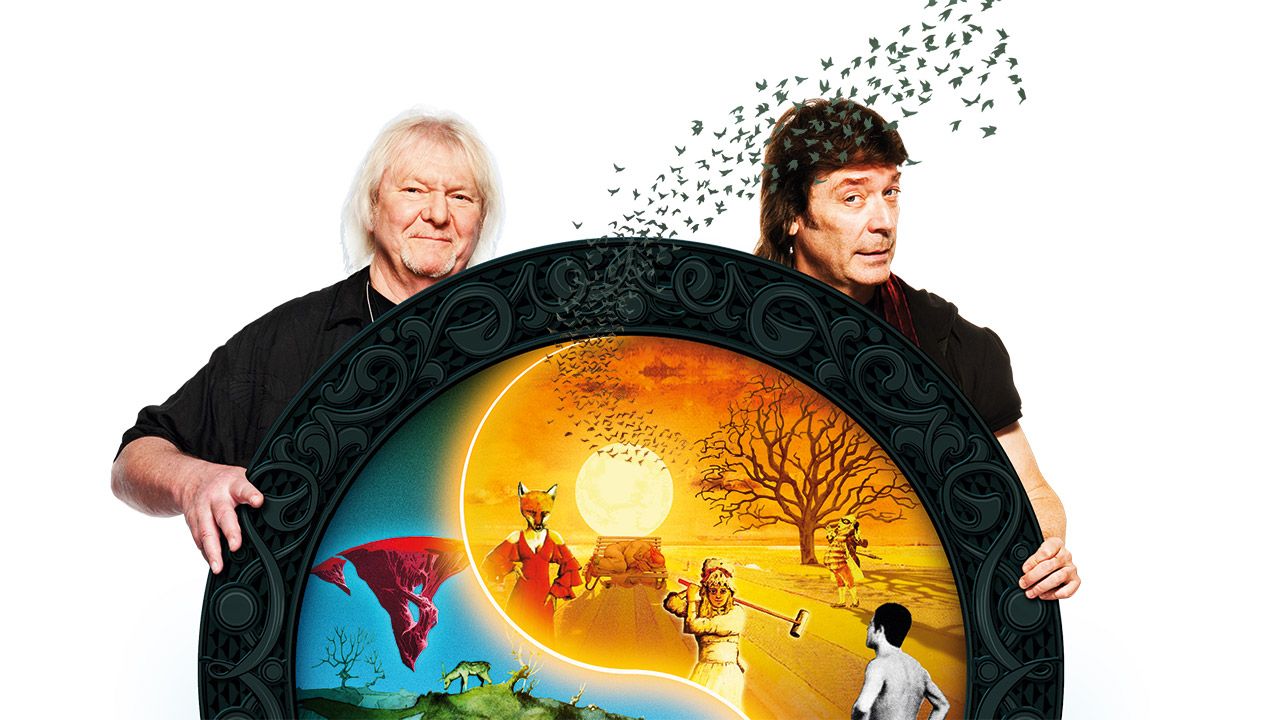
It was a long time coming, but after several years under wraps, Yes bassist Chris Squire and former Genesis guitarist Steve Hackett released A Life Within A Day – the only album they made as Squackett – in 2012. Three years before Squire’s passing, they gave Prog the backstory.
The union of Chris Squire and Steve Hackett has been mentioned in dispatches for almost half a decade. In recent years Squire has guested on Hackett’s solo albums, contributing his distinctive bass guitar to tracks on 2009’s Out Of The Tunnel’s Mouth and last year’s Beyond The Shrouded Horizon. But a full-blown collaboration between the Genesis and Yes legends has taken longer to come to fruition. At one point, Squackett looked like it would become an elusive, mythical beast – until the release of A Life Within A Day.
At just 46 minutes it might seem a modest dividend for the patience invested those awaiting this rare foray from Squire outside Yes and Hackett’s most notable collaboration since GTR (with Yes’ Steve Howe). But never mind the quantity of music on offer – just revel in the quality: A Life Within A Day’s nine tracks both surprise and delight.
Latest Videos From Louder

While they’ve never until now been in a band together, Squire and Hackett have shared history. “I first started working with Steve in 2006 on my Christmas album [Chris Squire’s Swiss Choir],” he explains. Squire’s original vision was to involve a number of guitarists on different tracks. “I was hoping to get Jeff Beck, Brian May… but everyone was busy.”
His drummer, Jeremy Stacey, suggested asking Hackett. Surprisingly, given their respective track records, Squire and Hackett’s paths had barely crossed. “I haven’t done a lot of things outside of Yes,” acknowledges the bassist. Initially he sent Hackett a couple of the songs destined for Swiss Choir. The guitarist took little persuasion. “I would have worked on anything that Chris had offered me because he’s such an icon,” he says. “When people think of bass sounds, they think of Chris.”

“What Steve did was so good that I immediately asked if he could do the whole album,” says Squire. “After that, I said that I’d be happy to reciprocate with anything he needed me to play or sing on.” As a result, he guested on Hackett’s last two solo albums. They considered writing a musical together, but ultimately settled for the more realistic album solution.
At the time, though, the bassist wasn’t actively seeking an outlet outside Yes. “I was living in London, doing the Christmas album, and Steve and I just developed a relationship.” It was uncomplicated and remarkably free of the titanic clash of egos that can bedevil such projects. “We got on easily and were able to create at a fast pace without feeling any pressure. That’s very valuable and helped move things along really smoothly.”
But A Life Within A Day has had a lengthy gestation, due to the belated return of Yes, the search for a suitable record label and simple geography. “When we started, Chris lived in this country and we were near neighbours,” Hackett recalls. “Suddenly America beckoned, and I had to put the album on hold for a while.” But the interregnum had an upside. “It meant that when we came back to it, it was all the stronger for that gap and there were things that we shifted around.”
Unusually in an age when many records are tracked by solitary musicians sending files to each other, the pair recorded most of the songs together in Hackett’s studio or at his house. “Most of it was done eyeball to eyeball,” he confirms. “I didn’t want to work in splendid isolation.”
He reports the writing sessions were painless. As a starting point he’d suggested that they pooled material, and Squire offered Aliens – which had already been performed live by Yes – while Hackett contributed Stormchaser. “I had three or four songs that I had written ostensibly for a solo project,” says Squire. “But that never happened, which is the story of my life!” In the end he, Hackett and keyboardist Roger King are all credited on each composition, with the tour-de-force title track and another highlight, Tall Ships, written specifically for the album.
Tall Ships came from Squire experimenting with a new bass and playing a sinuous, muscular riff that inspired Hackett. “It sounded like it had some swing to it,” the guitarist recalls. “Ninety nine per cent of people I‘ve worked with can’t remember the wonderful thing they’ve just played. So unless the tapes were running, you’ve had it. But Chris remembered it, and we had the rhythm which runs throughout the whole song. There was the unvarying link which provides the engine to the journey.”
He added a guitar phrase, the lyric and the chorus tune, while Squire provided the verse melody. “It was very easy to write together – a bunch of mates sat round in the living room, chipping in ideas,” Hackett continues. “It was like a giant jigsaw puzzle with three people going, ‘Here’s another piece – does that fit?’ We avoided the downside of composition by committee where people whittle each other down to the bare essentials and often end up with the lowest common denominator. That can be the downside of working with a group.”
My voice and Steve’s blend well together. That’s something I was surprised about
Chris Squire
The Squackett scenario of avoiding the dilution of ideas and feeding off but also deferring to each other was largely unfamiliar to Hackett as, since 1986’s GTR album with, he’s largely been captain of his own ship with his solo band. “I didn’t mind handing the wheel to Chris and we didn’t have too many moments where we thrashed it out,” he says. “Most of the time it was plain sailing. Occasionally we’d hit a sticky patch, but it seemed as if Chris and I had been working together all our lives.”
He cites the intensely commercial Divided Self as an example: “Chris played wonderfully and transformed it. He doesn’t just play a bass line. It must be his choral background; he comes up with another melody, counterpoint, descant, and makes it swing. He does things naturally that I suspect other bass players dream of. He plays with a guitarist’s sensibility. There‘s that sense of the size of the bass sound, but there’s also that twang and ring, so you can always focus on the bass part. It’s always clear as a bell and it’s not just all about how loud it is in the mix.”
Another striking feature of A Life Within A Day is the significant use of harmony vocals. “Chris and I are both fans of the great harmony bands – The Beatles, The Who, Crosby Stills & Nash,” says Hackett. While vocal harmonies featured prominently in Yes, they were less prevalent in Genesis. “I was often trying to steer it that way with my own stuff. We made them a raison d’être on this album.”

“My voice and Steve’s blend well together,” adds Squire. “That’s something I was surprised about, and the more we worked on harmonies the better they became.” Hackett and former choirboy Squire are responsible for all the vocals on the album, save for an appearance from Amanda Lehmann, a Hackett band regular who supplies some backing vocals, most notably on the smooth-as-silk Can’t Stop The Rain. Hackett thought that the track had an “a Burt Bacharach aspect to the chorus, so I suggested we go the whole hog and make it sound really luxurious and get some girls in. It needed something feminine.”
As the Bacharach reference suggests, A Life Within A Day contains some surprises, but it shouldn’t disappoint fans of Hackett or Squire. Hackett confirms the tempo for much of the album is very laidback, but it’s hugely atmospheric and rich in detail. There are some exceptions – most notably the frenetic middle section of the title track, which should sate the appetites of those wanting the two to cut loose instrumentally.
For years I’ve been trying to deny the fact that I love slow powerful rhythms – I thought they might be a bit soggy for people who want their rock to be fast
Steve Hackett
Any suspicions that the record might be a cynically contrived ‘GeneYes’ product prove wide of the mark. It’s not an album you might expect two such veterans to make, mainly because there was no masterplan. “It happened naturally,” Hackett explains. “We were working on a number of things for each other, and from the very first thing that Chris did on something of mine, I could see he was genuinely enjoying it. His whole body was moving. I realised that I had this top bass player – such a hero to a lot of people – giving it everything. Chris runs on enthusiasm.”
While they didn’t set out to cater to the Yes/Genesis audience, one track comes close. “The Summer Backwards is a nod to all things psychedelic and the 1960s,” reveals Hackett. “Listening to it a few days ago, I came to the conclusion that with two 12-strings and harmonies we’ve got Yes and Genesis, really. But that’s not what I was intending to do at the time.” In fact, The Summer Backwards was originally earmarked for a Hackett solo album before Squire intervened.
They drew on a wide array of reference points. Led Zeppelin influences are most apparent on Stormchaser and the title track. “It’s John Bonham meets Phil Collins meets Jason Bonham meets Jeremy Stacey meets the production values of the 1980s,” laughs Hackett. “Many years ago in Genesis, we were driving around the Shepherd’s Bush roundabout, having just driven back from Belgium or Italy with no sleep all night, and Kashmir by Zeppelin came on. We all stopped in our tracks, particularly Peter Gabriel and myself. The drums were enormous. It was Radio Luxembourg so it was probably even more distorted and strange coming to us in mono.
“It was nectar to the ears, a breath of fresh air. I loved the simple, demonic, relentless, mechanical approach to drums that just marched through time itself. It was a huge influence on Phil, Peter and me. Chriss favourite Zep track is Kashmir – surprise, surprise! In a sense it’s the model for something that can be both orchestral but minimal; something that has pauses.
“For years I’ve been trying to deny the fact that I love slow powerful rhythms – I thought they might be a bit soggy for people who want their rock to be fast. Again, I noticed these slow, heavy rhythms crop up on Joe Bonamassa’s stuff, like The Ballad Of John Henry. There’s something about the earthiness of that.
I’d like to think there’s time in our busy schedules to play live. But I don’t want to make promises I can’t keep
Steve Hackett
“I’m like a gannet,” adds Hackett. “I don’t have any prejudice against any musical form any more, because I’ve been caught out before.” He doesn’t disagree with the suggestion that he’s a musical contrarian. After all, choosing to exit Genesis in 1977 was a brave move. “I’ve always tried to prove a point,” he admits. “I’ve always wanted to prove people wrong.”
While Squackett is certainly varied, Squire is keen to point out that Yes have always been willing to head off in different musical directions: “I never put limits on Yes. We’ve delved into so many different areas over the years. We were more of a rock band in the 80s, more of a proggy jazz band in the 70s. I’m not afraid of moving in and out of different areas with Yes.”
An album whose longest tracks are under seven minutes might confound anyone expecting prog rock epics. Squire: “There was no conscious effort to go, ‘This is what we’ve done in our various bands, so let’s do something different.’ We just got on with it. If something had turned out to be a 10-minute plus track and we’d liked it, we’d have used it. There were no guidelines.”
As a teenager, Porcupine Tree mainman Steven Wilson was a swift convert to Hackett’s solo material. “When I was discovering the wonderful world of progressive music, one of the first albums I happened across was Steve’s Please Don’t Touch album, which totally blew me away,” Wilson says. “The second side especially remains for me one of the most inspiring 20-minute sequences of music ever recorded, covering everything from beautiful orchestral soul ballads to the dark nihilism of the title track, and all points in between.”

Wilson declares himself a fan of Hackett’s other early solo albums, and also an enthusiast of his more recent work: “It’s been inspiring to hear how Steve’s last few albums have recaptured the very best of that 70s work, but with a modern twist. His music is epic and musically dazzling – but always retains great songwriting and melody at its core.”
While Hackett’s recent solo albums have many merits, Squackett arguably has greater commercial potential. Whether that potential will be fully realised may depend on how much time and effort the musicians put into promoting it. Hackett relishes the opportunity to continue the partnership: “There’s a sense of harmony between us. Nobody was trying to knock anyone down.” But it’s unclear whether Squackett will tour – Squire’s schedule with Yes having nixed a potential opportunity to play at last year’s High Voltage festival in London.
“I would like to think there’s time in the midst of our busy schedules to play live together,” admits Hackett. “But I don’t want to make promises I can’t keep.” He continues to put in plenty of time on the road. “My attitude is that the clock is ticking for me. I love playing live. I do it because I must. I always want to do everything at 100 miles an hour. I think Chris has a more measured approach.”