


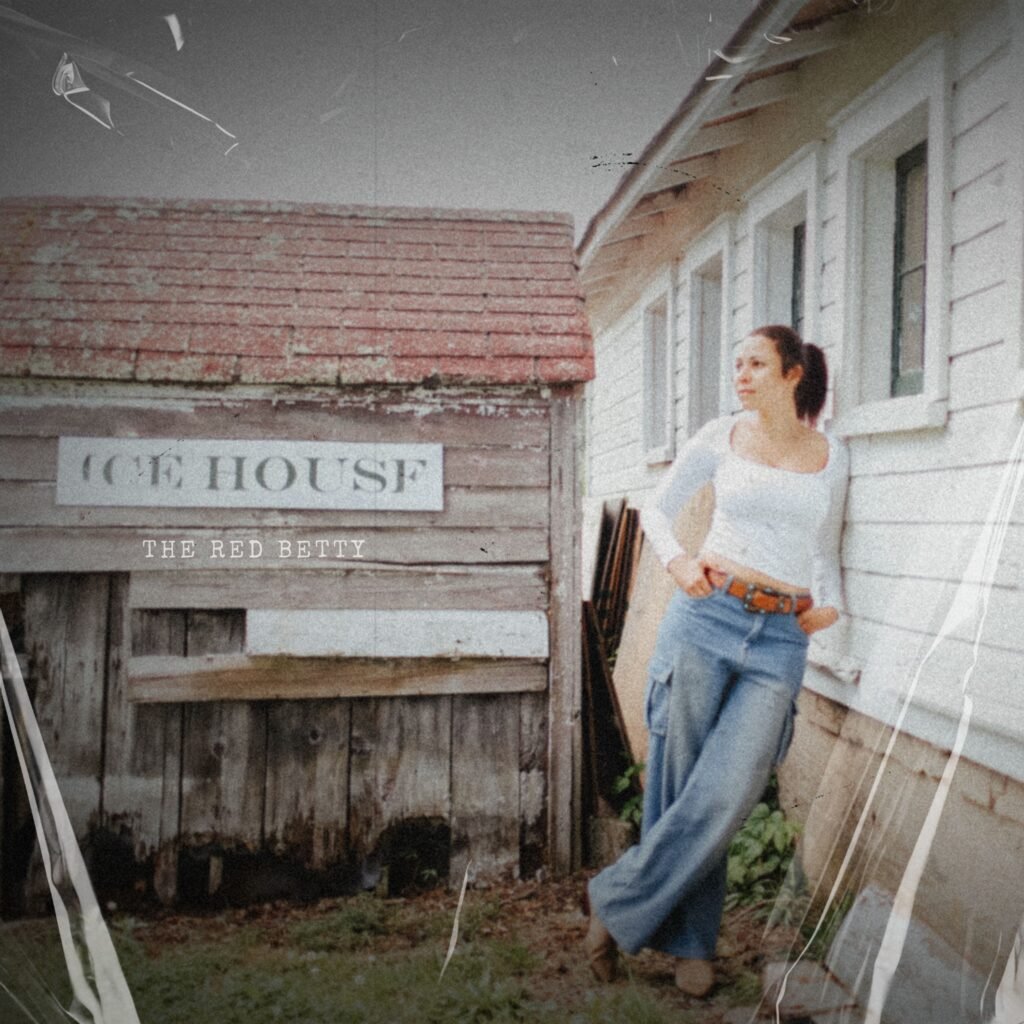
Coming from New Jersey, Brazilian born singer/songwriter The Red Betty welcomes her second album Icehouse through chronic stages of grief in a dead relationship. With her vibrant musical childhood from her father being a self-taught musician performing in Brazilian night life and her mother in a church choir, this album showcases both influences with The Red Betty’s unique display of cultural, nostalgic, and sweet lyrics and colorful instrumentation. Her visionary style is incredibly immersive as I feel as though I am outside in the mountains, walking through fields of tall grass, harmonica in hand, and a glass of whiskey in the other. And of course, to tie in the mood of this album, my chest aches with heartbreak.
“Six Feet Under Love” is a sullen start to the album in a warm and lonesome way. With the gentle guitar and violin chords blended with TRB’s soulful vocals highlight the burdens of love’s bitter sting. The song illustrates love, devotion, heartbreak, and grief. As the title cleverly suggests the saying “Six Feet Under” indicates a clear death and end, with “Love” being the subject. There is a maturity and realism in this song that talks about the struggles of a broken relationship as TRB describes herself and her partner spending nights with different people, but she still thinks of him: “When she’s lyin’ next to you/ Do you think of me, as I think of you/ You are dullin’ all your pain/ With a cheap soul and whiskey in your veins.” The lyricism cuts deep as she painfully copes with him moving on, believing their love had to be enough that he still thinks of her in another woman’s arms, but she is the one lingering and yearning alone. Her love is so devoted that “You[he] could break my[her] heart as you[he] goes/ I’ll [she’ll] follow you[him] to yonder,” a moving feeling that unfortunately will leave her wounded alone. This is a breathtaking start to the album.
With a beginning declaration of unrequited love, “Black Eyed Susans Way” redirects the route home to a resting place to nurture a weary heart. The beautiful mountain sound thrums fluidly with warmth and comfort, neither rushing nor completely slowly, just a comfortable walking pace as TRB travels home. To a person, a place, or deep within her soul, she’s being called home. It is about learning to let go of the past and TRB delivers a harmonious message, “Where I once just bared all of my soul/ Shared my dreams and fears of the past/ Black Eyed Susans calling me home.” TRB leaves us with a gleaming image of hope that things will be okay after a breakup, her gentle voice coaxing and sweet: “Atop the mountain stars all aglow/ The wind in my hair and heart full of hope/ Black Eyed Susans calling me home, so come on home.” In the end, we reach a sense of stability and peace.
“Sinners & Believers” introduces a funky blend to the south americana sound. I personally enjoyed the instrumentation in this piece, with the nostalgic americana melody and guitar with TBR’s modern kick is a delicious addition without taking away from its classic beauty. The sinners and believers point to a poisoned relationship where one partner sins by lying and cheating whilst the other carries false hope that they will change. The line “everyone will hurt” perfectly encapsulates the problematic discourse of being a disloyal partner and also choosing to stay, as the best course of action is to leave. This song doesn’t discourage love, but it pushes for something better, in which case is choosing yourself.
The narrative shifts in “2-Bit Sermon” to a religious church hymn. The feeling is evoked by the organ, choir, and TRB’s soft voice that also narrates parts of the song without singing, much like a priest preaching at the altar in front of devout followers. It’s wholly immersive with a meaningful message like all her songs thus far, on the complexities of life: “Access your life from time to time/ And find a path that suits you best/ Fast or slow it ain’t matter, right.” It’s important to understand this message as younger generations often feel rushed or behind in life when others around them appear successful and bountiful, but TRB assures that each life is unique and each path is different. The important thing is that we take our time, enjoy our ride, and see where we fit best in life.
“House Of A Broken Heart” incorporates blues and acoustics as TRB makes peace with her situation. Her vocal tone displays a state of dejection melded with the harmonica that expresses a crestfallen state in trying to find a “peace of mind.” It’s interesting to see the shift in initial yearning in the previous songs mold into an emptiness of moving on with the simpler acoustics and harmonica without drums or electric to mimic the notion of grabbing what you can carry and leaving with it. In a way, that also taps into a more classical Appalachian influence as the harmonica was easily portable and creates a nostalgic and, in this case, sorrowful sound. This level of vulnerability is comforting amidst pain all humans can relate to or understand.
“Raise’em Glasses” switches strings into a more prominent country-rock twang and faster tempo, a cheerful atmosphere in contrast to “Six Feet Under Love.” Here TRB reaches a sober phase of the breakup where all the pain has washed away with a banjo riff and full glasses, happy smiles, declaring “Cause’ aint nobody gonna cry my tears/ Ain’t gonna feel my fears/ Ain’t no man tell me what I’m worth.” A powerful image of self-worth in choosing yourself and not letting anybody “come rainin’ on my[your] parade.” It’s a fun song to clink glasses and line dance to in a bar of laughing folks.
Finally reaching the end of her journey, TRB conveys a last message in “The Love I Needed.” It’s a simple but powerful message of healing. TRB emphasizes needing love because it comes, it grows, it “Leaves,” and “Love grows anew.” She touches on the realistic fact that love may provide brief pleasure but does not always last. There is fear of love as some “People run away” and others fear being left behind. No matter what, you can start over again, because love can be as immortal as you allow it. TRB embeds more unexpected instrumentation for this song with the moving percussion and angelic choir that is reminiscent of a church. A sense of community that love brings and ties every song in this album as a whole. With that, Icehouse leaves us on a feathery note to the skies, healing and loving are interchangeable cores of life.
With a wise eye and heart, The Red Betty explored the complexity of the stages of grief within an ended relationship through a warm, soulful, and sorrowful note. With powerful, immersive lyrics and classic Americana influence and South American percussion, I felt a strong sense of validation from my own experience, and I believe many listeners will be able to relate in some form. Icehouse is uniquely crafted to showcase the woes of love whilst also uplifting the stage of healing and finding inner peace.
Amelia Suon