

This article was first published in the January 2021 issue of Uncut
Phoebe Bridgers is flicking through the pages of the latest issue of Pagan Dawn, the in-house quarterly of the British Pagan Foundation. “My favourite thing about it is that it says ‘DIY Funerals’ on the cover, but I read the piece and it was slightly disappointing,” she comments dryly. Bridgers picked up her copy of this esteemed publication on a recent trip from Los Angeles to London (complete with the requisite two weeks quarantine) at one of her favourite places – Treadwell’s, the specialist occult bookstore. “I have tons of weird shit over here that I got there,” she says of the shop, which, if you’re ever in the market for esoteric literature and bundles of ritualistic sage, can be found down an unassuming Bloomsbury backstreet.
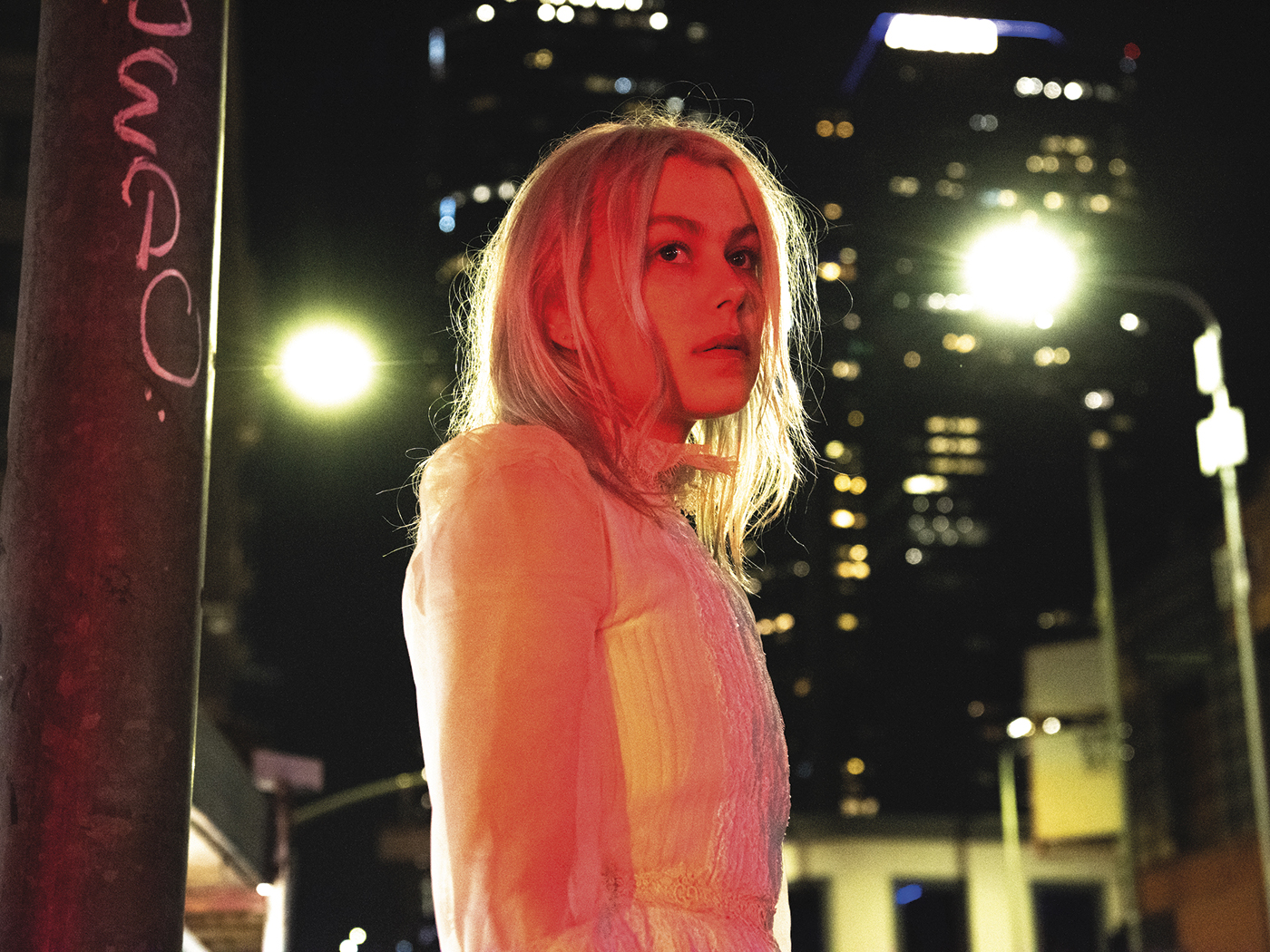
Uncut meets the 26-year-old singer-songwriter, producer and budding witch via video call from the wood-panelled office and guitar storage space in the Echo Park apartment she’s lived in for the past two years. Rifling around behind her laptop, a smiling Bridgers begins to wave other purchases from the store in front of her computer, including a hefty tome on this history of Welsh witches. Further rustling around among the tarot cards and incense leads Bridgers to grab what looks like a giant spell book. Holding it in front of her camera she opens it to reveal a hidden storage compartment containing the detritus of a touring musician – muddled lanyards, wristbands and backstage passes. It’s a collection, she notes, that hasn’t been topped up for a while.
2020 has been a strange year for everyone, but it’s been perhaps even stranger for Bridgers, who released her second album in the midst of a global pandemic. While other artists pushed back release dates to later in the year, Bridgers’ stark, sublime Punisher arrived in June, confirming her place at the centre of a cluster of millennial songwriters, pitched somewhere between Laurel Canyon classicism and indie folk. Though written and recorded over the previous year and a half, Punisher’s songs about the end of the world and anxiety proved remarkably prescient. Bridgers was now not just a great singer-songwriter, but a soothsayer too.
Despite the desolate emotion that haunts her material, Bridgers isn’t your typical introspective solo star. For one thing, she’s far from solitary. A deeply collaborative artist, since the release of her 2017 debut Stranger In The Alps she’s released two other records with impromptu side projects. First came a 2018 EP from trio Boygenius, featuring Bridgers alongside fellow songwriters Julien Baker and Lucy Dacus, and at the start of 2019 arrived the debut album from Better Oblivion Community Center, her newly minted duo with Bright Eyes’ Conor Oberst.
On top of Bridgers’ clutch of extracurricular bands are the seemingly endless one-off collaborations with a cross-generational, genre-fluid brace of artists. Over the past few years she’s teamed up with everyone from The 1975 – whom she was due to support on their cancelled 2020 arena tour – to Jackson Browne, The National’s Matt Berninger, Fiona Apple and, most recently, up-and-coming British singer Arlo Parks.
“They both fell into my lap,” explains Bridgers of Boygenius and Better Oblivion Community Center. “I dare anybody to say no to either of those things or to being on a 1975 record or singing with Matt Berninger from The National.”
Berninger is a fan, he says, not just because of Bridgers’ music but her attitude. “It’s like Phoebe has an allergy to bullshit,” he explains. “She seems almost incapable of being anything but 100 per cent genuine in everything she does. Very few people have that.” Bridgers’ deadpan humour also sets her apart from her more dour idols, like the late Elliott Smith. As sharp as any comedian on the LA stand-up scene, her Twitter feed is a constant source of fast, ennui-drenched one-liners, many wryly lampooning her music’s melancholy outlook.
“Blasting podcasts in your headphones drinking a black charcoal smoothie googling someone you used to know so you can see their tweets because you’re blocked is the best way to turn 26,” she tweeted on her birthday this August. “It’s just shitposting,” she says with a shrug, but there’s something deeper there too. In-between the sass-stacked millennial commentary, Bridgers can be found calling for justice for Breonna Taylor, advocating for abortion rights and never missing an opportunity to harangue Donald Trump.
For a while she was in two minds about being so openly political online. This summer she changed her mind. “I’m self-conscious of slacktivism and just posting your fucking opinion for tokenism or for some sort of ‘special white person in America’ award for caring about stuff,” she explains. “But then I still get messages being like, kill yourself bitch’ or [pro] Trump-y messages. So I think I’m realising that shit that I don’t think is that radical could actually be kind of useful in the world. I want to make it clear where I stand about basic human decency. I have a responsibility as an American right now to speak up.”
Phoebe Bridgers was born on August 17, 1994 in Pasadena, a sleepy middle class suburb of Los Angeles. Her parents bought her and her younger brother up on the California classics – Joni Mitchell, Neil Young and Tom Petty – with some Tom Waits and John Prine thrown in for good measure. As a kid her mum encouraged her to take piano lessons, but Bridgers hated every second. Instead, she made her own way to the guitar, encouraged by her father. By her mid-teens she was fully invested and started busking at the local farmers’ market, playing a mixture of her own material – including early versions of first album tracks “Chelsea” and “Georgia” – as well as Laurel Canyon standards. It’s an experience she looks back on with mixed emotions. “It felt exploitative almost,” she states. “Standing on the street with your guitar and old men stop and watch you for hours? I hated it… But it was really, really good practice.” Making inroads into a slightly more professional scene, she started booking gigs locally, including at LA’s cosy Bootleg Theater, where she later met Conor Oberst.
“But there were times where, literally, it was just my mom and whoever I brought in my car in the audience,” remembers Bridgers of her early shows. Around the same time she started playing bass guitar with local DIY band Sloppy Jane, whose music boasted a much harder edge than her own solo material. “I definitely played some empty venues (with them) too. But they were cool because they would play the craziest parties in Riverside where there’d be a trashcan fire,” she laughs.
After finishing school Bridgers became a fully fledged member of the band for a couple of years, and during one show was scouted by a talent agent. It proved to be pivotal in launching her solo career, leading to Bridgers being booked for a handful of television commercials, including high-profile slots for Taco Bell and the iPhone. In the latter a 19-year-old Bridgers leads a global band in a version of the Pixies’ “Gigantic”. “I maybe did three and it paid for a whole two years of my life to focus on music,” she says.
During that time she began work on what became Stranger In The Alps, but after a run of bad experiences, she decided to pare down plans for her debut album. “I was pretty sure I was going to make a folk record,” explains Bridgers, who was convinced she wanted to take things back to basics. “I had met so many shitty producers that I was like, ‘I’m just gonna make a four-track recording and people can just suck it.” Though she doesn’t name him during the interview – and her press agent has asked we refrain from asking about it – one of Bridgers’ early producers was Ryan Adams, who met Bridgers when she was 20 and he 40.
In 2015, he put out her debut single, a devastating acoustic ballad called “Killer”, on his Pax-Am label. The relationship, in a professional and romantic sense, was short-lived. But in February 2019, a New York Times article alleged that Adams had emotionally abused young women he had worked with and had also been sending explicit messages to an underage fan. Bridgers was one of the named contributors to the piece, stating that Adams had become troublingly obsessive when she called off the relationship and that he rescinded on professional promises as punishment for her ending things. It was only then that people learnt that deceptively upbeat first album single “Motion Sickness” was about Adams. “And why do you sing with an English accent/l guess it’s too late to change it now,” she sang on the coruscating kiss-off. “You said when you met me you were bored/And you, you were in a band when I was born.” Adams has denied the New York Times’ accusations.
No wonder, then, that Bridgers was wary of the music industry establishment. But then Bridgers met Tony Berg, who as well as producing the likes of Edie Brickell, Public Image Ltd and Aimee Mann had signed Beck when working as an A&R for Geffen. The pair bonded and Berg went on to produce Stranger In The Alps – alongside fellow LA musician Ethan Gruska – dedicated to bringing a fuller sound out of Bridgers’ material.
“I made songs with drums on them kicking and screaming,” she laughs. Even with drums, the album – which with typical Bridgers humour is named after the pre-watershed edit made to the line “Do you see what happens when you fuck a stranger in the ass?” in the US TV version of The Big Lebowski – is intimate and raw. Yet there remains a lushness that lifts it above mere navel gazing. “I think it would have been even more depressing of an album if I hadn’t met certain people,” adds Bridgers of Berg and Gruska.
Made pretty much on spec, the album was quickly picked up by the Dead Oceans label, also home to Kevin Morby, Khruangbin and Mitski. Bridgers fast became an artist who other musicians wanted to collaborate with. Matt Berninger was first made aware of Bridgers when she sang with The National during a festival in Wisconsin in 2018. “It was on a circular stage with a huge wooden spaceship thing teetering above us,” he recalls. “It was one of the scariest shows we’ve ever done and up walks Phoebe cool as ice and murders ‘Sorrow’. I had barely heard her music at that point, so I went back and listened to ‘Scott Street’ and was like, ‘Ah, OK, holy shit.”
“PEOPLE WITH ADHD ARE ACTUALLY KIND OF MAGICAL”
Bridgers’ Boygenius bandmate Julien Baker – whose 2021 album she will be guesting on – was one of many. “I believe that one thing which makes Phoebe’s art remarkable is her ability to render emotions in astonishing, sometimes discomforting accuracy,” explains Baker, somewhat awestruck.
Ask Phoebe Bridgers where her steely focus and drive comes from, and she’s quick to credit her diagnosis with ADHD, which she says allows her to fully commit to her passion. “I’m obsessed with this idea of unpreferred tasks, which is the thing that they talk about when you have ADHD,” she explains.
“People with ADHD are actually kind of magical, because the thing that you’re focusing on is the thing that you would do anything for – you don’t care if you don’t get sleep or have mania – and then other things are unpreferred tasks. School for me was an unpreferred task and doing anything other than music is pretty unpreferred.” Bridgers sits back from her computer camera for a second. “I thought I was just, like, bad at things and couldn’t do simple addition, but when it comes to music, I don’t really have another option.”
It also helps Bridgers spin her various musical plates – from pre-pandemic touring and lining up her various collaborations to simultaneously starting work on Punisher. Sessions for her second album took place over 18 months at LA’s Sound City, where Tom Petty’s Damn The Torpedoes, Fleetwood Mac’s self-titled 1975 LP and Nirvana’s Nevermind were all recorded. “I think we have a tongue-in-cheek approach to the legendary nature of it… All our WiFi passwords are ‘Dave Grohl!’,” she says with a smirk. “But that being said, it’s a fucking incredible studio. I was like, ‘Oh, this is why people record in real studios!’ My favourite piece of the studio was this echo chamber that looks like somewhere where you would, like, murder your friends…”
Bridgers and her band rolled in and out of Sound City whenever inspiration struck. “I think if we had been charged what a studio actually costs it would have been like an insanely expensive record,” she jokes. Another bonus of working at such a prestigious place was the access Bridgers had to passing artists, leading to cameos from Jim Keltner, who joined a guestlist that also included Yeah Yeah Yeahs’ Nick Zinner, Warpaint’s Jenny Lee Lindberg, Blake Mills and Bridgers’ regular collaborator Conor Oberst.
“i think if we had been charged what a studio actually costs, it would have been an insanely expensive record”
Like Stranger In The Alps before it, Punisher’s songs are almost unnervingly beautiful, but plug in directly to the darker moments in Bridgers’ life, featuring stories of isolation, dissociation and depression. Was being in the studio and having to re-enter the mindset she was in when she wrote those lyrics hard work emotionally? “I love it,” exclaims Bridgers. “Maybe it’s sociopathic, but I like singing really fucked-up lines and looking at the way that people will react, because I’m separate from it enough. When we were recording ‘Graceland Too’, I think several people cried, which was the biggest ego boost of all time. It takes me forever to write a song, so by the time I’m recording it, I know it so well that it doesn’t really even affect me any more.”
Phoebe Bridgers might easily be able to distance herself from her lyrics, but she’s had a harder time struggling through 2020, which she agrees has been both the best and worst year of her life so far; best because of Punisher’s success, and worst because, well, we don’t need to go into that again… “Totally,” she nods. “It’s just a shitty time to be alive. I would have loved to be travelling and be feeling [my music] with rooms full of people. Maybe it’ll all be worth it when I go on tour.”
A couple of weeks ago, Bridgers had a tantalising taste of her pre-lockdown life, playing to an empty Red Rocks, the outdoor amphitheatre in Colorado. “That was the closest thing to fun I’ve experienced in a while,” she admits. It was decided that a 30-hour round trip on a tourbus would be safer than flying, so Bridgers and her band packed the cheap skeleton jumpsuits that have become synonymous with Punisher (she wears the makeshift Halloween costume on the album cover because “I feel so conscious of being ‘lovely’ or having a glam shot on my art”) and hit the road.
“Having no audience wasn’t depressing in the way that I thought it was going to be, it just felt kind of surreal,” says Bridgers. “Mainly it just felt so good to play music.” Bridgers also recently took the decision to launch her own record label, Saddest Factory, in association with Dead Oceans. She has spent much of lockdown writing new music too, but is unsure if and when any of it will be released. “I can’t really see myself putting something out before I go on tour for Punisher, which is kind of a nice place to be. I’m just writing kind of aimlessly,” she admits. When it comes to solo album three, she’s still a way off working it out. “I don’t know which direction to go in. I like the mellow aspects of Punisher and I like the heavy aspects of Punisher,” she sighs. “I like this record so much, I just kind of want to keep making it!” It’s fair to say that if she did, there probably wouldn’t be too many complaints.