

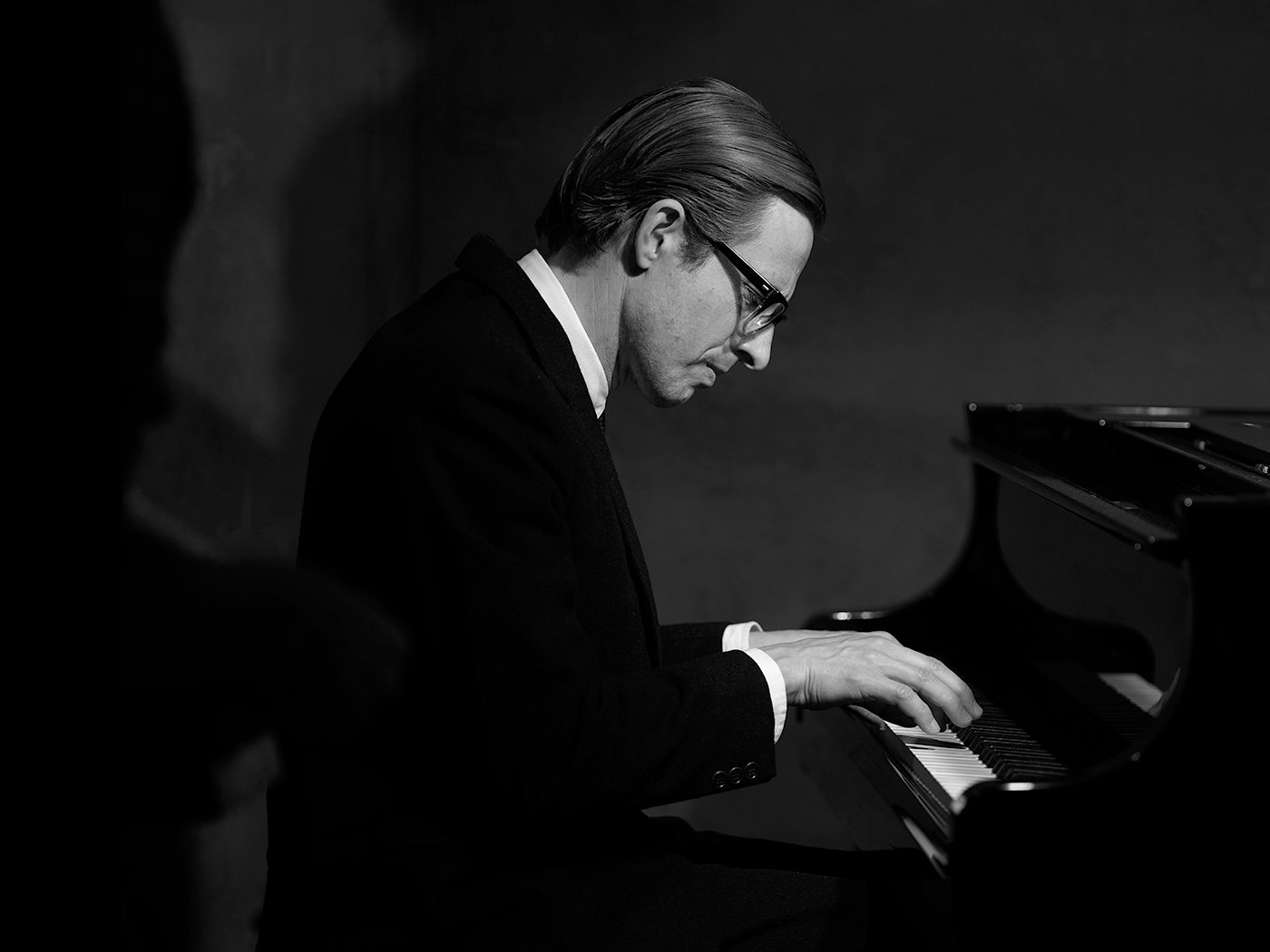
The monster success of Michael demonstrates that there is no horror that can’t be smoothed and sanitised by the Hollywood biopic factory, providing the soundtrack is strong enough and the volume is loud enough. But this year’s most intriguing recent music films have succeeded by zooming in on quiet, stray moments in musicians’ lives, telling fragmented, elliptical stories that find new angles on well worn stories. A couple of months ago Köln 75 put the high wire precarity back into Keith Jarrett’s performance by focusing on the screwball scaffolding of the gig’s staging. Now Grant Gee electrifies the spirit of Bill Evans, zapping him out of his Peaceful Piano rest home by focusing on the three months he deserted the piano stool following the death of bass player Scott LaFaro.
You’ll know director Grant Gee from his documentaries: most notably Meeting People Is Easy, which followed Radiohead through several circles of promotional hell, but also his lucid and compelling Joy Division (2007). More recently his work has taken a ludic, metaphysical turn, wandering through the fictions of W.G. Sebald, Iain Sinclair and Orhan Pamuk. But this is his first fully fictional feature.
It makes you wonder what took him so long. On a shoestring budget, with County Cork standing in for early ‘60s New York and Florida, he has created a black and white fever dream. It can’t have hurt that in his first experience directing actors he has assembled a dream cast: Bill Pullman as Evans’ boozy, brooding Welsh dad, Laurie Metcalf as his determined, devoted Russian mom and Valene Kane simply sensational as Ellaine, his ‘60s soulmate. Best of all is Anders Danielsen Lie, who has some form playing recovering junkies after his sublime lead in Joachim Trier’s Oslo, August 31st, as Evans himself.
We open on Evans, alone in his coldwater Manhattan room in July 1961. Two weeks earlier he, LaFaro and Paul Motian played at the Village Vanguard, performances that gently exploded and telepathically redefined the space-time of the jazz trio, that were recorded, released and have never stopped feeling like news since. Following LaFaro’s death in a car crash Evans is stunned into silence and sees no way forward.
He’s rescued from his isolation by his family. Taken in first by his older brother Harry, he forms a very loose quartet in the New York family home, with Harry’s wife and their daughter Debby (to whom Evans’ verdant waltz is dedicated), though he wanders out every night back to his old shooting galleries. He heads south, forms a scratch trio with his retired parents in Florida, and goes cold turkey.
He finally reunites in a duo with Ellaine, who has been going through her own private hell. But this isn’t a straight story of grief, rehab and transcendence: Gee can’t help but confound the timeline, cinematographer Piers McGrail’s stately monochrome interrupted by lurid Kodachrome premonitions from his future, skipping ahead to the traumas of 1973, 1979 and 1980, and any hopes of easy transcendence are dashed. Without ever canonising Evans as some holy jazz ruin, along the lines of Bruce Weber’s Chet Baker, Gee makes the patient, uncanny beauty of his music seem all the more remarkable.