

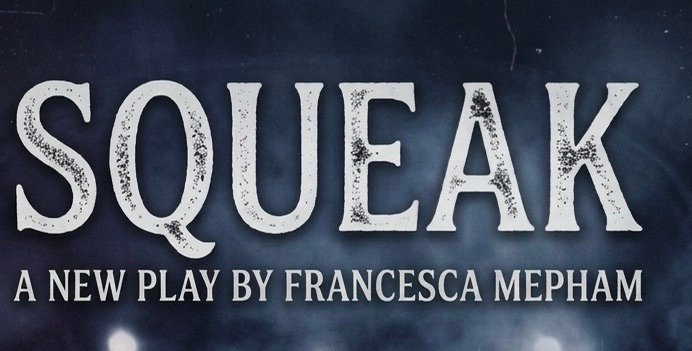


In a new interview for Blazing Minds, I caught up with the ever-busy and multifaceted Francesca Mepham to discuss her upcoming ghost story play Squeak, the dark drama mono film My Daddy Is a Rag and Bone Man, her recent appearance in the show Zik of Africa at the Shaw Theatre, her new podcast Fantastic View Of, and her work as Chairwoman of the ECG Official Theatre Expert Council.
Q: You’ve got your new ghost story called Squeak. Can you tell us a little bit about Squeak and what’s happening with that.

A: Yes. Originally, I came up with the idea just before lockdown. I was hoping it was going to be at a theatre scratch night, and then obviously that got cancelled. I think it was around February or March time, and that’s when I kind of knew things were getting serious.
I submitted it to The Side Hustle in 2024 at the London Unicorn Theatre, and David Brady chose the script, which was fantastic. Put together the two actors, Leanne (Sophia Grilli) and Dan (Will Meadows), along with our director, Asia Nerva-Culley. The rest is history, in a way. I’ve been working on it ever since. I decided to make it four characters rather than just two. So, we now have Carol Morgan, who is Mandy, Leanne’s mum, and we have Roger, who is Dan’s friend and father figure played by Philip Gill.
Basically, Leanne is the ghost in this. I won’t say how she died because that’s a big reveal and it’s kind of why it’s called Squeak, but it does have something to do with that. It shows that just because someone has died, it doesn’t mean they were some kind of angel, no pun intended. She is still as shady, funny and biting as she was when she was alive, and I love that. I love the one-liners.
It’s in contrast to Dan, who is very angry about what’s happened. They were this young couple just starting out and had their whole life ahead of them. It’s Leanne looking down, or looking in, and commenting on what’s going on. It’s uncomfortable for her to see that her boyfriend is suffering like this. She’s almost grieving herself, grieving the life that she thinks she should have had as well. So, there are two contrasting points of view of grief.
Then we’ve got Mandy, Leanne’s mum, who is this bubbly force of nature, and we’ve got Roger, who is a bit more reserved and dryly funny. The chemistry between the four of them is electric.
Q: How did the concept come about for the play originally? You had the two characters.
A: It almost feels like it wrote itself. I have no idea. I sat down and wanted to show this portrayal of grief because we don’t talk about death enough. We always have the perspective of the people left behind, but not that story of someone who has actually died and is watching people grieve for them, while feeling helpless.
I liked that idea of someone knowing what people were going through. You’re almost angry and resentful that they’re there and you’re not. I wanted to show that. I just don’t think we talk about death enough. We were saying with the cast the other day that we talk about weddings and birthdays, but we don’t talk about death and the realities of it.
I also wanted to show it through a young couple, but I always wanted to show what it was doing to an older couple as well. I wanted to show older characters on stage because we don’t always see that. We see people in their twenties, thirties and forties, but not people in their sixties or seventies who suddenly find love at a strange point in both of their lives. Both of them are grieving a life they think they should have had as well.
I wanted to show grief in different forms because grief and heartbreak are like physical pain. They go hand in hand. They are some of the most awful pains you can imagine. It doesn’t have to be that someone has physically died. They might have left you, you might have divorced, or they may have just walked out one day. It’s showing that there are so many different levels of grief, as well as the obvious one when somebody dies.
Q: What made you choose comedy for this Squeak? It’s quite hard to balance grief, death and those sorts of subjects and comedy is very difficult to get right?
A: I wanted to show that even when somebody is going through the worst point of their life, someone will say something that makes them laugh. It’s almost what they need, that little bit of relief. Humour can come from people tiptoeing around each other as well. You say something wrong, then laugh at yourself afterwards and think, “Oh God, what have I just said?” I think comedy is a great tool for exploring different scenarios and human emotions. Making somebody smile when they’re going through the depths of despair is a wonderful thing.
For this play, there are so many dark comic moments. Leanne was such a shady character when she was alive. She would just say things exactly how they were. There’s a point in the play where she’s in the pub watching Dan and Roger having a drink, and there’s a girl giving Dan the eye. Leanne says, “I bet her name begins with C. Charmaine, Charlotte, Carmel.” It’s exactly the sort of thing she would have said when she was alive, and probably directly to the girl as well.
Rather than being angry all the time, that humour breaks things up and shows the human side of her. Even though she’s a ghost, she’s still human. I think comedy is everything. It really is.

Q: You mentioned earlier how well the actors brought your characters to life. Did they make any changes to how you originally perceived the characters, or did they largely reflect what you had on the page?
A: The biggest surprise has actually been the character of Roger. The way Phil plays him, with this very dry humour and laid-back nature, creates such a contrast to the anger Dan is feeling. Dan is very lost, and Roger kind of brings him back down to earth.
It’s great seeing them together in the pub scenes. It’s a bit like a father-son relationship. You get that chilled father figure who seems to have everything under control, but then he’ll open up about his own problems, which takes Dan’s mind off his own struggles.
It’s great that Dan starts thinking about somebody else’s problems for a change. Roger becomes someone he relies on, perhaps more than he realises. Alongside Mandy, Roger becomes a real support system for him. It’s been wonderful watching that contrast in personalities develop, especially during the read-throughs.
I had a very clear idea of Mandy from the beginning. I wanted her to be bubbly, chatty, a bit of a gossip, and very funny. She always seems to know what’s going on with everybody. But she uses all that chatter as a distraction from the fact that she’s grieving for her daughter.
She sounds so much like Leanne as well. You can imagine Leanne becoming very much like her mum in thirty or forty years’ time. That’s one of the tragic aspects of the story. Mandy will never get to see her daughter grow older and become even more like her. I really love those moments between them, when they’re together talking about Dan, the future, and what might have been.
Q: Moving on to the film side, you are also producing the dark drama My Daddy Is a Rag and Bone Man, which you also wrote. Can you tell us a little bit about that?
A: It’s a monologue that was originally called My Daddy Is Mexican and forms part of a collection called No One Wants a Pretty Girl. It was originally performed in 2017, and I started looking at those monologues again and thinking I’d like to do something more with them. I’d already created an audio version of Should, which is about heartbreak, and I felt this one had a particularly interesting story to tell. At its heart, it’s about hate and what happens when hate is put into motion and acted upon. Sadly, it’s such a relevant subject right now when we see so much happening around the world that is driven by hate.
I had an actress in mind for the role, Melina, and everything I write is about telling authentic stories. Melina’s father is a Romany Traveller, and I thought we could really tell this story in a truthful and meaningful way. The film explores what happens to a young woman as a consequence of hate. I won’t give away too much because it has a lasting impact on her life, but the effects become very apparent.
As we prepared the film, I thought about changing the title. I asked Melina what she would like it to be called, and we discussed terms such as “Romany” and “Traveller”. Then she suggested My Daddy Is a Rag and Bone Man. I immediately loved it because it’s a phrase people still recognise, and it has a darker tone that suits the story.
Together, Melina and I adapted parts of the script. Originally, My Daddy Is Mexican was written in response to some of the political rhetoric surrounding President Trump in America during 2016 and 2017. For this adaptation, I wanted to bring it into 2026 and tell a story that reflected Melina’s heritage and experiences. The core story remains the same, but we’ve adjusted some elements to make it feel authentic to her truth and background. Ultimately, it’s still a story about what happens when prejudice and hatred are turned into actions.
We’ve got a great team involved, including Chuck as Director of Photography. It’s a very small production team, and I deliberately wanted to keep it that way because I wanted the focus to remain solely on one woman telling her story. Melina is a fantastic actress, and I think the intimacy of having one person on screen sharing this experience is incredibly powerful. Since we’ve adapted the script to reflect aspects of her heritage, it feels particularly authentic.
We’re filming in London, and I’m really excited about it. Mono films aren’t something you see all that often. More commonly you’ll see conversations between multiple characters, but watching someone tell a deeply personal, dark and heartbreaking story directly to camera can be incredibly effective. The story is tragic, but it’s also about resilience and defiance. Lacey could be broken by what’s happened to her, but she still carries that spark of optimism. I’m really excited to film it.

Q: It’s interesting because you’re really stripping everything back.
A: Exactly. She’s simply talking about what she’s been through and telling the story from her perspective. I think that’s incredibly powerful because you’re not being shown events directly. Instead, you’re experiencing them through her memories and emotions.
You see the pain in her face, her voice and her reactions. There are so many different emotional peaks and troughs throughout the piece. At the same time, one of the key ideas is that she refuses to be defined by what happened to her. I think that’s both beautiful and brave. It takes courage to talk openly about trauma, and it places a lot of responsibility on the actress because everything rests on her performance.
Q: Is there much of Melina’s own background in the story now
A: Yes, mainly in terms of language, culture and perspective. Thankfully, she has never experienced anything like the attack that Lacey experiences in the story, nor has she lost someone because they were Romany. But she understands how prejudice and discrimination can affect people’s lives, because those attitudes still exist.
When I hear the way some people talk about the Traveller community, it genuinely upsets me because I’ve seen first-hand how welcoming and supportive people are. They’ve embraced me whenever I’ve sung at weddings and funerals, and it’s allowed me to learn a great deal about their culture and music.
Melina has said that she inherited a great deal from her father, as well as from her mother. That heritage helped shape who she is as a performer. She brings knowledge and authenticity to the role, which was exactly what I wanted. I wanted this story to feel truthful.
Whilst thankfully these events have never happened to her personally, the story explores what could have happened under different circumstances. That’s what makes it such a powerful piece.
I think having one woman sit there and tell her story will be incredibly effective, particularly because Melina is so connected to the material. I love it when actors truly become their characters. That’s what audiences respond to. They want to watch someone fully inhabit a role and tell a story honestly. When someone genuinely loves a character and believes in the story they’re telling, it shines through.
Q: Who will be directing the film?
A: We do have a director, although he’s working remotely. I need to double-check how we’re crediting everything, but Stephen Hunter is involved as director. He’s known for appearing in The Hobbit films, which was completely unexpected.
He’s been working with Melina and offered to direct the project. Because he’s currently in Australia, much of that work is being done remotely through online meetings and coaching sessions over Zoom, which has been fantastic. He was originally coaching her and then she mentioned the project. He said he’d love to be involved, which was wonderful.
Q: You’ve got a great team around the project. How did the Director of Photography become involved?
A: We’ve got Jay as Director of Photography, who I worked with on The Space Between Decisions back in June.
After we finished that project, I looked at some of his previous work and realised he specialises in monologues and monodramas. He does a lot of showreels and monologue-based pieces, and I thought that was exactly what I wanted for this film. I wanted someone who really understood how to capture a single person telling a story.
It’s been great bringing everyone together. I worked with Melina last year on a show as well, so there’s already that trust there. It feels like one of those situations where everything comes together naturally. You meet people who are incredibly talented and who share the same excitement and passion that you do for a project. When that happens, it really does feel like fate. So yes, it’s a fantastic team.
Q: Next is your acting work, as you’ve recently been performing in Zik of Africa at the Shaw Theatre, haven’t you?
A: Yes, and that was fantastic. I actually had about two weeks’ notice before joining the production.
Q: Only two weeks?
A: Yes. What’s really interesting is that Tayo Aluko, who’s the producer, actually performed one of my monologues around nine years ago. It was a piece called Should, which is a very dark story about heartbreak.

She’s an incredible actress, and we’d stayed in touch over the years. I’d always said I’d love to work on anything she was involved in. She contacted me about Zik of Africa and told me there was a role called Shirley. She’s an American character from the 1960s and very bubbly. I remember thinking, “That sounds like me.” So, I went along to rehearsals and was immediately blown away by the talent, the music, the energy and the story itself.
It’s about Nigeria’s first president, and honestly it felt more like a musical. The music was incredible. One of the dancers, Eddie, was phenomenal. I remember thinking he should be choreographing Strictly Come Dancing. The amount of energy he had was astonishing. He was choreographing, performing and doing everything. It was incredible to watch.
The entire cast was fantastic, and I met some wonderful people who I’m sure I’ll work with again in the future.
Q: So you ended up playing more than one role?
A: I did. I ended up playing the Queen as well. Three days before the performances, they decided that because I’m classically trained, I would sing the national anthem at the beginning of the show. Here I was in a huge white dress and a tiara. I felt like I was entering a beauty pageant. It was brilliant.
I also learned the Nigerian national anthem, so I performed both. I remember someone asking whether my microphone levels were okay, and I said, “I’m not using a microphone.” Because of my classical training, I was confident I could project to the whole theatre, and thankfully the acoustics at the Shaw Theatre were fantastic.
It was such a lovely contrast because one minute I was playing the Queen and the next I was Shirley, this energetic American character from the 1960s. She was full of life, always saying, “Speech! Speech! Speech!” It was so much fun to play. I also love performing American accents, so I had the best time.
Q: What was the main story of the play?
A: It followed Zik’s journey to becoming president. That’s actually where the title comes from, as “Zik” was his nickname.
The story begins with his first wife, Flora, played by Tayo, and follows his life all the way through to his second marriage and his rise to political leadership.
What I loved was that it showed both the visionary and the man behind the public figure. There are moments where you see him enjoying life and celebrating with people in America, and then later you see a much more serious and reflective side of him. It was a really powerful story about ambition, determination and self-belief, and about the future he wanted to create for Nigeria.
Michael, who played Zik, was extraordinary. It’s a very word-heavy role and he had a huge amount of dialogue to carry. Throughout the play, he portrayed Zik at various stages of his life, from a younger man to an older statesman. Seeing that transformation was really impressive. I think he’s only in his late thirties himself, but he handled those different ages brilliantly.
There was also a younger actor playing the earliest version of Zik, but Michael carried the majority of the role and did so beautifully. It was a real privilege to watch.
Q: Next, let’s talk about your new podcast, Fantastic View Of. Can you tell us a bit about that?
A: I really wanted to create a podcast featuring people who I consider to be trailblazers within the industry. I’m fascinated by people who have carved out unique careers for themselves, who have created opportunities not only for themselves but for others as well. These days, very few people are just one thing.

You’re often an actor, writer, producer, entrepreneur or creator all at once, and I think there are some remarkable individuals out there who deserve to have their stories heard. I wanted a platform where I could have conversations with people I genuinely admire and find out what drives them, what motivates them and how they’ve built their careers.
Q: Do you have any guests lined up?
A: One of the guests will be Priscilla Ogofere. I’ve known Priscilla for nearly ten years. We performed together in Edinburgh in a production that transferred from London, and since then she’s built an incredible career as an entrepreneur, businesswoman, actress, singer and comedian. We’ve even written comedy together.
She has her own podcast now as well, and I’m really looking forward to having her on because there’s so much we can talk about.
Another guest will be Spencer Hawken. He’s a fantastic example of someone who has created opportunities not only for himself but for countless others through the Romford Film Festival and the Lumiere. He’s built a genuine creative hub and community.
People like that inspire me because they’ve gone out and created something unique. Those are exactly the kinds of conversations I want the podcast to have.
Q: When are you looking to launch the podcast? Will it be this year?
A: Yes, definitely this year. I’ve already recorded the first episode and now it’s just a case of editing it. I’m hoping to launch the first episode this autumn, most likely in October. Then I’ll record a batch of additional episodes and release them over the following months. Ideally, I’d like the second episode to come out around November.
It’s all about building up a collection of conversations and getting everything ready ahead of Christmas.
Q: You are also Chairwoman of the ECG Official Theatre Expert Council. Can you tell us a bit about what’s happening there?
A: Dean Zenko, who is part of the ECG, came up with the idea of creating an online theatre festival. Because I’m Chairwoman of the ECG Theatre Council and have a background in theatre, it made sense for Dean and I to work together on developing it.
We’ve been putting together plans for an online theatre festival that will run alongside the ECG Film Festival. The idea is that the winners of the theatre festival will be announced at the same time as the film festival winners. We’re hoping to launch it within the next few months so that people can begin submitting entries.
The main goal is to create opportunities for theatre companies from all over the world. Whether it’s a small community theatre company or a large-scale production, we want everyone to have the chance to be seen.
We’ll have a range of categories, including Best Play, Best Musical Theatre Production, Best New Work and Best Ensemble. We want to celebrate theatre wherever it is being created and ensure that quality work is recognised regardless of location.
Q: You also have some ideas for celebrating the launch?
A: I have. To mark the formation of both the Theatre Council and the Online Theatre Festival, I’d love to organise a concert. I was thinking somewhere like the Lumiere, which already hosts musical theatre events and has become such a fantastic community space.
My idea would be to combine performances, extracts from plays, new writing and musical theatre pieces into a celebration of theatre. Then, when the awards are presented, everything feels part of one larger event. I’ve discussed the idea with Dean and he’s really enthusiastic about it.
It would give performers and writers the chance to showcase their work while also celebrating the launch of the council and festival. I think it could become a really special event.
If you go to the Drayton Arms Theatre website they can book tickets for the Squeak readthrough . Any media or press who are interested can get in touch with Francesca Mepham directly to arrange complimentary tickets.
The reading is at 7:30pm on Tuesday 29th September at the Drayton Arms Theatre.

Published in various websites, Philip is a reviewer who is best known for his interviews and media coverage of independent projects including; films, books, theatre and live events. Always on the lookout for something different to cover!