

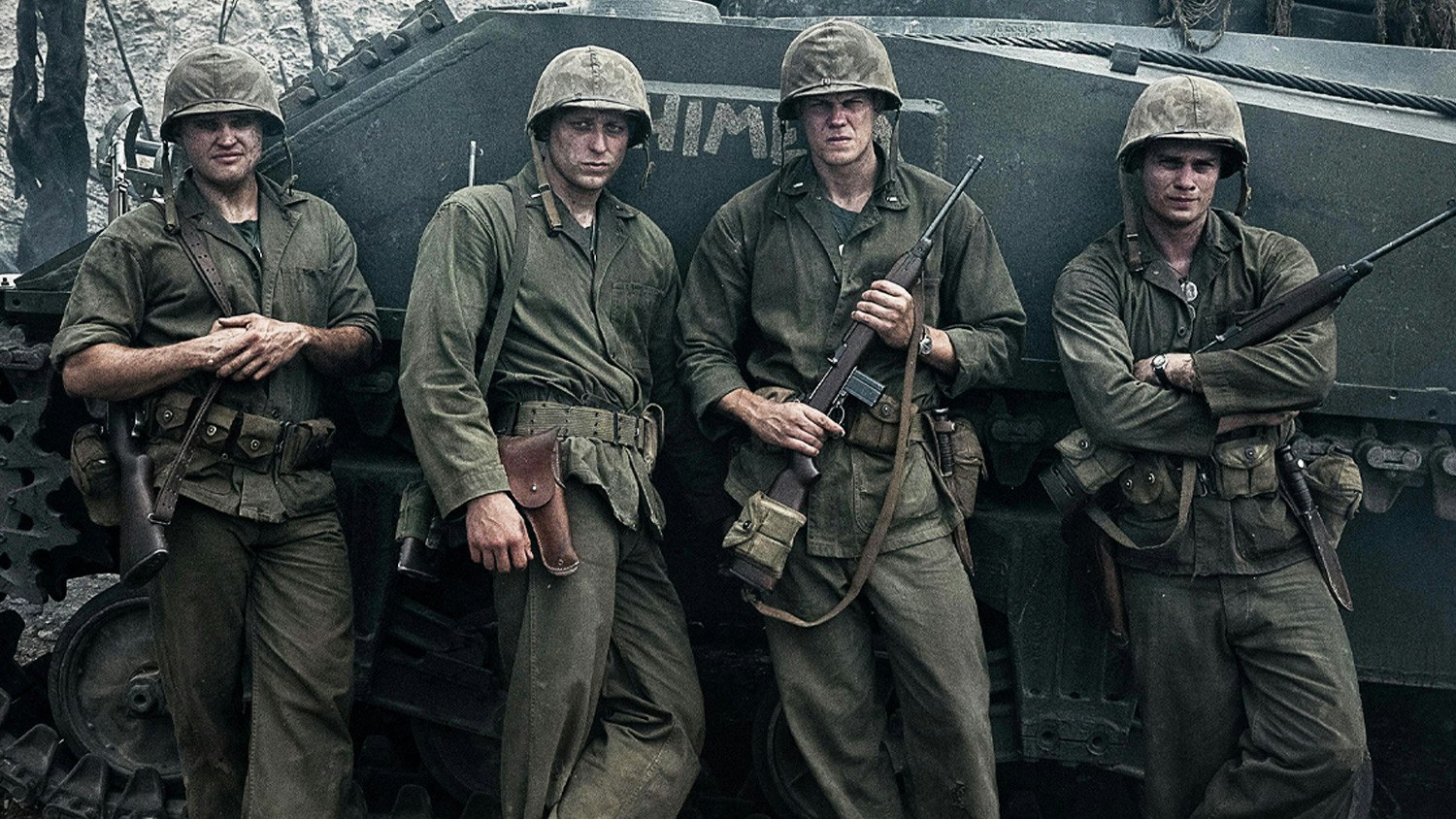
Following the 1941 attack on Pearl Harbor, four top American-football players join the Marines. Their love of the game will lead to a historic moment during the Pacific War.
It’s a boss-level Peter Berg concept: a quartet of all-American athletes are sent into the violent, cruel belly of war. For the man who helmed Friday Night Lights — the sports film and its five-season TV follow-up — and battlefield movies like Lone Survivor and The Kingdom, Buzz Bissinger’s historical non-fiction book The Mosquito Bowl: A Game Of Life And Death In World War II must be like catnip. Four college footballers, played by Nicholas Galitzine, Bill Skarsgård, Ray Nicholson and Tom Francis, enlist to fight in Japan. After a breakneck training regime and their first battle — which they barely make it out of alive — the boys help to orchestrate the Mosquito Bowl, a morale-boosting football game held on Christmas Eve 1944 at Guadalcanal.

The ensemble is stellar. Galitzine, who has risen through the Hollywood ranks playing Prince Charming- and boyband-types, matures into a convincingly sombre presence as the horrors of conflict cause his character John to shatter. Nicholson is boundlessly charismatic while Francis, in his first film but with an Olivier award for his stagework, goes toe-to-toe with the pair plus Skarsgård’s farm lad, who despite being raised castrating bulls can’t stop his hands from shaking after his first brush with death.
Berg’s film is fiercely anti-war, opening with a quote from Herbert Hoover: “Older men declare war. But it is the youth that must fight and die.” Combat scenes are relentless: bodies ricochet through the air away from explosions or are enveloped by angry waves; a familiar skull explodes in front of the four men. It’s shot on an epic scale by cinematographer Jacques Jouffret, who brought a similarly scorched look to Berg’s series American Primeval. As the four brothers-in-arms move tentatively through the intricately arranged diorama of carnage, facing off against Japanese soldiers, it becomes abundantly clear that luck alone is keeping them alive.
On the football pitch, it’s a different matter. Berg fires on all cylinders to make the Mosquito Bowl feel both monumental and naturalistic, even for those unfamiliar with the game. It’s a welcome reprieve not least because this is far from a subtle film. While the on-the-ground politics of war are interrogated — America’s treatment of the Japanese soldiers dominates some unflinching scenes — the principal motive seems to be to shock and dismay, somewhat numbing the viewer’s ability to feel anything for themselves and reducing supporting roles to human targets. The cast are collectively gripping, however, navigating the pitch and trenches with touching camaraderie, their expressive faces carrying all that The Mosquito Bowl wants to say.
A beautifully shot account of American brotherhood. While its depiction of war shocks like an ice bath, the performances ensure a more humanistic experience.