

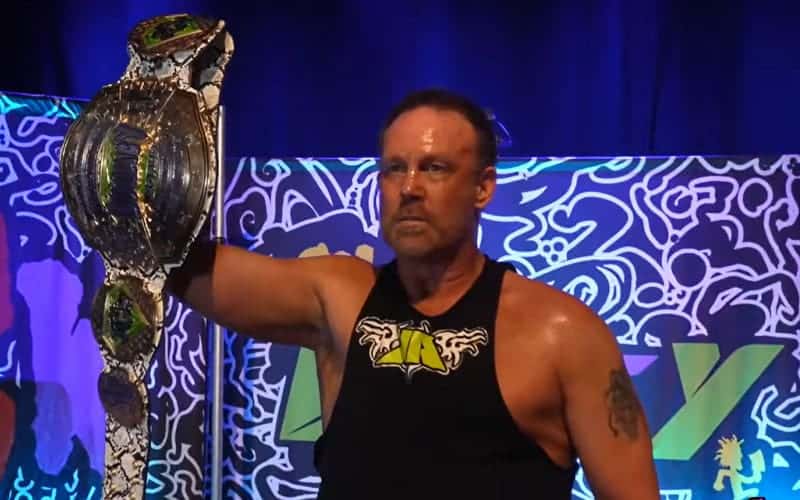
Ken Anderson looks like he’s having the time of his life again – and he’ll tell you straight away, that’s because he is. For a guy who’s lived through the extremes ofWWE, carried the top belt inTNA, and now juggles training the next generation with hosting his ownMic Checkpodcast, that sentence says a lot. It’s not just about being back in the ring – it’s aboutwhereandhowhe’s doing it.
JCW and the Lost Art of Having Fun
When Anderson talks about JCW, there’s no corporate gloss, no buzzwords, just a genuine gratitude for the environment.
He describes the vibe in the company in simple, almost old-school terms: camaraderie, fellowship, a room full of people on the same page, pulling in the same direction. “I’ve only been in a couple locker rooms where the vibe is just camaraderie, it’s fellowship… everybody is there to do the exact same thing, we’re just out there having a ball.”
There’s a pause, like he knows what comparison is coming before he even makes it. “I would never say that anything felt like ECW… but it’s as close to that as I can imagine.”
For a performer whose career has been defined by character, timing and connection, the JCW environment is more than just a booking – it’s a reminder of what wrestling can be when the business side doesn’t suffocate the joy out of it. It’s a place where a guy who’s been to the top can still feel like a fan who got lucky enough to live out his dream.
And hovering over that, somewhere in the background, is a line from the most powerful man in modern wrestling history. “Vince McMahon used to say to us all the time, ‘We put smiles on people’s faces.’”
Anderson laughs a little as he recalls it, because it’s such a “Vince” thing to say, but also because, in its own slightly corny way, it’s true. Whatever you think of WWE’s product over the years, that’s the core of Anderson’s in-ring philosophy: you’re there to make people feel something. Whether it’s in a 70,000-seat stadium, a TNA Impact Zone, or a scrappy, buzzing JCW venue, the job is the same.
WWE and the Voice That Took Over
To talk about Ken Anderson andnottalk about the voice is basically impossible. AsMr. Kennedyin WWE and laterMr. Andersonin TNA, his ring introductions became as iconic as his matches. That booming, drawn-out surname is etched into the collective memory of a generation of fans.
It didn’t come from nowhere. Before WWE, before the national TV runs, before the world title belts, Anderson was just a kid with a fascination for sound. He grew up imitating what he heard – radio hosts, audiobook narrators, that heightened “announcer” tone that somehow makes even the mundane sound important. “It was really just mimicking what I saw… I spent a lot of time in my room by myself listening to records… audio books… I had the Lord of the Ringscassette tapes – four cassette tapes per book, 12-part series the BBC put out – and I just listened to that thing over and over again.”
In high school, amass media classchanged everything. The assignment was simple: invent a product and market it using different media formats. Anderson chose a radio ad and a TV commercial. He did the voiceovers himself – leaning into that exaggerated, almost parody “radio voice” that he’d grown up hearing.
His teacher noticed. “My teacher was like, ‘You have a really good voice, and you should do this. You should do something with this.’”
From there, he was pushed into announcing high school sports – girls’ and guys’ basketball, JV and varsity, volleyball – all the way through his school years. Night after night, he’d get on the mic, hit names with a little extra emphasis, and experiment with projection and rhythm.
Then he left high school and forgot about it. Or thought he had.
Fast forward a few years. Anderson’s inOVW, WWE’s developmental territory at the time, working under the watchful (and inventive) eye ofPaul Heyman. One night, Heyman throws down a challenge that will essentially change the direction of Anderson’s entire career: “Paul Heyman one day at OVW says, ‘Tonight, cut the ring announcer off, cuss him out, and then you do your own big introduction.’ … He said, ‘Just make it big and over the top.’”
In that moment, Anderson didn’t pull something new out of thin air. He went back to the kid in the high school gym. He took the thing that had felt so natural to him in those small-town bleachers and amplified it to fit the WWE stage. “In the moment, when I was in the ring, I decided to hit my last name twice, which was something that I always did when I was announcing basketball games and volleyball games… and then here we are today.”
That’s the thing about wrestling at the highest level: the moves can be taught, the conditioning can be trained, but thevoice, in every sense has to be experienced.
In-Ring Psychology
Anderson moves on to talking about in-ring psychology. For him, it’s not some abstract theory; it’s rooted in lived experience, long drives, and quiet car journeys with veterans telling stories that never made it to TV. “One of the best things in life for me has been getting in the car with a veteran and just listening to the stories and trying to bring that to the people.”
Those car rides shaped how he views wrestling: not as a series of spots, but as a shared language between performers and crowd. The locker rooms he loves – the JCWs, the TNA runs where it felt like family – are the ones where everyone understands they’re part of a bigger narrative.
When he talks aboutTNA, where he not only thrived but became atwo-time world champion, he doesn’t just mention the belts; he talks aboutbelonging. About walking back into that company nearly a decade later and being greeted in a way that reminded him he’d made an impact there. “I remember I walked in, and they were having a meeting, and Tommy Dreamer said, ‘Hey, everybody, here’s former two-time heavyweight champion Mr. Kennedy/Anderson,’ and everybody was very, very welcoming… just a great feeling, great vibes all around.”
There’s a particularly poignant story about his (most recent) return to TNA that sums up how his career and his life as a father intersect. A few weeks before the show, his daughter told him she wanted to see him wrestle for one of the “big companies” again. He already knew the return was coming, but kept it close to his chest. On the night, his wife, and kids came to the show under the impression that Dad was just doing some work at the academy before joining them in the crowd. Then his music hit. “At some point my music hits, and both the kids realise that I’m not going to come sit with them. It was just such a cool thing for me to experience.”
Psychology, at its core, is about moments like that. The switch from anticipation to realisation. The shared shock. The emotional pop. Whether it’s carefully laid out with an agent at WWE, improvised in TNA, or organic in JCW, those moments are (clearly) what Anderson lives for.
Too Funny for Vince McMahon?
To understand why Anderson values that freedom so much now, you have to go back to his WWE run, and to the man at the top.
At first, the instructions from Vince McMahon were surprisingly loose. “I remember asking Vince, ‘What do you want me to do in this promo?’ And he was just like, ‘Don’t go out there and worry about being a good guy or a bad guy, just get over. Just be entertaining.’”
So he did. AsMr. Kennedy, Anderson cranked everything to 11: the smugness, the timing, the mic work, the famous double surname. He even turned ring announcerTony Chimelinto his unofficial first feud, leaning into their on-screen friction as he repeatedly cut Chimel off and introduced himself.
Then came a doughnut…
One day in catering, he spotted a box of doughnuts and instantly thought of Full Metal Jacket: the scene where Private Pyle is caught with a jelly donut in his foot locker, and the drill sergeant humiliates him in front of the platoon. Anderson pitched a riff on it to Chimel, they ran it in the ring, and he essentially re-enacted the whole scene live on SmackDown.
The crowd ate it up. Backstage, Vince had a very different reaction. “Vince flat-out told me I was too funny,” Anderson remembers. “I came back through the curtain after that jelly donut bit with Chimel and he just goes, ‘Too funny, goddammit.’”
It didn’t stop there. WWE.com had given Anderson a segment called“Kennedy Declares”, where he’d cut worked-shoot style rants on different topics. One week he went in onTom Cruise, Scientology, all the couch-jumping weirdness rolled into one.
Again, it landed. Again, Vince pulled the reins. “Later he said to me, ‘Funny does not equal money.’ That’s when I realised there was a ceiling on how far they wanted me to push that side of my personality.”
Anderson pushed back, pointing to the most obvious counterexample in WWE history. “I said, ‘What about The Rock?’ And he was like, ‘Well, I hear you, but…’”
Vince’s logic, as he explained it, was simple: once Rock did the legendaryBilly Gunn ‘Dear God’ promo, he set a bar he had to hit or surpass every week. Comedy, in that system, became a monster you had to keep feeding.
Anderson can see both sides.
He understands the fear of becoming “the funny guy” in a company that still sells itself on big-fight stakes. But it also crystallised something for him: WWE wanted “just get over”, as long as it was within very specific, controllable parameters.
Why Psychology Still Rules
Right now, one of the most polarising figures in wrestling discourse isDanhausen– a performer whose whole act is built on an absurd, horror-comedy character that divides opinion online while shifting a ton of merch.
Anderson, who’s had his own share of viral comedy moments, is firmly in the “there’s absolutely a place for this” camp. “I absolutely believe that comedy will always have a place in wrestling. At the end of the day, we’re just supposed to entertain people, that’s it. And I find it super entertaining.”
For him, you can argue all you want about taste, but the numbers don’t lie. “If Danhausen’s numbers tanked every time he touched the screen, if the merchandise sales were non-existent, they would stop using him. But apparently it’s working. So I think the people who are complaining… sometimes the people with the loudest voices are actually in the minority.”
That doesn’t mean he sees wrestling as an endless meme reel. Quite the opposite: his whole philosophy is built onknowing when not to be funny. “I try to add comedy whenever I can, when it’s appropriate. You can’t use it every single match, every single interview. There needs to be an element of seriousness behind what we do.”
Ask Anderson who has the best grasp ofin-ring psychology today, and he goes right to the top of the card. “I’m a big fan of Roman Reigns. I know that’s an obvious choice, but he gets it. He gets what his role is.”
For Anderson, psychology is about more than just selling or firing up at the right time, it’s about fully inhabiting the function you serve within the show, and working from there.
He also singles outBrock Lesnar, a name more often associated with raw physical dominance than subtle storytelling. “Brock is very giving. That guy could beat anybody up in every locker room, essentially, but he is giving at certain points. It just has to be earned. He’s very good at making sure that if he’s going to sell, it’s going to be for a good reason.”
That “earned” part is the key: Brock selling means somethingbecausehe’s so careful with it. When he chooses to register for someone, the audience knows it matters.
Then there’sMJF, who Anderson puts over without hesitation.“MJF is just… he’s so good. He really is so good.”
All three, in different ways, understand the same core truth:moves are interchangeable, meaning isn’t. You can steal a high spot from YouTube. You can’t steal the way a crowd feels when they see Roman take his time, or Brock finally go down, or MJF twist a city’s love into hatred over the course of a single promo.
Dialling It Down
For someone with such a huge, recognisable “promo voice,” you might expect Anderson to unleash it constantly in real life. He doesn’t.
But he does admit there was a time when his temper used to flare – particularly in the early days of running hiswrestling academy, which he opened around ten years ago. “I think I used to snap fairly regularly for people not listening… it always, always [was] for not paying attention or not listening. That’s really the one thing that irritates me.”
There’s a great line he remembers fromBooker T, a man whose presence in a locker room is its own kind of psychology. “We were discussing something in the locker room, and Booker said, you know, sometimes I like to get mad… sometimes it feels good just to, I like to get mad.”
Anderson gets it. There’s a release there. But over time, especially teaching, he’s had to find a different gear. “I’ve learned to dial it down a lot, so it rarely, rarely comes out.”
That’s part of the story of Ken Anderson now: a guy who once played loud, cocky, larger-than-life characters on the biggest stages in the industry, now figuring out how to channel that energy into creating a space where younger wrestlers can learnwithoutgetting chewed out every five minutes.
It’s in the academy. It’s onMic Check, where he’s not “interviewing” The Undertaker or Kurt Angle so much as sitting with his friends and letting the conversation flow like it would off-camera. “I don’t want it to be an interview… these are my friends and we’re just going to have discussions about the business and where we cross paths in the business.”
Full Circle
Strip away the titles, the initials, the corporate branding, and what’s left is simple: Ken Anderson is, by his own definition, still just a wrestling fan. “If you peel back the layers, I’m just a wrestling fan. I was such a huge wrestling fan that I decided to do it – to actually run around in my underwear – to take it to that level.”
From the kid absorbingBBC audiobooks, to the high school announcer hitting surnames twice, to the WWE loudmouth repeating “Kennedy” into the rafters, to the JCW veteran laughing with a locker room full of hungry talent, it all traces one clear line.
In WWE, working under Vince, the message was simple: put smiles on faces. In TNA, the mission became: find family, find trust. In JCW, it’s back to basics: camaraderie, creativity, and joy. Through it all, the voice, that voice, has never really gone away. It just keeps finding new ways to be heard.
Listen and watch below: