


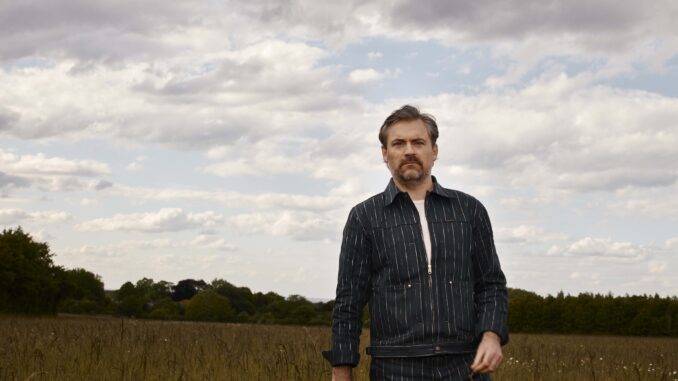
2026 has passed by in a blur for Alex Ellis and his musical project Our Man in the Field. The band have shared stages with the likes of Chuck Prophet, The Delines and Neil Young while also crossing the Atlantic for a series of showcases at AmericanaFest. Somewhere in between the relentless touring schedule, Ellis has found the time to put out a brand new album, Silverado. Our Man in the Field’s third full-length studio album was recorded at Mark Knopfler’s British Grove Studios, with former Dire Straits member Guy Fletcher on production duties as well as contributing his considerable musical talents.
The new songs are ambitious and expansive while retaining that clear Our Man in the Field identity: Ellis’s delicate, vulnerable storytelling vocal over soulful instrumental layers, including Henry Senior’s ethereal pedal steel, which is always a defining feature of Our Man in the Field’s sound. AUK’s Andrew Frolish caught up with Alex Ellis in between shows on the group’s recent tour in support of Huey Morgan shortly after Silverado, the follow-up to the beautifully crafted Gold on the Horizon, was released. Alex Ellis was full of good humour and interesting tales from the road and the studio.
This was a timely chat just before Our Man in the Field are due to make an appearance at the Americana UK 25 Festival: this year’s premiere event!
Americana UK:Let’s start by talkingabout touring. You’ve had some pretty incredible tours and gigs recently. Let’s beginwith Hyde Park with Neil Young. Tell us about that.
AlexEllis: That came about through Jack Bennett at Live Nation. Live Nation is what it is, and the industry was always going to have corporations at the top, dominating the rest of it. But I have to say that the people at Live Nation I’ve worked with have all been really nice, conscientious and professional. What’s heartening is that they’re musical: they know what they’re doing, and they’re just like the rest of us.
Jack really liked our record, Gold on the Horizon, and his boss, Anna-Sophie Mertens, liked it too. They put us on Highways at the Royal Albert Hall, which started last year, and that helped get things moving. They then got us on tour with Jackson Dean, who’s more country than us, but not on the mainstream country side of things. He was selling out large venues, including the O2 Forum Kentish Town and other big places around the country.Touring with him was good because it got us used to playing big venues. They allowed us to play with our full band, which was rare and brilliant.
From there, Darcey Jackson at AEG got involved. She and Jack are friends, which is another nice thing: these two big agencies compete with each other, but the people working there share knowledge. Jack said he thought we’d fit the bill; Darcey liked us, and she put us on the Neil Young bill. It was a super-hot dayin Hyde Park. People were worried that trees might catch fire! The backstage area was shared between Neil Young’s people, Van Morrison’s people, Cat Stevens’s people and the less well-known acts, each with their own little windbreak around their trailer. You’d see the superstars walking around.
Then we heard that Van Morrison wanted to go to bed and wasn’t going to wait around. We were asked whether we’d mind going on after Van Morrison, just before Neil Young. I said, ‘Does that mean Van Morrison is now opening for us?’ They said, ‘Well, it kind of does.’ So, we took it.It was bizarre. We got to see Neil Young, who was suitably angry about everything, just brilliant. He wanted it to be less hot, but there wasn’t much anyone could do about that. They actually put a gazebo on the stage so he could supposedly get out of the sun. On the big video screen, all you could see was his legs because the gazebo was so big, but he was still singing. That was surreal. Then we stood beside the stage watching Neil Young’s show, seeing all the instruments and bits and pieces coming in and out. It was a really great day.
We played with our full band, and Guy Fletcher joined us on Hammond organ. Our friend Anna Lindquist, a Swedish tour manager, happened to be in town with her partner Jamie. They manage and do sound for artists including Israel Nash, Frazey Ford and Kassi Valazza. They had a day off, so I asked whether they could come and help. I had twelve people to manage, and it was going to be hectic. Anna and I have been friends since we started touring in Sweden; she worked at one of the first venues we played. She took some of the administrative pressure off me, which was lovely. It was a fantastic experience.
AUK: What was it like playing in front of a crowd like that?
AE: A bit weird, because nobody knew who we were. We went out during the day with pieces of cardboard with QR codes on them, trying to encourage people to come back for our set.At those events, people have invested a lot of money, and it’s a whole-day experience. Even if they don’t know the bands, they don’t necessarily want to disappear and come back later. They’ll stick around and see what you’re like. By the time we finished, it was absolutely packed, so I think we gained a bunch of new fans.
We also showed that we could confidently perform as a big band on those stages. That has helped us pitch for other shows, including things happening next year. We can show footage from Hyde Park, and our CV now has Glastonbury on it too. For European festivals looking for a big band that can deliver a big show without costing them an arm and a leg, that’s us!
AUK: You’ve found your niche. Big stage and not going to cost an arm and a leg; that’s a great space to occupy. You mentioned Glastonbury as well. That’s another great one for the CV, and very different again, I imagine.
AE: It was in a tent, the Acoustic Stage, but a really nice, massive tent, similar to the one we played a few years ago, only about twice the size. We were a bit worried because Dua Lipa announced a secret show ten minutes before we went on. We thought, ‘Oh, God.’ But it was still great. Perhaps Dua Lipa fans aren’t necessarily the people we need to worry about, but it was fine.
We were talking about it last night, when we played the Phoenix Arts Centre in Exeter. We’ve done a lot of these shows with Huey Morgan in nice venues, and we’re getting better at understanding what needs to happen technically on bigger stages. The people working on those stages have seen it all before, so they can get things sorted quickly. They do it every day and know what to expect.
At Glastonbury, we had the full ten- or eleven-piece band again: horns, percussion, the whole shebang. I expected the first five or ten minutes of our forty-minute set to be a soundcheck, but it wasn’t. I think we’re getting more confident about saying what we need, and the crews are good at what they do. It was great.
AUK: It was a very different crowd again, perhaps.
AE: Yes. Paul Charles from Asgard booked it. It was a thoughtful crowd; perhaps the thinking person’s festival audience. People were watching the instruments and listening to the music, and afterwards they were asking questions about the arrangements. You don’t normally get that sort of response. We knew we had to finish on time. We were coming up to the cut-off during No More, the last song, and I could see we were going to go over. I put my hand in the air to signal that we were at the end, and we cut about a third off the song and went straight to the ending. Paul appreciated that I’d done it to finish exactly on time. He said, ‘I appreciate that. Thanks, man.’ So, I think we kept the people booking the stages happy, which is important.
AUK: Very professional; sticking to time.
AE: Absolutely. I learned from Chuck Prophet. He has a big analogue clock on stage, so he always knows what time it is and can manage what’s happening. Now, for these Huey Morgan gigs, I take a little IKEA clock with luminous numbers and put it on the floor beside my pedals.It’s good when you’re supporting someone, because it shows that you’re not going to run over and that you’re on top of things. But it’s also genuinely helpful. You might have to change the set on the fly. If you feel like doing a bit of storytelling because the audience seems to want that, you may need to rearrange what you do. It helps to know the time.At that Glastonbury gig, I could see we were going to be cut off, so I had to be ready.
AUK: The last thing you want is the plug being pulled halfway through a song.
AE: Yes. Nothing worse!

AUK: You’ve toured recently with Chuck Prophet and The Delines, and you’re away with Huey Morgan at the moment. These are top-class artists to play with, and you must learn a lot from them. What do you take from each of these bands or artists?
AE: There’s a lot to take from them. On the tour we’re on now, everyone is very relaxed. First of all, everyone is nice and polite. Even if they don’t necessarily feel like being nice and polite, they are, because that’s how you keep a tour going for a long time.Our percussion player is currently touring in America with a big band. We actually met him in Nashville because his tour happened to be playing there on one of the nights we were in town. The seven of us arrived and needed two Ubers. He said, ‘We’ve just come in twenty-two trucks from New York.’ It’s a different world. He’s playing to crowds of at least 20,000; tours like that are made or broken by whether people are polite to one another at the beginning and keep it up. Obviously, the music has to stay good, and people mustn’t fall out. I don’t think Huey’s people, Chuck’s people or our people are likely to fall out, but there’s a relaxed atmosphere. We’re all going to do this, and the minimum we can do is be really polite to one another and look after each other. Then the show will take care of itself. That’s important, and it’s something we try to do with Our Man in the Field. You have to trust that your music is good enough by the time you get on stage for the first show. You rehearse, prepare and get on with it.
From Chuck, I’ve learned a lot about showmanship and stagecraft. Huey has a different approach. He’s very relaxed with the audience, talks to them and tells stories, probably more in the way I do. Chuck is a persona on stage. There’s music happening while he talks, and it’s almost like going to the circus and listening to a man announce, ‘And now here comes the lion tamer,’ except it’s him doing the next song.
Huey is very much himself. He makes jokes and tells stories, and he’s a fantastic guitarist, by the way. I don’t think people realise how good a guitarist Huey Morgan is. His band are all really great too. I like Huey’s approach because, and people won’t necessarily, automatically see this, he makes the whole thing into an event. It reminds me a little of what Nick Cave does, and what British Sea Power used to do with their live shows. There’s a theme, and the whole thing becomes a block party. Mateo DiFontaine is on the decks playing records. If you imagine going to a show in the late eighties or early nineties in a big warehouse, there’d be a DJ playing records and a whole scene around it. That’s the feeling Huey creates. He considers the whole event, even if the changes are subtle.I like that approach. I haven’t fully worked out how we could do it ourselves, but it connects with what we’re doing with Radio Free Silverado. The album concept is meant to influence all the different parts of what we do. Huey does that in his way, and Chuck does it in his.
The Delines are The Delines. They warm you up in a slow burn. You listen to most of what they’re doing and think, ‘Oh, my God.’ The stories are in the songs, so you have to listen to the words, and they transport you to wherever the song is set. All of that is something to learn from.It’s repetition. The more comfortable you become on stage, the more comfortable you become playing guitar or singing. There comes a point where I don’t have to worry about what I’m going to say. I never really prepare it, and sometimes it’s gone a bit sideways, but I don’t worry about it now. In fact, I deliberately don’t prepare something, because it’ll be all right. I’ll know what I’m going to say, and something will come out. I think that’s better. It’s what Chuck does, and it seems to be what Huey does. It’s always better if it feels spontaneous and belongs to that night. What I’m saying to you tonight isn’t what I said last night, even if I’m talking about the same thing. It’s for you tonight only, and I think that’s important.
AUK: If it’s too planned and something goes slightly wrong, or you say the wrong thing, you can get thrown. It’s probably better for it to come out as if it’s fresh.
AE:I used to worry that if I didn’t say certain things, I’d forget something important and the story wouldn’t be as good. Now I think that if I forget something, the other bit must have been good enough on its own.
AUK: You mentioned Nashville earlier, where you met up with your usual percussionist. We’ve got to talk about AmericanaFest. Am I right in remembering you had five showcases?
AE: We did. We hadn’t got a slot at AmericanaFest, as far as I could tell. I was disappointed because we’d applied every year for as long as I could remember, and I was beginning to think we just weren’t going to get a chance.It came about because we were opening for the Del Fuegos in London in June. I lived not far from Gatwick and was coming back from Spain, so I volunteered to pick Warren Zanesup from the airport. We didn’t have much time, and I thought I could help with the gear. In the end, some of the band had to go to hotels, so it was just me and Warrenand the gear, driving to the Lexington, where we were playing.
Warren knows Chuck, and Chuck had already told him I’m a good guy or whatever. We had a lovely long conversation in traffic about all sorts of things. He talked about how Tom Petty had helped the Del Fuegos. What you need, he said, is an agent, by which he meant a musician who is further along in their career and can open doors for you. People in the industry listen to artists. They listen to other people because they work with them, so they do what they must do, but when another artist asks for something, they may do it because they feel the benefit themselves and want to help.
Tom Petty had been pivotal for the Del Fuegos. He would often say they were his favourite band, and they got opportunities because he kept mentioning them.Heaskedme, ‘When you play, is there anything I can do to help?’ I was taken aback. He asked when we were playing next, and I said we were still waiting to hear whether we’d got a slot at AmericanaFest in Nashville. I thought we should have heard by then.He said he was personal friends with Jed Hilly, who runs AmericanaFest, and asked whether that was the person I meant. I said yes. He messaged him while we were in the car and said he’d call him in a bit and sort it out. I thought, ‘I’m pretty sure it doesn’t work like that, but…!’
When we were playing the gig, I could see Warren holding his phone out towards us. After we played, he was on the phone saying, ‘No, Jed, you don’t understand. It’ll be good for you. These guys are fucking amazing.’ He hung up and said, ‘It’s a done deal. You’re on.’ Sure enough, we got an email confirming it.
Then it was a mad scramble to get onto the PRS International Showcase Fund and sort out flights and accommodation. But we did it, and it was great. I really owe Warren one. People often say they want to help or ask if there’s anything they can do and, in the moment, they think they can; it’s not just the beer talking. But it’s rare they can because the reality is usually more complicated than that. But he did it that moment; he made the call, did the deal, on our behalf. The reason I’d been so keen to get an official showcase was that a few people had said, ‘If you get an official showcase, we’ve got another showcase we can put you on, but we can’t get you on until you have the one from Jed.’ Once we got that, everything else kicked in.
Our friend, Graham Weber, who works for the Texas Music Office, had arranged for a letter from the governor of Texas, Greg Abbott, personally inviting us to play on the Beyond the Texas stage at AmericanaFest. We were the first non-Texans, not even the first non-Americans, but the first non-Texans. It’s like being the first non-Yorkshireman to play for Yorkshire at cricket. It was a huge honour, and we had a great slot. They packed the venue, and it was brilliant. We played the British Underground showcase, another one with the Texas people, our official showcase, and one on the Sunday as well. From that, we’ve had some big festival offers in America, some really good club offers with good fees, and plenty of other things happening with labels and press.
Some European opportunities have come from it too. There’s a really good festival in the Netherlands where the organiser couldn’t get to our showcase at Skinny Dennis, the Texas one, but had heard it was sensational. He asked whether we could hold a date for next year. I always thought that if we got the chance, especially with the band as it is now, we’d do well. Hopefully, people can see we’re doing this professionally, rather than treating it like a holiday tour. It went better than I expected, and we now have almost a problem in terms of how many tours we could fit in. We need to get the visas, which is great, but we have to fit everything in around what we’re doing here. Next year is going to be super-busy, but in a good way. It’s taken a while to get to this point, but there are all sorts of benefits from that. One is that we can deliver what’s needed. We’re good enough on stage for people to feel that it was worth the effort of getting us there. The money we’re being offered now makes it viable; previously, it would have been much more difficult. We’ve also got a back catalogue now, so it isn’t just a case of, ‘Why this band tonight? Here’s something that’ll be gone tomorrow.’ There’s a story and a history behind how we got here, and I think the kind of audience we’re aiming for appreciates that.
There’s a venue called Callaghan’s in Alabama, witha small listening room. The person who runs itmightput uson in the same series as Jason Isbell and Dylan LeBlanc. The ticket prices for those artists might be $100 or $200. He said we could still fill the room with tickets at perhaps $30, while earning a good fee. Audiences almost prefer that kind of discovery: they may not know the next artist, but they trust that the venue’s choices will connect with their taste. That’s exciting.
Another thing that’s happened since Nashville is that we’ve also had a lot of radio play in America. Every few days we get enquiries from festivals or other places saying they’ve heard us on this station or that station. Colorado, for example, is somewhere we haven’t spent much energy marketing, but people there seem to really dig it. There are a couple of good festivals there we might get onto.There’s also the Sonny Landreth connection through the record that could lead to some exciting things in New Orleans, probably in 2028. It’s great that people are discovering us through this record and then looking back at the previous onewe did with Tucker Martine and wanting to bring us over to play that material too.
I always thought America was a market we should focus on, because our streaming analytics showed that more than fifty per cent of our audience was there. People would tell me it was too expensive to tour America and that it wasn’t achievable. I nodded along, but I always thought we didn’t know that yet, because we hadn’t been there to see what we could do.
There are bands who might have been told the same thing over in America. Chuck is a good example: he comes over here, and it flies, to his delight. The UK and parts of Europe became his best markets. Taking the romance out of it and looking at it as a business, that’s what happened to his career. I’m already hearing similar things said about us, and venues understand that they may need to pay us a bit more than a local band because we’ve come all the way from the UK. They appreciate the cost of getting us there. Fingers crossed it all stays as busy as it looks.
AUK: You mentioned the radio play in the US. Which songs are getting traction over there?
AE: Wall of Sound, which was the first track we put out from the record, seems to be getting a lot of play. Doing Alright is doing well too. There’s a story in that song that people can probably work out and connect to if they listen to the lyrics. And Don’t Think is quite a radio-friendly driving tune.
AUK: We’ll definitely get into the songs from the new album, but before we move on from the live stuff, there’s one show we have to mention: the Americana UK 25th anniversary. That must be the biggest show of the year for you; forget Glastonbury and Neil Young at Hyde Park! That’s pretty cool.
AE: Biggest show ever! I can’t wait. We’re on tour with Chuck around then, and it falls in the middle of those dates, but the band are going to drive or get the train up. I think our slot is about 2.45, so it’s very doable for everyone to get there. We’re coming in mob-handed! I hope they’re ready for us, because sometimes people are surprised by how many of us there are. I’m looking forward to it. I’ll be right in the middle of that Chuck run, so I’ll be match-fit, so to speak.
AUK: It’s a great line-up for the festival and a great celebration for us.
AE: I think there’ll be a lot of people there who still haven’t seen us play live, even though youguys have written about and supported us since the beginning. We’ve never played in Liverpool, for example, so I’m looking forward to that. I don’t think many people have seen this format of the band yet, and hopefully it’ll be a nice surprise to discover there’s more going on.

AUK: Who’s in the band at the moment who’ll be touring with you?
AE: It’ll be Jimmy on drums, Raul on keys, Henry Senioron Dobro and pedal steel, and Maddy Cundall on cello, then Miles and Matt Backer. Matt is our guitarist. He’s played with Emmylou Harris and Steve Earle, and was in ABC for a while. He’s played with all sorts of people. His son Miles is our bass player, and he’s phenomenal. He’s in his twenties, but he’s one of those musicians whose dad put a guitar in his hands from the start and said, “That’s you.” They’re brilliant. Our horn players are Steve Grainger and Stewart Prosser. Steve was in Culture Club, and both of them have played with Paul Weller since the eighties. They’re fantastic. We also have Will Fry on percussion, who plays with Jungle. There may be a gap in his schedule: he comes back at the end of November and then goes back out with Jungle, so there’s an outside chance he’ll be with us. And you never know, the magical Guy Fletcher might just arrive ready to roll.
AUK: It’s a hell of a band, and a huge number of people on stage to create that wall of sound.
AE: While opening for Huey, we’ve done shows in different formats: some full band, some solo, some just with Henry and Maddy. We’re hopefully doing a TV show next year, and we’ll possibly do it as a three- or four-piece, depending on what they want. I think one of the strengths of Our Man in the Field is that it can fit whatever the situation needs. If people like the music, I can turn up solo and open for Huey Morgan, which some people thought wasn’t going to work. I just change the set and play the material that fits. That’s worked really well. We had a nice review in the local Brighton paper after one of those shows, and then the next night we were in London with the full band and got a good response there too.
One way to make the modern music scene work is to be able to say yes to every gig if you want that gig.Don’t worry if someone can’t afford the ten-piece band, or if that isn’t appropriate. We can do a folky Our Man in the Field set, or we can do the full soul-and-groove thing. We can do that without pissing offthe people who like the folkier material by suddenly being a bit more groovy.I think we’ve found a really good balance with the players we have. Nothing pokes out too much. You have to be honest with yourself and listen. You might really like the way someone plays something, but you have to ask whether it works for what you’re trying to do. That’s one of the difficult parts of being a bandleader: recognising what isn’t working and making a difficult decision so the music can reach its full potential. That responsibility falls to me.I think we’ve found that balance now. When we send out our information and videos showing what we sound like with everyone in the band, the package is basically saying: we can do almost anything. Whatever budget you have, we can deliver you a band. That’s quite rare, and it’s helping us.
AUK: The band is versatile, but you’re also staying true to what you doand being consistent. The fact that thesongs work solo acoustically or with a full band swinging and swaying behind youis a realtestament to thequality of the songcraft: the songs can be played in different ways and still come through as Our Man in the Field.
AE: That’s good to hear. One of the challenges we’ve had, and something we’ve talked about a lot in the band, is making sure the vocal sits right above everything else. If people can’t hear what I’m saying, the music might sound great, but they won’t get the full thing. People who know us have sometimes said afterwards that they couldn’t really hear my voice, which means other people in the audience won’t have got the full experience either.Now, when we go into new rooms with new engineers, we have a set of instructions. My voice has to be right above everything else. If that feels uncomfortable, go with it a bit, and we’ll tell you if it isn’t quite right.The engineers in Nashville are a particularly good standard, even in small clubs. They understood straight away that it’s vocal-led music, so they would EQ the vocal and place it higher in the mix. If it didn’t sound right, we’d change it.
We’ve got quite good at knowing how to set things up at soundcheck so people can hear what I’m saying. I think I’ve also got better at enunciating. I have a tendency to mumble when I’m thinking about something, and when I get into the moment, I can jibber on. I used to do that when I was telling the story behind a song: I’d be living the experience and then just talk and talk. Something about it is just being able to recognise the little tweaks, small percentages of stagecraft, relaxing and being able to enunciate. The story parts need filtering down, too, so you don’t necessarily have to do the whole War and Peace about a song to get its essence across in a little bit of chat. That might change depending on what’s happening in the room. The more you do it, the more you make notes and learn from different things, the easier it gets. The thing you mentioned about still being Our Man in the Field, whether it’s me and Henry or me and ten other people, that helps people. In York, for example, we’ve got Steve from The Chances drumming for us because Jimmy is in New York. We’ve got different musicians who can come in. He’s a great drummer, a different feel from Jimmy, but we all respond to that and make it positive. The steadier I am, the more the band can do their thing and respond musically in the moment to whatever’s going on.
AUK: I remember seeing just you and Henry in Norwich years ago. For some reason his pedal steel wasn’t working, so he had to do everything on the Dobro. It was as acoustic as you could possibly get: just the two of you, without the pedal steel. Everything was stripped back to the bare bones of the songs, so it really relied on their strength and the storytelling. I’ve also seen those same songs with a full band behind you. They have a totally different feel, but they’re clearly still the same songs and the same band. That adaptability and versatility, while remaining true to yourselves, is important, and that kind of adaptability is one of the reasons you’ve been successful.
We’d better get into the album. Your new record is called Silverado, and this time you recorded with Guy Fletcher from Dire Straits. What’s the story behind the writing and recording of the album, and how did that connection come about?
AE: Raoul, our keyboard player, has known Guy for 30-odd years. They were friends in the 1980s. Raoul was in some bands that had a bit of crossover with Guy’s work. As a side note, Raoul actually bought the keyboard used on Walk of Life, with the original synth sounds in it. He’s now auctioning that keyboard to raise money for War Child, for the song we’re doing, Something Has Got to Be Done.
Guy is involved with Dolby Atmos. He, his dad and his brother started a company called Airsound, which makes these amazing Dolby Atmos speakers in a much smaller form. Previously, you needed somebody to come in and install fifteen speakers in your ceiling and fifteen in the floor to get that three-dimensional sound. At some point it would be cheaper to have a band come and play in the room! Guy developed speakers where you only need two, but they do all this clever stuff. His dad used to work for one of the big studio companies.
Guy said he’d like to remix Gold on the Horizon in Dolby Atmos for free. Normally that would cost thousands, so I thought it was because he was friends with Raoul and had the equipment to do it. We said, “Yes, of course.”He did it, and I didn’t know how it was going to sound. I’d always felt that Gold on the Horizon hadn’t got in front of enough people. I thought it was a great record and was disappointed it hadn’t been played on the radio more. This gave us a chance to do a kind of re-release.
We had a listening event in Soho. Some press people came, along with people from television and radio. I ended up playing Glad to See You on guitar before we listened to the Dolby Atmos mix. That was a huge mistake on my part, because I found myself about four feet away from Bill Wyman, who was staring at me while I played and sang. I thought, “What? Nobody told me this was going to happen!”It was all a bit surreal, but people really liked the mix, and it went well.
I think that helped form the relationship. Guy then said he’d love to produce a record, and that we could do it at British Grove if we went ahead. We had conversations about what that might look like. He asked me, in a money-no-object situation, who I’d want to play on it and what I’d want to achieve. I described the sound I had in mind and said I had loads ofsongs; it was just a question of working out how to make the next record.
I mentioned Ethan Johns on drums, partly because of theRay LaMontagneconnection and the bands he’d worked with and played in. He has a sound I thought would be interesting to try on these new songs. I’d also been listening to a lot of Curtis Mayfield and wanted to move the feel towards a more soulful, American sound –something like what Van Morrison was doing in the late 1970s, up to Beautiful Vision. Those more American-sounding, Caledonian soul records.
I listed people who might play, and Guy said he knew all those people personally and could definitely get Ethan, and probably his dad, to come down. That’s what happened. We did some demos at Guy’s house, then had a week at British Grove. He brought in Sonny Landreth, a close friend of his, to play on Something Has Got to Be Done. Ethan Johns was there, Nick Pini was there, and the rhythm section was the gold standard – the best rhythm section you could imagine. Ethan’s dad, Glynn, came in too.
At one point I was looking out from the control room, with all this fancy equipment, and there were Glynnand Ethan Johns playing, Nick Pini over there, and Guy on the Hammond. It was surreal. Then P.P. Arnold came in. Our publisher knows people and is a close friend of P.P. Arnold, and she was amazing. She just came in and blew everyone away with what she could do. Robbie McIntosh came in and played and was obviously fantastic. My band rose to the occasion as well.
It was a surreal five days. We got thirteen or fourteen songs done in five days. When you have people who are that good, and everybody is playing live, the sound is so immediate. Whenever I’ve made a record before, I’ve been a bit nervous about the first bar of the first song, wondering whether it’s going to work and whether it’s going to be tricky. This was like a dream. It was as if we’d been playing together for years.
Ethan’s approach was so interesting because he would add things I don’t think I’d ever have thought of. That influenced everybody else and the personality they brought to their instruments. On No More, Raoul went to university in New Orleans, and we were talking about that New Orleans feel in the drumming; the marching-band kind of thing. Ethan came up with this rolling pattern. It was really complicated, but it changed the way I sang the song and the way everybody played it. We thought, ‘Oh, this is it.’ We did it in two or three takes.
Another amazing thing about British Grove is that, when you walk back to listen, there are four or five people in white coats transferring the recording to tape. You can listen to the tape rather than just a digital Pro Tools playback. You hear everything properly in the control room, which sounds like the most amazing cinema you’ve ever been in. All of that helped, as did Guy doing such an amazing job.We had that week of preparation, during which we made the demos, so everybody could hear a really good version of what we were trying to achieve. Guy did loads of work on those demos, so everyone knew what we were going for. We had every opportunity to make a good record, and everybody did. It sounds amazing.
AUK: How did that compare with working with Tucker Martine in Portland?
AE: That was a wonderful experience as well. It was in the middle of the COVID period. We flew into Portland as soon as the restrictions were relaxed enough to let us in, and then had to create a sort of bubble while we were there. We did lots of strange COVID testing, but we were legally allowed to work with the people involved. We were there for just under a month, so we had much longer to try things out.
We broke things down differently and started with the rhythm section. There was an amazing bass player called Luke Ydstie, who plays with Blind Pilot and The Hackles and has toured here a bit. He’s a Swiss-army-knife kind of musician who plays just about everything and had great ideas. We had a long time to listen, come up with ideas and try things out.
I think everybody had been starved of company and work, so sometimes we’d go on until two or three in the morning, trying guitar pedals on synths or random envelope filters on the double bass to see if we could make it sound different. The drum sound on L’Étranger, for example, comes from Jerry Joseph’s National guitar, tuned to E-flat major, or whatever key the song is in. The microphone inside it picked up the drums, and that was linked to an amp in Tucker’s reverb chamber in the basement, which had physical plates in it. The sound resonated through the metal body of the guitar and its pickup, down into the reverb chamber. It sounded like a bell in the distance, but it was actually the drums.
That record was different because Tucker and I had had about a year of conversations before making it. We’d send endless demos and ideas back and forth. Afterwards, we had a long time to ask what we thought of things and what we wanted to add. I look back on it very fondly. Tucker is a really nice bloke; we became good friends and still message each other about bands and ideas.
The collaboration was about Tucker and me coming up with ideas, and then the group of people we had there working together. The band flew out, and we were all in it together. It felt a bit like us against the world. Henry was starting to play more Dobro at that point. Traditionally, you’d mic a Dobro and get a nice, clean acoustic sound, but we were putting distortion into it, trying different amps and pickups, to make it sound more like an electric guitar while keeping Henry’s personality. Raoul was back in the UK, sending keyboard takes overnight, so the next day we’d have a whole new thing to listen to and fit in. It was different, but I look back on it very fondly.
AUK: One thing I’ve noticed about Silverado is that quite a number of the songs are long; five or six are well over five minutes. They seem to have movements within them, instrumental sections and complex arrangements. The writing and arrangements are ambitious. I imagine that’s partly a product of working with such a talented group of players, but could you talk about what you were trying to achieve with that direction and sound?
AE: Some of the songs were written a long time ago, or the ideas came from a long time ago, while others happened very close to the record. Once I decided the record was going to be about America from a non-American’s point of view, I could collect the songs that were already about that and think about the ideas they gave me. Most of them are about individuals we’ve met.
We had quite a body of work and lots of songs to choose from. When we started playing the first few with that incredibly talented group of eleven people, it was a bit like a jam band. You’d be playing the groove, and things would happen and develop. There may well be an extended Silverado double album at some point. There are versions of No More and War of the Worlds that will be released as a companion disc for the vinyl. We couldn’t fit all the songs on one record anyway, because some of them are eight or nine minutes long.
I’d like people to hear those versions because Ethan changes something, then you hear the bass respond, and somebody goes off on a little mini-solo. It’s lovely. The first rough mixes we got back from the studio were all very long, and we had a difficult job deciding what to cut. There was such good playing and such a good feel; the musicians had taken the essence of the song and run somewhere with it, and you wanted to keep it.
We had to edit things down for the digital and vinyl releases. I’ve finally managed to collect the vinyl from the pressing plant. We could only fit eight songs on that, so we knew we’d probably need to release some more next year. There’s another song I’d like to record, too. We may use that next disc to include the longer version of War of the Worlds and the longer version of Barrier, which is about the protests in Austin and my pal Graham. We won’t be so restricted by the vinyl format.
Some of the playing was just so good that we had to keep it in. Guy was fantastic at helping us manage the songs, taking bits out without losing their heart and soul. In terms of what I was trying to do, the stories in the songs are what matter. We’re never going to be a pop sensation with two-and-a-half minutes of chorus, chorus, chorus, so I wasn’t too worried about length when I was writing.
War of the Worlds, for example, has two more verses that won’t be on the version coming out in the new year. The same is true of a couple of the others. They’ll come out at some point because they’re part of the story, and you want to give them an airing in some capacity. Thankfully, we’re not restricted by that. Our publisher did say we’d need shorter versions for radio, and we did make a shorter version of Wall of Sound. There’s a fantastic long intro to Wall of Sound that will be on the album but not on the radio single. No More has an outro that would be a shame never to hear.
AUK: I love those otherworldly intros and music you can get lost in. I was listening to No More the other day, relaxing and not really thinking consciously, and then realised I was still listening to the same song. I love that feeling of being so absorbed in the music that you get lost in it and in the moment. That’s one of the things I really like about this album.Let’s think about the inspiration behind some of the individual songs and their stories. Wall of Sound has been one of the singles. What’s the story behind that song and the characters in it?
AE: Wall of Sound came from our first trip to America in 2019, during the first Trump presidential term. I was a little worried about what we might find, but at that point it was almost a novelty: “Gosh, they’ve voted this guy in, and he’s completely upset the system.”It didn’t feel as alarming as it might now. It was also post-Brexit, so there was something happening in both countries that felt similar. We weren’t travelling through major cities. We drove from New York down through Memphis and Nashville, down to El Paso, then to the Grand Canyon and across to Los Angeles. We saw a lot of small towns and places. As soon as people realised we were British, they wanted to talk to us at petrol stations and elsewhere. One particular guy wanted to show us his truck. In Arkansas, some older guys had brought out a couple of classic cars at an ordinary petrol station and were polishing them. They weren’t doing it for money; they were doing it for themselves, sitting in deckchairs and talking about the cars. I was looking at them because they were cool.
The guy with the truck wanted to show me pictures of a truck he’d had to get rid of. He now had to be a company man because the government had changed the rules about how self-employed people reported their taxes. It was no longer viable to be an independent trucker; you had to work for a company and drive its truck. He was really angry about it. Before I could ask whether he’d voted for the government that had brought in the changes, I saw that his truck was covered in Trump stickers.I asked him about that, and he said, “No, no, no, you don’t understand. That’s totally different. He’s on our side.”He thought Trump was going to bring it all back. I didn’t push the point. The man had voted for someone who had done the opposite of what he was complaining about, but he clearly saw something in Trump that he thought would make things better for him.
He showed me inside the truck. It was incredible: basically a camper van at the front, with a big bed at the back, a toilet and shower, and then the driving seat. I’d always wanted to get inside one of those big American trucks. Romantically, I’d imagined it would be quite cool, and it was. I could see the appeal of driving thousands of miles a year and seeing the vast expanse of America. The flatness and vastness of the southern states are different from driving in the UK or Europe. It’s not the same as driving from Leeds to Stockton.
His reasoning for supporting Trump, and his dissatisfaction with his lot, reminded me of people in the north-east of England and the north who voted for Brexit, including fishermen in different parts of the country. They thought they were voting for something positive, but they were voting for the very thing that would ruin their lifestyle, their livelihoods and their children’s futures if they wanted to do the same work.
I remember a man in Doncaster on the news, in his pub, in a piece about not being able to get workers from Europe. He was angry about that, but he’d voted for Brexit because the council had spent £10,000 on an art installation; a metal statue or something. I could understand his frustration. Perhaps Doncaster didn’t need a million pounds spent on art if it didn’t have good schools or whatever. I could see where he was coming from, but he’d been persuaded that voting for Brexit would help, and obviously it didn’t. It wasn’t the case.
AUK: So, halfway around the world, you find similar stories and similar feelings. Human stories, that’s what comes through in a lot of these songs. Another song that intrigued me lyrically is Something Has Got to Be Done. It feels almost like a newsreport from the field, and again there are human stories coming through. What was the inspiration behind it?
AE: That’s a long story. John Snow went to report on a children’s hospital, I think in 2014. It was the first recorded incident in which a children’s hospital was deemed a legitimate target, supposedly because there was a rocket launcher in the hospital. It had been bombed to prevent that rocket launcher from firing rockets.He had to interview the politicians and was live at the hospital, but he wasn’t allowed to show the children or the doctors, or really much of the hospital at all. He made a film and put it out on YouTube himself, saying, “This is what I wasn’t supposed to show you, but I’m going to do it myself.” He thought he had permission from Channel 4 to do it, but it nearly cost him his job because it was deemed to be outside the editorial rules.
At that time, Channel 4’s licence was under threat for quite a long period. It felt as though there was nothing the Conservatives would like more than to revoke the licence and sell it to one of their friends. It was a dicey time. I happened to see the YouTube film and wrote the song about it. I’ve always thought of Our Man in the Field as a correspondent: someone sent to a place to report on the people who aren’t necessarily the politicians or the polished figures we see on the news, but on how events affect ordinary people. That was what John Snow had done.
I sent a demo to his agent and asked them to pass it on because I thought what he’d done was great. I didn’t think much more about it. Not long afterwards, I went to Paris with some friends. We were going out for dinner and perhaps to see some bands. It happened to be the night of the terrorist attacks. We’d had a few drinks and were eating dinner when something started happening, although we didn’t know what it was.First, we were locked in the restaurant, then everybody was kicked out. We walked the streets, but the phone signal was turned off, and the Internet wasn’t working properly. We were a bit stuck. We saw lots of police and realised something was happening. We heard some explosions and gunfire. There was nobody else on the streets, just us, and it took hours to get back to our hotel.
My partner, Ellie, managed to get a phone signal and used Google Maps. I told her where we were, and she told us where to walk, but we’d get somewhere and find a roadblock. There were police cars, and even civilian cars with police in them. Some officers looked as though they’d just got out of bed: they’d put on their bulletproof vests, picked up their guns and helmets, and were stopping to look around. One of the guys I was with was pushed against a wall and shouted at in French. We didn’t understand what they were asking. Eventually we got back to the hotel at about four in the morning.
I went to reception to see whether somebody could tell us when the next train was or give us some information. The Channel 4 news team came in, and I found myself standing next to John Snow. It was too strange not to say something. I said, “Excuse me, Mr Snow. I know you’re busy, but it would be weird if I didn’t say anything. I’m Alex. I wrote a song about you, and your agent sent it to you.” He remembered it and said, “Oh, you’re Our Man in the Field.” He said this was going totake ages and suggested we have a coffee. We ended up having a croissant and a coffee in the hotel lobby. He told me that he and his generation of news correspondents were worried about the way news was changing. They weren’t allowed to report on things in the way they were used to, and people’s consumption of news was changing. This was before TikTok and Instagram had taken hold, although Facebook was already influencing the way people consumed news.
He was deeply concerned and said a lot of people of his generation felt the same. We talked about making a film to go with the song, and we kept in touch. He spoke to some of his colleagues, and we had people from CNN and other recognisable news organisations involved. The idea was to capture what happens just after correspondents return to the studio from reporting somewhere. There can be a moment when you see their real feelings: a facial expression, a shout, a cry, a swear word, or something happening behind them that they’re trying to ignore. John felt that people don’t usually see that human side, but perhaps they should.
Unfortunately, Channel 4 said he couldn’t participate because the whole impartiality thing would be in question, so the film didn’t happen on that basis. When I sent the demos for the new record to Guy, the song was among them, and he said we should definitely record it. I explained the John Snow story and said that if this song is going to be in there, it must be for War Child; there has to be an explanation. I was concerned that we shouldn’t appear to be raising the profile of Our Man in the Field through somebody else’s suffering. That was especially important because the subject is even more relevant now than it was then.
Guy said, “I’m Guy Fletcher. I’m in Dire Straits. We’re already well known. You’ve got these people on the record. You don’t have to worry about that side of it.” So, we recorded it, and I think we’ve done a good job of the song. We are releasing it with War Child. We’re also putting together a film. We have a lot of footage, although some of the available footage of children in war is very difficult to watch. We haven’t got as much behind-the-scenes or B-roll footage of war correspondents as we’d like.We’re still hoping to get more. In the last couple of weeks, a chap who works with Adam Curtis has been in touch, and he has some stuff. A Palestinian journalist has also been in touch with a big archive. We’re close to finishing the film, and then we can do the special War Child version of Something Has Got to Be Done.
AUK: It’s a brilliant song, and in many ways it sums up what Our Man in the Field is about: the correspondent reporting back on different human stories. I think it’s an important song for that reason. Could we have a word about the title track, Silverado, and the inspiration behind it?
AE: The title track, Silverado, is basically me trying to bring together all the influences I could think of. The album, in its essence, is about that. There are so many great Americans we know from history, as well as our friends. We can’t just shout and criticise America as though it’s one mob, one person or one thing. It’s so much more than that.You’re not going to bring anybody round to your way of thinking by shouting at them. A child doesn’t respond to being shouted at, and adults certainly don’t either. I was trying to remind myself of all the things I love about America and the great influences it has had on everybody, whether we like it or not. Hopefully we can support those people, because they’re the only ones who are going to get themselves out of this. We can’t take America on in any capacity.The essence of the album is to celebrate the good Americans and give them some sort of support, while reminding myself of the things I love about the country. I’m driving around in a 1993 Ford Econoline van because my 2004 Ford Explorer is in the garage. It’s that sort of thing, really.
AUK: Finally, can we have aquick word about Al’s Pals?
AE: Al’sPals is a sort of secret, semi-secret songwriters’ round. We did the first one with Laura Veirs and Karl Blau last month, and we’re going to do another in the new year. Whenever we find a songwriter we really like who is playing in London, we bring them together with somebody people might not know so well but whom we know is really good. It’s just the three of us: me, that songwriter and the other person.
We’ve been talking to various arts organisations and venues that are keen for us to do it. The eventual plan is to have three or four songs each, and perhaps my band will back the visiting songwriter for a full-band version of one of their songs. It’s been quite flexible so far. It seems to be something that the UK, or London at least, doesn’t have in quite the same way, whereas other places do.
We’ve got great film from the Laura and Karl Blau event, which we’ll release when we announce the next one. We’ll use that video to show people what it is. Everybody seems up for it: the artists, the managers and the venue, and they understand that it isn’t a gig. It’s a storytelling and songwriting event that happens in America all the time. The songwriters’ round is a well-established format there, but I think it’s still unfamiliar here.
AUK: That sounds brilliant, and it’s not something we see a lot of over here. I always love hearing the stories behind songs, so I think that’s great. As ever, it’s been a pleasure to talk to you, Alex. I hope to catch up again soon. Thanks very much for sitting down with us, and good luck with the rest of the tour.
AE: You’re very welcome. Thanks for having me, AUK; looking forward to seeing you later in November. Take it easy.

Related