

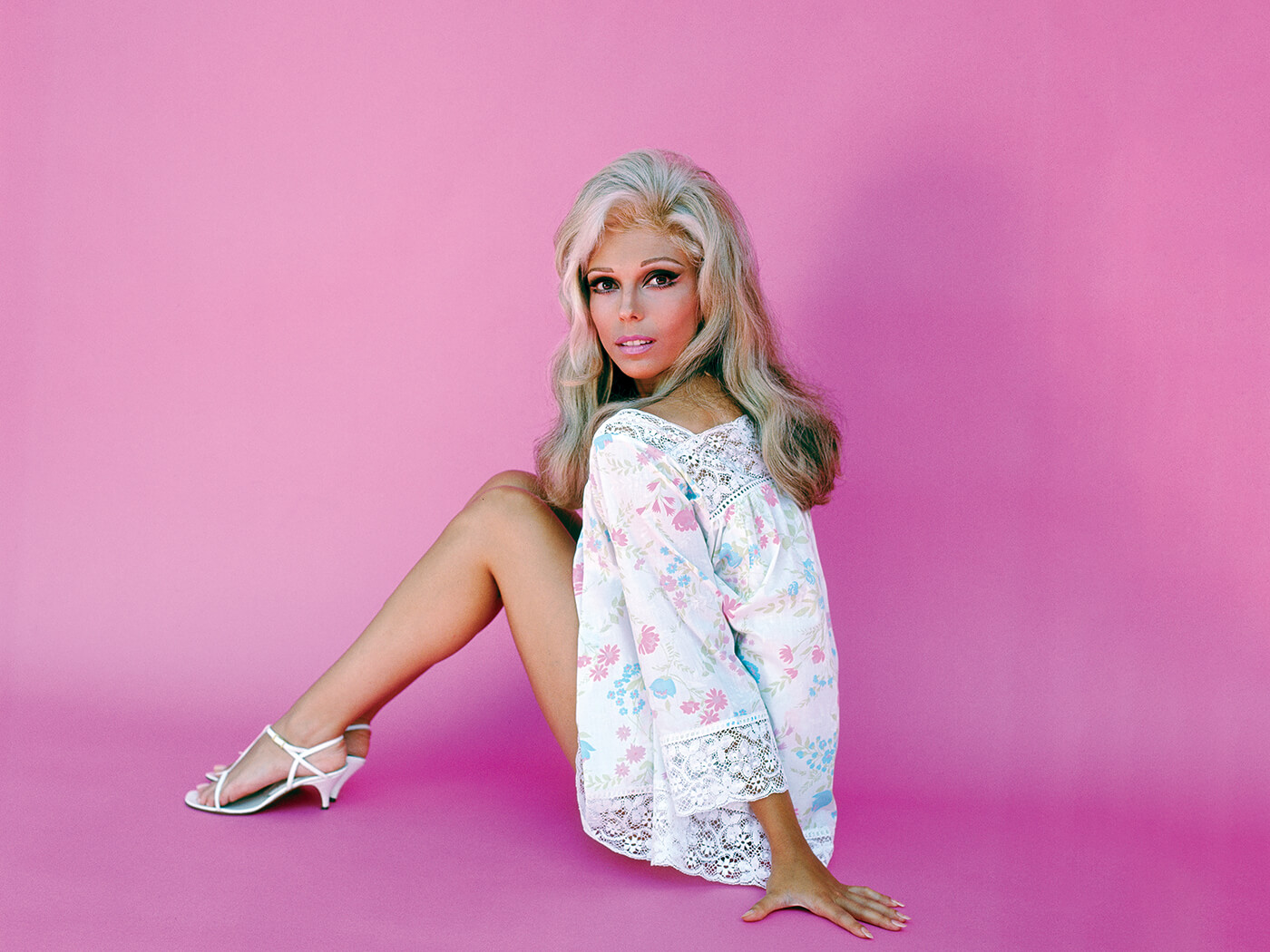
“LEE Hazlewood changed everything,” says Nancy Sinatra. “I was doing bubblegum music and singing in higher keys and he said, ‘That’s not right. You’re not a virgin any more. You’ve been married and divorced. We need to get you where you belong.’ And he was right – it was silly to keep doing what I called ‘Nancy nice lady’. It was time for a change.”
“So Long Babe” was the first fruits of this new collaboration and it charted where all the ‘Nancy nice lady’ singles had failed to. With its kiss-off lyrics and Sinatra’s low, nonchalant delivery, it was what Hazlewood would call “dumb”. “He’d say, ‘If it’s dumb, it’s good,’” says Sinatra, speaking to Uncut from her Hollywood apartment. “Meaning not stupid, but simple. It’s tough to do that, it really is.”
Hazlewood’s next planned single for Sinatra was “The City Never Sleeps At Night”. But when the singer heard another new track he and arranger Billy Strange intended to record for a Hazlewood record, she demanded to cut it herself. “I fell in love with the song, right there and then.”
To track the song, “These Boots Are Made For Walkin’”, they enlisted the help of the crack studio musicians later known as the Wrecking Crew, who recorded it in a couple of hours and a handful of takes at Hollywood’s famed United Western Recorders.
“I always thought Lee was a cantankerous son of a bitch,” laughs keyboardist Don Randi. “Once you got through that wall, you were OK. In Europe they knew Lee as a solo artist before they knew Nancy, which was hard for me to imagine because he was really closer to being a hillbilly than anything else.”
“He played at that,” counters Nancy. “He played at being a shitkicker and he wasn’t – he was highly educated, extremely bright. He was a well-versed, smart individual.”
With “The City Never Sleeps At Night” relegated to the B-side, “Boots…” topped charts around the world in 1966, helped along by a pioneering colour video featuring Sinatra – now a blonde – and a troupe of dancers in, naturally, boots. The song and makeover, the latter led by Sinatra herself, cemented the singer as a global success. Within 18 months, she sang John Barry and Leslie Bricusse’s theme song to You Only Live Twice, followed by a set of pioneering songs made in collaboration with Hazlewood, notably 1967’s transcendent “Some Velvet Morning”.
“I always say that I walked into this wonderful, lucky situation,” she explains. “If I had not had ‘Boots’, no-one would have heard of me, except as Frank’s daughter. I never get tired of talking about it. It’s like having a child.” — TOM PINNOCK
NANCY SINATRA: We were at my mother’s house when I heard the song for the first time. Barton [Lee Hazlewood] and Billy Strange came over. Billy had his guitar. You can’t really play the “Boots” bassline on a guitar, but he managed to make me understand what was going to happen. But Barton wrote it for himself, which I thought was a horrible mistake – because a man saying “One of these days these boots are gonna walk all over you” is a nasty threat. Whereas with a girl singing it, it becomes coy and kind of cute.
DON RANDI: I remember hearing Nancy arguing with Lee over it. I heard her saying, “I have to do this song”, and that was the end of that. What’s great is the persistence of Nancy – I mean, it could very well have been that Lee wins the argument and she doesn’t sing the song. Can you imagine that?
SINATRA: He said that somewhere in the press [that he told Sinatra to “sing like a 14-year-old girl who fucks truck drivers”]. He never actually said that to me. What he said to me was, “You’ve been married and divorced – behave like it, sing like that. Don’t sing like a little girl any more.” It made sense. We went into United Western Recorders to do “Boots” and “The City Never Sleeps At Night”, which was one of Lee’s favourites. He wanted that to be the A-side. In the studio with Lee and the Wrecking Crew was the best place to be in the whole world.
RANDI: Lee was a character, he was who he was. Over the years, when he had that LHI record company, I think I did over 100 albums for him. That’s a lot of work! Western was a great studio. The room itself sounded good. It was all mono, then it went to four-track. I remember being in that studio later when they went to eight-track and [Wrecking Crew guitarist] Tommy Tedesco saying, “What are they going to do with all those tracks?”
CHUCK BERGHOFER: The studio console was just, like, four big black knobs in those days.
SINATRA: There was this tangible vibe in the room with [the Wrecking Crew]. First of all, they were highly professional. They were brilliant musicians. They knew exactly what was written on the sheet music, they could all read – except for Glen Campbell, he wasn’t a reader, but he picked things up very fast, so he was great also. I had some incredible luck, I really did.
BERGHOFER: Working for Lee was definitely easier than working with Phil Spector, with a gun sitting next to him.
RANDI: Phil’s first job was actually working for Lee Hazlewood. People make comparisons constantly between Lee and Brian Wilson and Phil Spector – but they forget there was a lot of other great producers, like Jimmy Bowen, Dick Glasser, David Axelrod. Lee was a little more outside – but those guys all had a budget, whereas Brian and Phil didn’t have budgets, so they could do whatever they wanted. Right around that time [of “Boots”] everybody decided to put our names on album covers – before that nobody knew who played – and that’s how we all started getting some credit. Then that helped us get a lot more work – “We got to get those guys…”
SINATRA: One of the key factors of that track that I always carry with me, in my head and my heart, is that tape reverb technique that [engineer] Eddie Brackett used to use. The magic of that big tape machine, those big reels going round and round and round during the whole session.
BERGHOFER: We got the thing in about six takes or something.
RANDI: I don’t think it was more than that. Because in those days we didn’t overdub like they do now. Everything was live. This is what you got.
BERGHOFER: That was probably one of three dates I did that day. It’s weird. I’d go out in the morning, start working and then by the time I get through, it’d be dark out. Then I’d go to Donte’s, the jazz club, to hang out there ’til four in the morning. Boy, it pays to be young.
RANDI: Was Lee calling the shots in the studio? It was pretty simple. You know, we all were playing, and it was Billy Strange playing the rhythm part on it, too. It was simple. Had it been more complicated, it wouldn’t have happened. It had to be ‘dumb’, as Nancy said. If you did it any other way, it would have been actually stupid, you know?
SINATRA: There were three guitar players in a row in the studio that day: Donnie Owens and Glen Campbell and Al Casey. It was so great. They played the heck out of that thing and it was just fabulous. That chunk, chunk-a chunk, chunk-a-chunk… the dumb sound that Lee just loved.
RANDI: I was on the road with Nancy for forever. The bass players that we would have, they would come close to Chuck’s part, but it never was what Chuck played. It was very hard to play.
SINATRA: First of all, you can’t play that line on an electric bass. They all played electric.
BERGHOFER: This song is like my whole life. Every bass solo I ever play anywhere, I always put “Boots” into it for a second.
RANDI: No matter what fantastic orchestra Chuck’s playing with, some symphonic thing or some great jazz thing, at some point, the guy – Michel Legrand or whoever it is – is going to say, “Chuck, you got to play that ‘Boots’ line one time…” And he’s got to stop and play that line. I love that! Then there’s the horn part that Billy Strange wrote. Every horn player in the world knows it, you don’t have to put the music in front of them.
SINATRA: When we recorded in the studio, we did the music first, which is not unusual, so that they can get the mic’ing right for all the different instruments, and then we added the vocal with me alone in the studio later so nothing fed into the other mics. But when I heard the track to “Boots” I said, “Release the track [as the A-side], the track is a hit!” That quartertone bassline, you always know what’s coming. We used to call it a hook – you have to have a hook in order to get songs played on the radio, because if you can’t grab an audience in the first 20 seconds they’ve changed the station. So I just kept pushing for “Boots” to be the A-side, as it’s just a perfect song. The only thing different to the demo was the final line, which was something I just made up on the spot in the studio. “Are you ready, boots? Start walking”. That was just out of the blue, which is a good thing, because it’s the only thing that Lee hadn’t copyrighted, which meant I could use it wherever I wanted to.
BERGHOFER: I can’t think of a hit that’s gone longer than this one.
RANDI: What’s amazing to me is that every singer would love to have this song that Nancy had, to have a signature song. That is so important. I remember Nancy saying one time, “I’m sick of doing this song.” I mean, we had done it thousands of times, you can’t blame her. “I don’t want to do it tonight.” I said, “If you don’t do the song, I’m going home now” [laughs].
SINATRA: I’ve been very fortunate with great songs. “Bang Bang”, “You Only Live Twice”… My whole physical appearance changed with “Boots”, everything changed. That was because a friend of mine named Amy Greene, who was married to the great Marilyn Monroe photographer Milton Greene, worked for Glamour magazine. She was known as the makeover editor. She took me by the hand in New York to Mr Kenneth, a very famous hair designer. And Kenneth and Rosemary, his colourist, created this nonsense [points to hair]. And little girls everywhere tried to copy it. It just took off – it was new at the time, right, unless you were a natural blonde, which I was not. And that black sparkly dress in the video was actually a sweater that just barely covered important items. Was my makeover driven by Lee? I think it was just complete cooperation. I was determined to bring the miniskirt to the United States. I saw it in London, and I went to a designer place called Mary Quant. She had the first miniskirts, I guess. I brought them home to California and I wore them all over the place. People stared like, ‘Where’s her dress?’ But it was time. Was I ever a bad girl? No, I’m kind of a boring mom.
RANDI: It was the first women’s rights song.
SINATRA: I think Helen Reddy’s “I Am Woman” was the one that did that.
RANDI: Yeah, but the one with the sense of humour that cut deeper was “These Boots Are Made For Walkin’”.
SINATRA: It was definitely more likeable [than “I Am Woman”]. I remember one show we did, Pat Boone was hosting it. When I was walking off the side of the stage, Pat was shaking his head back and forth. I just looked and said, “What’s the matter?” He says, “Oh, why can’t I have a song like that?” I performed it in Vietnam to the GIs, it was like a theme song there. They loved it – they sang along and came up and danced with me. It was an amazing experience. Tragic, though.
BERGHOFER: Frank Sinatra asked me to go on tour with him in the ’60s, and Tommy Tedesco said, “If you take that job, you can kiss studio work goodbye.” So I didn’t take it then, and Tom was right. But much later on in the ’90s I went on the road with Frank and that was perfect then.
RANDI: Well, I stayed doing studio work and went on the road with Miss Nancy Sinatra. Because of Nancy, I got to see the world. We went all over.
SINATRA: History has proven that it’s a perfect song. People love it. The kids love it from the time they’re two years old and they’re walking around the house. Each new generation embraces it. I donated the actual boots [I wore in the video] to charity decades ago. I did turn a pair of boots into wall lamps, I still have those.
RANDI: When we’d go on tour, we’d get to places like London and all the musicians wanted to know how we did it. And I always found that so interesting, because you don’t think of that when you’re recording. You’re thinking, ‘This is the way everyone does it.’ But it wasn’t. We were very lucky to be able to have the good equipment and the good artists to work with.
SINATRA: And we all had much better hair in those days.