

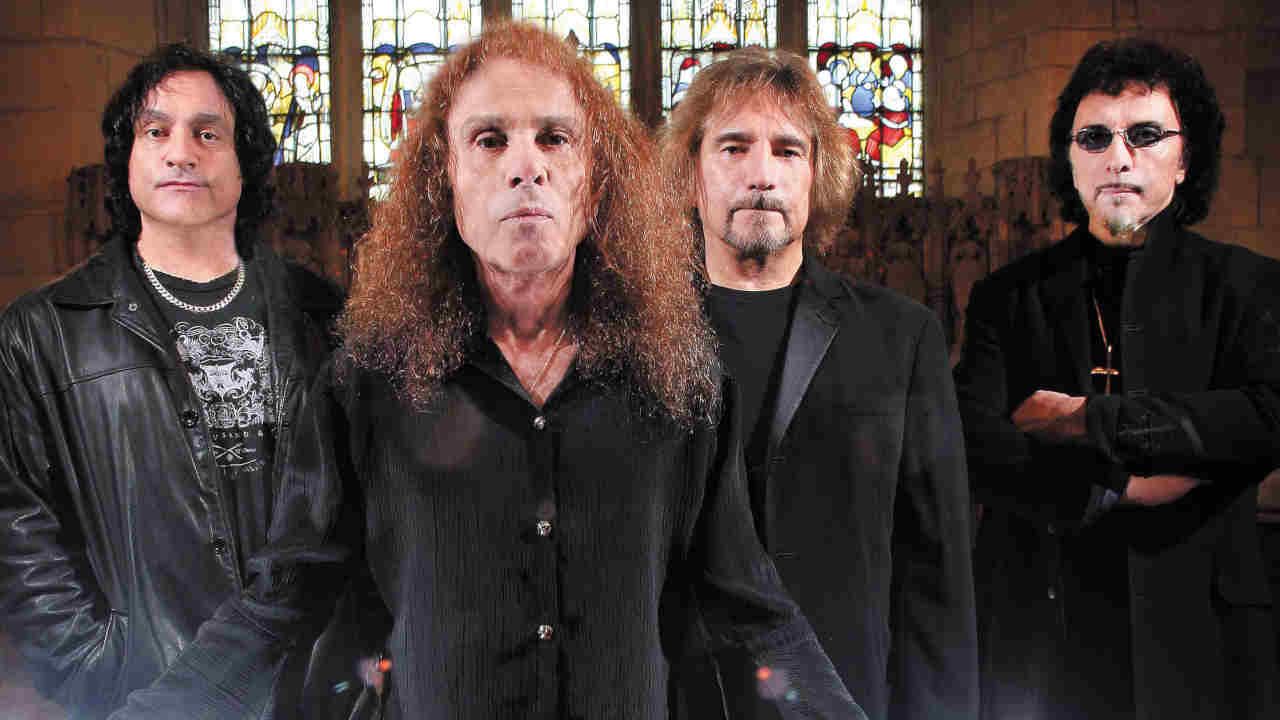
In 2007, Black Sabbath’s classic Mob Rules-era line-up reunited for the third time, this time under the name Heaven And Hell. As they prepared to tour the UK, Tony Iommi, Geezer Butler and Ronnie James Dio looked back over their tangled history together.

It was spring 1979, and Ronnie Dio, still sore from his recent dismissal from Ritchie Blackmore’s Rainbow, found himself courted by perhaps the only British heavy metal guitarist more eminent than Blackmore: Tony Iommi. The Sabbath guitarist, whose band was going through a rather black period with their drug- and alcohol-riddled frontman Ozzy Osbourne, had his eye on Dio. Ronnie might’ve been small in stature but his voice was huge.
After a chance meeting one night at a bar in Hollywood, Iommi invited Dio to his house in Beverly Hills for an impromptu jam with himself, Sabbath’s bassist Geezer Butler and drummer Bill Ward. “Fifteen minutes in, we had a song written,” Dio remembers. Appropriately, when Iommi extended his offer to the singer to join Black Sabbath, it wasn’t posed as a question. “I couldn’t have said no anyway,” Dio confesses. “I had some other projects on the table at the time, but this was Black Sabbath. Plus I knew that it was perfect for me.”
Latest Videos From Louder

Perfect, too, for the three Sabbath men. In fact, after the hell they were going through with Ozzy, tying the knot musically with Dio was something of a marriage made in heaven. At the time, the veteran band were in the midst of a creative and commercial rut. Bringing Dio in gave them a renewed sense of purpose as well enabling them to update their sound for a new decade.

The two studio albums Black Sabbath recorded with Dio during his initial tenure with the band, 1980’s Heaven And Hell and the next year’s Mob Rules (Dio later rejoined briefly for a third, 1992’s Dehumanizer) spark with some of the most electrifying music of their career. Few tracks in the band’s catalogue kick with the force of Neon Knights and Turn Up The Night, the respective openers of those two albums, while the title tracks – the barnstorming The Mob Rules and the positively monstrous Heaven And Hell – are on par with even Sabbath’s most revered Ozzy-fronted material.
That said, Black Sabbath’s output with Dio, sandwiched between the band’s hugely influential, frequently ground-breaking 1970s work with Ozzy and the numerous albums recorded with different line-ups throughout much of the 80s and 90s, has sometimes been overshadowed by . And the flurry of Ozzy activity that has driven the band for much of the past decade – sporadic reunion tours, various compilations and box sets, a smattering of new recordings, persistent rumours of a full-fledged studio album and, most notably, the 2006 induction of the original line-up of Osbourne, Iommi, Butler and Ward into the Rock And Roll Hall Of Fame – has left the Ozzyless parts of Black Sabbath’s history being viewed as something of an aberration.
But the Dio era has its staunch defenders, who will be excited by the fact that the Mob Rules era line-up – Dio, Iommi, Butler and drummer Vinny Appice, the latter having replaced Bill Ward in the summer of 1980 – have reunited for the second time, 25 years after they originally played together and 15 years since their comeback. The difference this time is that the band won’t be called Black Sabbath, instead adopting the monicker Heaven And Hell.

The wheels for this unexpected third reunion were inadvertently set in motion by Rhino Records, who recently released the compilation album, Black Sabbath: The Dio Years. The label contacted Iommi’s management to inquire whether any previously unreleased Dio-era material existed that could be included in the prospective package. There wasn’t. So Iommi, for the first time in more than a decade, reached out to Dio with the idea of recording a few new songs. Although over the years the guitarist and singer had occasionally been at odds, in October 2005, prior to a Dio solo show in Iommi’s home town of Birmingham, the two met to discuss the possibility of working together again.
“We just sat and talked, got rid of all the skeletons in the closet and blew the cobwebs away,” says Dio. “And before I knew it, Tony and I were sitting in his home studio in England, throwing ideas around.”
Over the next few months, writing sessions between the two yielded the songs Shadow Of The Wind, The Devil Cried and Ear In The Wall, which Dio describes, astutely, as “a slow one, a mid-tempo one and a fast one”. With the rhythm section of Butler and Appice (it was initially reported that Bill Ward would be involved in the project, but he bowed out and was ultimately replaced by the man who’d done so back in 1980), the three songs were then recorded for inclusion on The Dio Years. “We got on really well,” Iommi says of working with his former singer again. “At first we only planned on doing two songs, but then two became three, and from there we went to, ‘How about a tour?’”
![Heaven & Hell - Shadow Of The Wind [Radio City Music Hall, 2007] (Official Live Video) - YouTube](https://img.youtube.com/vi/kjG5CspkBuI/maxresdefault.jpg)
“It seemed like the right time to go out with Ronnie,” Geezer Butler adds. “We’d been doing the reunion thing with Ozzy for so long. No disrespect to that, but we’ve got some great songs and this is a great line-up.”
Be that as it may, it is not, by everyone’s estimation, a Black Sabbath line-up. Shortly after it was announced that Heaven And Hell would be touring in support of the compilation The Dio Years, a statement was issued by Ozzy’s camp wishing the band much success, while asserting: ‘There is only one Black Sabbath. Ozzy, Tony, Geezer and Bill will be touring late next year along with a new album.’
If Ozzy wielded any influence over the band having chosen an alternative name, no one on either side is saying so. For his part, Iommi, the sole member to have appeared on every Sabbath recording, and the person believed to own the rights to the band’s name, says the motivation behind touring as Heaven And Hell was to avoid confusion with the Osbourne-Ward version of Black Sabbath, which is still, it appears, a living, breathing entity.

Perhaps it’s fitting that the Dio-fronted Black Sabbath is now represented as a distinct unit, as, in spirit if not name, it always had been. The reconfigured band came together during a period of turmoil and uncertainty, with both sides reeling from the after-effects of bad break-ups. In Sabbath’s case, the three remaining original members were also forced to contend with the enormous shadow cast by their own legacy, as well as the spectre of their former singer, whose popularity and notoriety would only increase throughout the 80s, and with whom the band would occasionally be drawn into a very public war of words.
And yet with Dio at the helm Black Sabbath not only survived, but also flourished, producing their strongest material in years. If The Dio Years is a welcome and long-overdue tribute, the Heaven And Hell tour is an even more anticipated, and fitting, celebration of this band.
“The music we made together stirred the souls of a new generation of fans,” Ronnie Dio says proudly. “When we came out with Heaven And Hell, Black Sabbath was reborn.”
Indeed prior to Dio’s arrival in 1979 it looked as if Black Sabbath’s days were numbered. Their final album with Ozzy, released the year before, was titled Never Say Die!, but it was obvious to everyone involved that the band had already flat-lined. In stark contrast to such revolutionary releases as their 1970 self-titled debut and follow-up Paranoid albums – which not only launched the band to stardom but arguably gave birth to heavy metal itself – Sabbath’s recent output had been artistically weak and commercially disastrous.

The band were old news, particularly at home in Britain, where the more immediate and visceral sounds of punk had replaced hard rock as the soundtrack for the young and disenfranchised. Additionally, a fresh crop of bands who would serve as the earliest entries into what would become known as the New Wave Of British Heavy Metal movement were plying a harder, faster strain of the basic Sabbath formula. Caught in the middle of this charged musical climate, the members of Black Sabbath found they were in no shape to compete with the new generation. “We were all going through bad things with drugs and alcohol, and I don’t think any of us knew what was going on,” Iommi says. “We were so lost within ourselves.”
No one more so than Ozzy, who had left the band briefly after 1977’s Technical Ecstasy (he was replaced by former Savoy Brown and Fleetwood Mac vocalist Dave Walker), and then returned for the desultory Never Say Die! When it came time to record a follow-up, it was obvious that Black Sabbath would have to take drastic measures in order to survive.
“The record company kept asking: ‘Where’s our album?’” says Iommi. “Well, we didn’t have it! We were coming up with some riffs, but Ozzy just… wasn’t capable of singing to them at the time. So we had to say to him: ‘Well, if you can’t do it we’ll have to find somebody who can.’ Which is what happened in the end.”

With Ozzy on his way out, the band began the search for potential replacements. On the shortlist were two former Deep Purple men: David Coverdale and bassist/vocalist Glenn Hughes (in an interesting turn of events, Sabbath would later team up with Ian Gillan, the most renowned of Purple’s singers, and, eventually, Hughes as well). And there was Ronnie Dio, who had recently split from another former Deep Purple man, guitarist Ritchie Blackmore. Blackmore was in a bid to sell his then-current band Rainbow to a wider audience, and decided that Dio, with his operatic, vibrato-heavy vocal style and penchant for writing fantastical lyrics, did not possess the necessary mainstream appeal.
But Blackmore’s loss turned out to be Iommi’s gain, as Tony recognised in Dio not only a kindred heavy metal spirit but also a man positioned at a similar musical crossroads. “I was sitting around at home in Connecticut after being booted out of Rainbow when I got a call from Tony,” Dio recalls. “After that, every few weeks we would just talk on the phone, discussing the possibility of doing something together. But at that point I had still never even met him in person.”
It wasn’t until Dio moved to Los Angeles a few months later that things progressed any further. “I ran into Tony one night at the Rainbow, of all places,” the singer says with a laugh, “and he invited me back to his place to play with Geezer and Bill.” At Iommi’s home the three presented him with the music to a song they’d recently written, and Dio jotted down some lyrics. After giving the new tune, titled Children Of The Sea, a run-through, the deal was sealed.
“At that point we’d been out in LA trying to get moving on an album for almost a year,” says Iommi. “We had started it with Ozzy, and now, finally, with Ronnie we were going to finish it.”
But not, as it turned out, with Geezer Butler. Soon after Dio joined, Sabbath’s stalwart bassist announced, to everyone’s surprise, that he was leaving the band. “My head was just in another place at the time,” says Butler. “I was going through a horrendous divorce, and dealing with all sorts of personal stuff. I couldn’t concentrate on music. I had to go back home to England and get my life sorted out.”
If Black Sabbath had been teetering on the brink of disaster for some time, they had now, at the end of what had been a largely triumphant decade, reached critical mass. In just a few months, Tony Iommi had lost both his highly charismatic frontman and the band’s founding bassist (drummer Bill Ward was still on board, but dealing with his own substance addictions), and was now a guitarist without much of a band. Meanwhile, Warner Bros. were champing at the bit for a new record that would be Black Sabbath’s celebratory ‘10th Anniversary’ album. It was also to be their final one under contract to the label. And Iommi was coming up empty-handed.

In desperation the guitarist turned to his new singer, and the two of them composed the bulk of what would become the Heaven And Hell album. Although the partnership was untested, it proved to be extremely fertile. In addition to having a voice that was more dynamic and more authoritative than Ozzy’s, Dio also ably filled the songwriting hole created by Geezer Butler’s departure. Where Butler had always been Black Sabbath’s chief lyricist, and had written the bulk of the words that Ozzy ultimately delivered as his own, Dio wrote his own lines – doing the same in Rainbow contributed to his dismissal from that group, now it was crucial to his new band. He was also a capable bassist – “You can’t call yourself a musician if all you do is write poetry,” he says defiantly – and so could chug along in Butler’s place while Iommi worked up the riffs.
“Ronnie opened me up to a whole new way of writing,” says Iommi. “And what resulted was all these different types of songs that sounded nothing like what Sabbath had done in the past.”
Another significant figure during this time was Geoff Nicholls, a British musician who had of late been Black Sabbath’s touring keyboardist. He was also an accomplished guitarist and bassist, and it was Nicholls’s bass figure (lifted from a tune recorded by his former band, Quartz) that laid the foundation for Heaven And Hell, the song that would become the album’s title track and centre-piece. Furthermore, Iommi at one point even considered taking Nicholls on board as a second guitarist. “Geoff and I did try out the two-guitar thing in rehearsal a few times,” says Iommi, “but it just felt weird. Although it certainly was nice and loud.”

Nicholls was also considered as a replacement for Geezer Butler (as was ex-Rainbow bassist Craig Gruber and, briefly, Dio himself), but that sorted itself out when, prior to Black Sabbath entering the studio, Geezer returned. “I had kept in contact with Tony during the time I was back home in England,” he says. “So as soon as I felt that I had my life under control I was happy to come back to the band.”
Butler’s arrival also aided in putting to rest another question: would the band still be called Black Sabbath? Confronted (much as they are today) with the absence of their most recognisable member, at one point the band considered changing their name in the hope of having the new material with Dio judged independently of their Ozzy-era work. “It was discussed for a time,” Butler confirms, “though in the end the name change didn’t seem necessary. Plus,” he admits, “Warner Brothers would have never taken that risk. They basically said: ‘If you want us to put the album out, it’s gotta say Black Sabbath on it.’”
Which was, by all means, a better name than the one that had occasionally been used disparagingly in the press, and the origins of which could allegedly be traced back to Ozzy Osbourne: Black Rainbow. A few years later, in a particularly low blow, Ozzy, perhaps acutely aware of Sabbath’s achievements without him, incorporated into the stage show for
his Diary Of A Madman tour a midget roadie he called Ronnie.

But with three original members on board and some very strong material – including the songs Children Of The Sea, Die Young and the title track – in the can, the band still known as Black Sabbath entered Criteria Recording Studios in Miami in late 1979 to begin tracking what would become the Heaven And Hell album. While their past few records had been self-produced – which perhaps contributed to them being far from spectacular-sounding – this time they brought in Martin Birch, a much in-demand producer who had worked with such hard rock heavyweights as Blue Öyster Cult, Whitesnake and Dio’s former associates, Rainbow.
“I contacted Martin and told him what I was up to,” says Dio, “and he was like: ‘Black Sabbath?’ Because he felt the same as everyone did at the time – they’re trouble. But I said: ‘Trust me. We’ve got something special going on. You’ll love the songs. You’ll love the guys. They’ll love you.’”
The band wrapped up at Criteria just prior to Christmas and went to London to mix the album. Although the recording had gone without a hitch, it was during the mixing stage that Martin Birch’s earlier concern that Sabbath were ‘trouble’ proved to be well-founded. The band, and in particular drummer Bill Ward, showed themselves to be dangerously combustible.

“Bill and I used to have this little party piece we’d do, where I’d light him on fire,” Iommi explains. “So one day in the studio in London I thought it’d be fun to freak out Martin, and I asked Bill if I could light him up. Bill said: ‘Uh, not just yet, I’m a bit busy at the moment.’ I looked over at Martin, and he had this look on his face like, ‘What the hell is going on?’” Iommi laughs. “About two hours later Bill came back and said: ‘Okay, I’m going home now. Do you want to set fire to me or what?’ So I poured all this bloody alcohol over him, lit it, and Bill went up like a bomb. Martin nearly had a fit!”
Which was not exactly the intended outcome. Ward wound up in the hospital. “I thought I’d killed him,” says Iommi. But the drummer was back on his feet to join the band (now tax-exiled to France) for one final recording session at Studio Ferber in Paris.
Determining that the album was still in need of the killer lead-off track, it was here that Sabbath recorded the album opener that would also serve as their 1980 live set opener, as well as prove to be one of the fiercest tunes in their catalogue: Neon Knights.
“We hadn’t really done too much up-tempo stuff with Ozzy, but it’s something that really appealed to Ronnie, and also something that he was very good at,” Iommi explains. “A song like Neon Knights could have only come together at that time.”
“We knew we needed a fast one to introduce the band,” Dio says, “so we just laid that song out. It’s simple, and it does exactly what it’s designed to do. The riff hits you right out of the box.”
Released in April 1980, the Heaven And Hell album, led by the rampaging Neon Knights and centred on three epic tracks – Children Of The Sea, Die Young and the title cut – re-established Black Sabbath as heavy metal alpha males, on a par with top artists of the day like Judas Priest and AC/DC. The record’s focused attack, coupled with Birch’s modern-sounding production, endeared the band to younger fans of NWOBHM bands like Def Leppard and Iron Maiden as well.
“I knew we had a great album,” says Dio. “And it was nice to see it so well-received. You can never tell how the public will react. But as a band we were all on the same page. We believed in the songs we were writing, and had this feeling of: ‘Fuck you, this is going to happen.’ No matter what obstacles we faced, we were not going to be stopped from doing that record. We had the right group of people, we had the right songs and it was the right time. And it worked.”
Heaven And Hell proved to be both a critical and commercial high point for the Dio-led configuration of Black Sabbath. The album eventually went platinum – the only non-Ozzy Sabbath release to date to reach that benchmark. And Warner Brothers, who hadn’t shown much faith in, or offered much support to, the band during its recording, extended the band’s contract well into the 80s. Sabbath then embarked on a massive world tour in support of the record, including appearances at major festivals like California’s Day On The Green and also a highly anticipated co-headlining trip with Blue Öyster Cult (at this point Sabbath were being guided by BÖC manager Sandy Pearlman), dubbed the Black & Blue tour.

By the summer, however, signs of strain were already beginning to show. In August Bill Ward, suffering from substance addiction and in poor health, quit the band following a gig in Indiana. “He was in a bad way with drink and drugs,” says Butler, “and he just couldn’t keep it together. One day we looked up and Bill was just gone.”
He was quickly replaced with former Rick Derringer drummer Vinny Appice. But not long after the Black & Blue tour recommenced, disaster struck again when Butler was knocked out by an object thrown during a show in Milwaukee, landing the bassist in the hospital and sparking an all-out riot at the venue. With a recovered Butler the band completed the tour, which they followed with quick runs through Japan (where Iommi was hit with food poisoning), Australia and the UK.
By the time Black Sabbath entered the studio in early 1981 to begin recording for Mob Rules, once again with Martin Birch at the controls, they were all a bit the worse for the wear. By some accounts, Dio, no longer the new guy, and emboldened by the tremendous response afforded to Heaven And Hell, took on a more authoritative role during the sessions. And while that role was perhaps well-earned, it made for a tense situation. But the resulting album, with strong tracks like Turn Up the Night, The Sign Of The Southern Cross and the title track, was another solid affair, even if it arguably stuck a little bit too close to the Heaven And Hell blueprint.
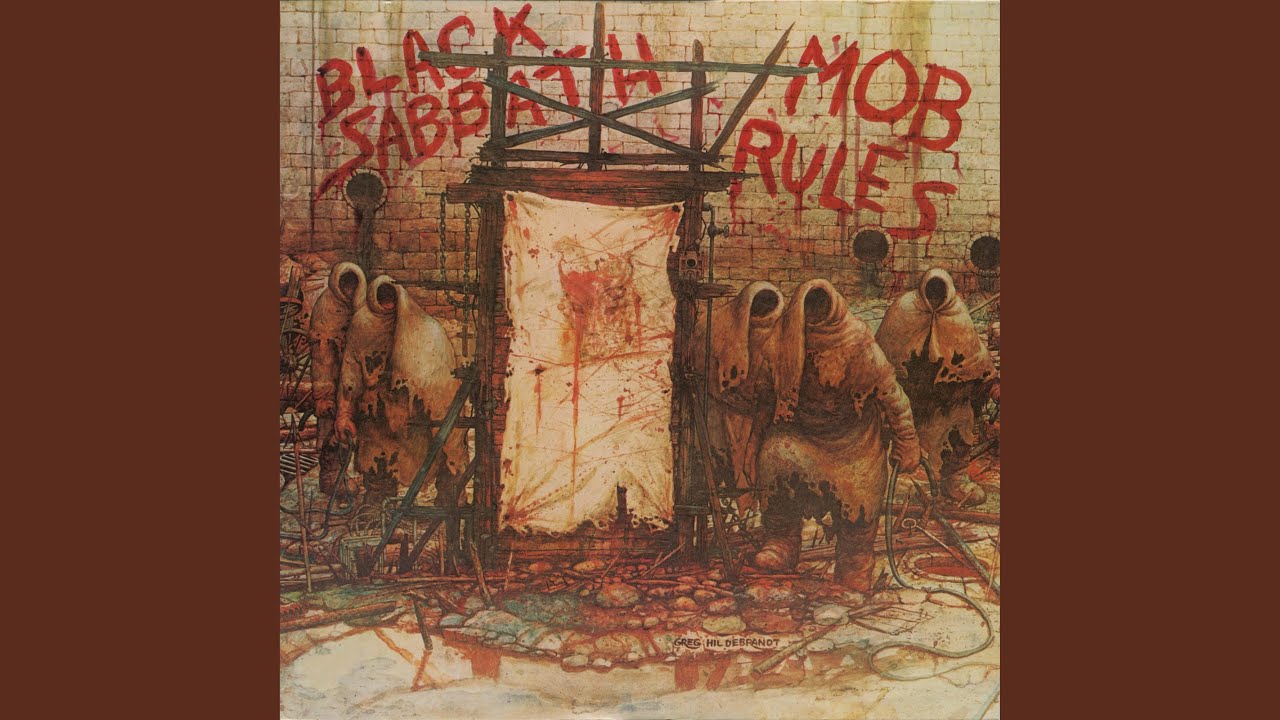
The band hit the road in support of Mob Rules in November 1981. The tour, which took them all the way through the summer of 1982, was another success, and shows in San Antonio, Dallas and Seattle were recorded for a proposed live album. But by the time Live Evil was released, in January 1983, Ronnie Dio and Vinny Appice were out of Black Sabbath.
Prior to the album’s release, reports had begun to surface in the British press that Iommi and Butler had suspected their bandmates of tampering with the unmixed live tracks. “There were all these tales being told that Vinny and I were sneaking into the studio to raise the drums and vocals, and for some reason Tony and Geezer chose to believe what them,” says Dio. “What happened was, we’d arrive at the studio, and the other two guys wouldn’t show up. This went on for a couple days, until finally we got tired of sitting around and decided that maybe we should listen to some of the stuff. And we probably said things like: ‘What would it sound like if the drums were raised a bit?’ But we weren’t mixing, we were waiting.”
“Things were just screwed up at that point,” says Iommi. “No one was communicating, and Geezer and I were just going by what the studio engineer was telling us. Everything got blown out of proportion and just escalated beyond control.”
When it was over, Black Sabbath had split in half. After Dio and Appice had been handed their walking papers, the singer wasted no time in getting together a new group (which included Appice) under his own surname. “The truth is, the writing was on the wall at that point anyway,” says Dio. “We had done some great things together, but the band had fallen apart. There was no need to try to continue.”
It would be almost a decade before Ronnie Dio would play with Black Sabbath again. In 1991, he and Appice reunited with Iommi and Butler for the following year’s well-received Dehumanizer album and tour. But once again things ended on a sour note, when Dio baulked at the band’s announcement that, for the final two shows of the tour, in Costa Mesa, California, they would perform as the support act for none other than Ozzy Osbourne. “I said: ‘No, I won’t do that,’” says Dio. “I thought it was a blow to our pride. But, you know, I guess other things, like money, were worth more than pride.”
As the Dehumanizer tour traversed the US and the Costa Mesa dates drew near, Dio was again approached with the plan. “About two weeks before the gigs, the other guys came to me and said: ‘You’re really going to do it, aren’t you?’ And again I said: ‘No, I’m not.’ I was positive that this whole thing was going to end with the announcement that they were going to re-form Black Sabbath with Ozzy. And, well, what do you know, that’s exactly what happened. So I wanted no part of it.”

Dio’s final performance as Black Sabbath’s singer took place in Oakland on November 13, 1992, one night before the first of the two Costa Mesa gigs. “That was it,” he says. “I didn’t even see the other guys afterwards. They just got on a bus and left. It was a bit hurtful, but, I don’t know, I guess I should have been prepared for it. Things had ended badly once before.”
Black Sabbath brought in Judas Priest frontman and fellow Birmingham native Rob Halford for the final two shows, and, as Dio had suspected, on the second night joined with Ozzy for a four-song set. Afterwards talk of a full-scale reunion with Ozzy ensued; in fact it was five years before he, Iommi and Butler got together, along with ex-Faith No More drummer Mike Bordin, and played Ozzfest in 1997.
A decade later, Iommi and Butler are once again back with Dio and Appice, but this time with a new name and, just as significantly, a better understanding of the expectations surrounding the band.
“We’re all just treating this as a project, an album and a tour, and that’s it,” says Dio. “And I think if we look at it that way it won’t feel so loaded, and we’ll all be much better off down the line. There won’t be any hurt feelings, there won’t be any arguments, and, you know, maybe it won’t be another 12 years before we talk to each other again.”
As for any plans after Heaven And Hell, Dio is eager to get back to work with his solo band, but the doesn’t rule out the possibility of a new studio album with his Black Sabbath mates. “We will contemplate doing one at some point,” he says, “but we want to finish this project first. Everyone wants to put the cart before the horse. Instead of applauding us for getting back together and doing it, everybody’s more concerned about whether we’re going to be doing it again at some point. Our plan is to continue with this until to December, and after that we’ll decide the next step. The Heaven And Hell project may certainly have longevity. But we all have other commitments… commitments that were in place before we got back together. The other guys might have some things to do with Ozzy. After all, Black Sabbath’s 40th anniversary is coming up soon.”
Originally published in Metal Hammer issue 112 (October 2007)