

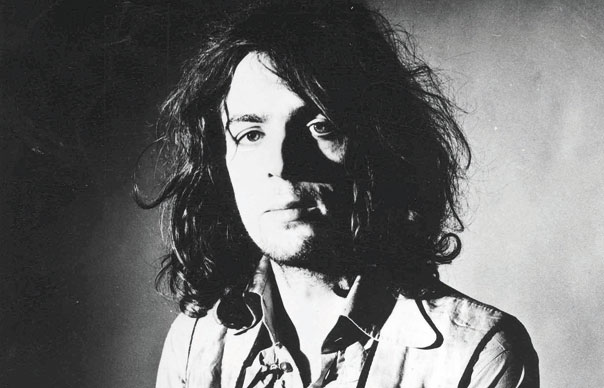
Originally published in Uncut Take 112 (September 2006 issue)…
In the end, after 35 years of declining to countenance the far-reaching impact of his talent on the history of rock’n’roll, Syd Barrett departed his dark globe peacefully, aged 60, in Cambridge on July 7. Early reports indicated that his death was due to complications arising from diabetes/cancer. He left the world as he had lived in it for the past 25 years (and for the first 15): not as the tousle-haired poet/star ‘Syd’, but as Roger Barrett, a lover of painting, a private citizen, a non-musician. He had lived alone in suburban Cambridge since his mother’s death in 1991, and had been diagnosed as a diabetic – following more than three decades of mental illness – in 1998.
What has been lost to us? Barrett, in a former existence, was spectacularly gifted, one of the most original songwriters and true visionaries that England has ever produced. Arguably the key musical personality of 1967 on either side of the Atlantic, he was on a par with The Beatles for most of that year, and might conceivably have outstripped them if his terrible LSD-related problems hadn’t stopped him in his tracks. Which they did straight afterwards.
What has been lost to us? Barrett, singing from a lonely place an awfully long time ago, gave posterity two scruffy, endearing, fragmentary solo albums to remember him by when he took his absence. Which he did straight afterwards.
What has been lost to us? Nothing in real terms, you could unsentimentally argue. There was never any serious question of a comeback after all these years; and by all accounts Syd Barrett ceased to exist as a person a long time ago anyway. What has been lost to us? Only the ridiculous hope that an impossible miracle could have happened. And now there’s only the desperate sadness that poor Syd Barrett is dead.
Barrett – although it’s always been debatable whether he knew it – was a famous man in Britain long after his premature retirement in the early ’70s. Perhaps he did know it, but needed to disbelieve it for the sake of privacy and peace of mind. He did not solicit the public’s respect during the next 30 years; but they gave it to him, unsolicited, all the same. In absentia – and there has never been an absentia quite like Barrett’s – he joined the ranks of the most revered figures that rock has ever known, without apparently hearing one single note of music played by any of the artists he influenced. Was he aware of Julian Cope? Did he check out the Britpop boys? Had he heard the Mary Chain’s version of “Vegetable Man”? You have to say it’s unlikely. The last time Barrett released a record, Ted Heath was prime minister and Britain had not yet gone decimal.
“The past is not something Rog ever discusses,” Ian Barrett, his level-headed-sounding nephew, wrote in a mid-’90s email correspondence with a Pink Floyd fansite. “[He] is so removed now from the glamour and excitement of the showbiz world… I’m sure it confuses him that anyone else would care so much that he sang a few songs and played a bit of guitar in the ’60s.”
By the time his nephew’s words were written, Barrett’s life – and his indefinite absence – had already inspired several books and a plethora of ‘anniversary’ retrospectives in magazines. It was 20 years since he had vanished. It was 25. Bloody hell, it was 30.
In 2001, Barrett was the subject of an Omnibus documentary on the BBC, in which David Gilmour and Roger Waters from his Pink Floyd otherlife spoke warmly of him. Barrett himself didn’t appear: this was not a surprise as the Floyd hadn’t seen him since 1975 (and they hadn’t even recognised him then). It is said that Barrett watched the programme at his sister’s house when it went out, and showed some pleasure at the old footage of “See Emily Play”. But he deemed the proceedings as a whole to be “a bit noisy”. Perhaps it’s a good job he never heard the Mary Chain.
For the most part, according to his nephew, Ian, the memories of his pop star heyday were so painful that Barrett couldn’t bear to think of them. He was “simply [not] interested in going back over a time in his life that precipitated his breakdown and retreat from society.” So we’ll probably never know whether the reclusive Barrett was having an evening with the TV switched on or off, when the following words were broadcast to the world. “Anyway, we’re doing this for everyone who’s not here,” said Waters at Pink Floyd’s Live8 reunion last summer, “particularly, of course, for Syd.”
Roger Keith Barrett was born in Cambridge on January 6, 1946. The youngest of five children, he grew up in comfortable middle-class surroundings, receiving encouragement from his parents in both music and art. After attending school in Cambridge, where he met the future Pink Floyd musicians David Gilmour and Roger Waters, Barrett won a scholarship to Camberwell Art School in London. By his mid-teens he’d acquired the nickname, Syd, a misspelt reference to a Cambridge drummer, Sid Barrett.
In London, Syd was invited by Waters to join a collection of musicians who had variously been calling themselves Sigma 6, The Tea Set and The Abdabs. Barrett climbed aboard one of the final incarnations – which tellingly included Waters (bass), Rick Wright (keyboards) and Nick Mason (drums) – but renamed them The Pink Floyd Sound, juxtaposing the first names of two bluesmen, Pink Anderson and Floyd Council, whom he’d recently read about on a record sleeve. By 1966, the band had shortened their name to Pink Floyd and were playing around London, where they were soon swapping their repertoire of American R&B covers for newly written, and highly experimental, Barrett material.
Signed to EMI in early 1967 as the leading lights of London’s new psychedelic underground, Pink Floyd released their debut single, “Arnold Layne”, in March. Stunningly original (and much different to the open-ended improvisations of their live show), the Barrett-composed song invited the listener’s compassion for a transvestite who is arrested for stealing women’s clothes from washing lines. When Arnold is imprisoned at the end of the song, the sense of injustice in Barrett’s voice is palpable (“he hates it!”).
The song was brilliant. Barrett, indeed, was now in an exceptionally creative period that would last throughout 1967. As a wordsmith, he was able to map out a long-term blueprint for British psychedelia that took elements from sci-fi and children’s stories to create an utterly rapt lysergic atmosphere of syllables and textures – of futures and histories – of adventures and escapades – alternately taking place in exquisite leafy gardens, in outer space and in a fantasy nursery where the only interruptions come from that great psychedelic Barrett standby: the soothing maternal presence. Aaaah, Mother.
It had been noted by friends that Barrett was taking a lot of acid in the early months of 1967. On stage he’d been exploring the outer limits of the rock avant-garde with Pink Floyd at their increasingly popular acid-soaked rave-ups in the capital. In the studio, meanwhile, Barrett had revealed an unexpected flair for writing thrillingly kaleidoscopic, yet perfectly concise singles – the Top 20 hit, “Arnold Layne”, was followed by “See Emily Play” (which reached No 6) and the breathtaking “Apples And Oranges” (an unaccountable commercial failure).
It’s in the former that we hear Barrett’s middle-class vowels at their most seductively enunciated (dig that crazy meticulous BBC English!), but it’s in the seldom-heard latter that we really appreciate how close Syd Barrett came to being a genius. “Got a flip-top pack of cigarettes in her pocket/Feeling good at the top, shopping in sharp shoes…” The outrageous tongue-tapping syncopation of his opening couplet is matched by his innovative use of guitar, not least his superbly controlled feedback and wah-wah. But outside his music, control was now slipping away disastrously from Barrett. He had lost the attention of the public, and his friends feared he was losing his mind to acid.
Floyd’s co-manager Peter Jenner told Uncut in 2001: “During that summer [’67], Syd was becoming increasingly difficult. At some of the UFO gigs, he’d play one note all night. Even though he was tripping on acid, I thought that was odd behaviour…”
The pressures on Barrett had become considerable, especially if one bears in mind that he may have been required by 1967’s unstoppable chain of events to be simultaneously Pink Floyd’s breadwinner, their de facto pop idol, their creative lynchpin and their most extravagant LSD-taker. Barrett had peaked musically in the summer of ’67 with the release of the Floyd’s debut, The Piper At The Gates Of Dawn, a masterpiece that he’d written almost entirely on his own. It was to be the only album he ever completed with Pink Floyd.
Barrett behaved unpredictably from the autumn into the winter. In Santa Monica on the US tour, he squeezed a tube of Brylcreem (which he then mixed with crushed Mandrax) on to his head prior to a gig, so that his face appeared to be melting horrifically under the lights.
In early 1968, his old Cambridge friend, Dave Gilmour, was asked to join Pink Floyd as a second guitarist – but really as emergency cover for Barrett if the latter’s deterioration continued. It did. After only a handful of shows as a quintet, during which Barrett’s antics infuriated his colleagues once too often, the unstable frontman was asked to leave the Floyd in April 1968. Two months later, “Jugband Blues”, a song he’d recorded before his departure, emerged as a poignant and deeply quizzical valedictory statement on the new Floyd album, A Saucerful Of Secrets. Barrett sounded for all the world as if he knew there was no way back.
As Pink Floyd and Syd Barrett took their respective forks in the road that spring, it was supposed to open up bright new possibilities for Barrett as a solo artist. Free of the pressures of commercial expectation, there was hope that he might flourish – or at least start to recover. At first, though, he seemed incapable of comprehending that he was no longer a member of Pink Floyd. He would turn up to their gigs with his guitar, and have to be told in no uncertain terms that he wasn’t going to be permitted to play. Nor did Barrett’s solo career begin too auspiciously. Peter Jenner organised a series of recording sessions at Abbey Road, but only a smattering of viable material resulted. Syd’s biographer, Tim Willis, later wrote: “Barrett was all over the place – forgetting to bring his guitar to sessions… sometimes, he couldn’t even hold his plectrum. He was in a state.”
But it must be stressed here that Barrett’s uncanny gifts as a songwriter had not deserted him. There are perfectly sentient people in this world who regard the music Barrett released in 1970 as the best stuff he ever did. Syd’s solo debut album The Madcap Laughs and its follow-up, Barrett, released at either end of the year, were, it’s true, somewhat reduced in musical circumstances if one compares them to the hi-tech Abbey Road studio finesse that producer Norman Smith had applied to The Piper At The Gates Of Dawn. Whereas Floyd’s debut had been, in places, an electronic tour de force to rival Sgt Pepper – all systems blazing, all weapons on ‘stun’ – The Madcap Laughs, by contrast, got underway with the most lethargic strumming of an acoustic guitar ever committed to tape – and a voice with sleep in its eyes singing: “I really love you… and I mean you.”
Barrett upped the psychological ante on a song called “Dark Globe” by hitting a gigantic non-chord to drive home the panic and loss in his words. “Won’t you miss me? [claaaang]… Wouldn’t you miss me at all?? [claaaang, claaaang, claaaang].” The psychedelic voyage – at least in musical terms – had crash-landed with no survivors. On side two , you could almost hear his psyche falling to bits.
But here is the proof of the pudding. Even when there was no news on the Barrett horizon for 20 years, neither LP was allowed to go out of print. Now, both command levels of respect and love that are far removed from the shambolic way in which they were created. Partly, this is because the songs are so fragile (whether charmingly or frighteningly so). Each song sounds so hugely important to Barrett; the anxiety is there in his voice. Touched by his dedication and amused by his wonky humour, but at the same time concerned for his welfare, we are drawn back to these intimate performances again and again. When he died, it was probably to our copies of The Madcap Laughs that most of us instinctively raced.
And then there was silence. And as we now know, it was pretty much unbroken. There was an abortive attempt in ’74 to record him again. The following year, he turned up uninvited and shaven-headed at Pink Floyd’s sessions for Wish You Were Here. The band were distressed by his appearance, and mortified when he tried to clean his teeth by holding his toothbrush steady and jumping up and down on the spot. By the early ’80s, it was generally accepted that there would be no further communications of a musical nature from the former Syd Barrett. He’d moved from London to his mother’s house in Cambridge in ’81, re-adopting his Christian name of Roger. After a brief return to London in ’82, he made the same journey back home to his mother in Cambridge – only this time, he walked. We’re fortunate that we have no idea what that walk must have been like.
From what is known of the last 25-30 years of Barrett’s life, he never married or had children. He never had a job that lasted very long. He liked to paint but had a tendency to destroy paintings he didn’t think were perfect. He ballooned in weight, then suffered an ulcer that made him lose it. He spent time in psychiatric hospitals – but was never sectioned. He was not prescribed drugs for his mental health. He seems never to have had any more direct contact with the band who wrote “Shine On You Crazy Diamond” in his honour. The band that he had co-founded, led and named.
Now and again, incongruously, Barrett’s bald pate and middle-aged paunch would appear in a tabloid, photographed by a paparazzo as he trudged to the shops. For an individual so beautiful in his youth, his appearance now took some getting used to. But because so few photos of latter-day Barrett did the rounds – and because the images of him from 1967-’70 were still so potent – it’s no wonder that his fans preferred to think of him prowling around his London apartment with its black and orange floorboards, or looking lugubrious next to his Mini, or obtaining some astounding futuristic noise from a silver guitar with mirrors on it.
In that context, it seems almost irrelevant to point out that Syd never went out of fashion. He survived punk, disco, house and the late-’80s goth threat. He survived every trend in exactly the same way: by not being there. He literally went away and never came back.
Or did he? We could always hypothesise: there’s nothing to stop us. We could suppose that the indefinite absence did not last, in fact, for all time. Perennial interrogation marks hang over his life even in death, encouraging us to pose the rhetorical question. Did Barrett’s mind allow him a flicker of reminiscence at the end? Did he flash back – did he return just once – to ’67? Did he behold his fabulous 21-year-old self at the helm of Pink Floyd? Did a stoned apparition come to him through the fog and the lights, calling itself ‘Syd’ – were the two lives of Roger Keith Barrett finally reconciled?
But it’s probably too inappropriate a conceit, isn’t it, for us to go there. So may he simply rest in peace…whoever he was.